
On raising an inter-faith kid

I haven’t written much about the religious element of our household because frankly I think of blogging as a little bit like having a private conversation in the middle of a crowded pub; yes, I’ll reveal quite a lot about my life, but on the understanding that a bunch of randoms are listening in. And frankly, the very last thing I want to talk about with the randoms of the Internet is religion. And yet, I find myself writing this. We’ve navigated Christmas and Hannukah, Pesach and Easter are around the corner – it just seems like the time to get a few thoughts down. I can’t promise they’ll make much sense.

I spend most of my time online surrounded by lefty, feminist, yogurt-crocheting types like me, and of course they’re largely atheist or agnostic; those that aren’t, like the awesome Hannah Mudge, are excellent, but actually I don’t want to immerse myself too much in that part of the Twitterverse either. This is partly because I feel like faith is a fiercely private thing (one of the many reasons I object to state-funded religious education despite being a signed-up member of a particular faith), but also because a lot of what I come across is very much about a particular faith – so often evangelical Christianity, which to this Greek Orthodox-raised kid is as foreign as any non-Christian denomination could be.

If my adopted surname isn’t too much of a giveaway, we also ain’t a one-faith household.

I’ve thought about blogging what we do to try and tread that line between faiths and opening our daughter up to the idea of faith in general, but really, we’re stabbing in the dark as much as anyone. Had I married someone ‘like me’, I’d have done the default Christening and never thought about it twice; now, confronted with being unable to make that choice for her, I wonder why I thought it would even be okay to do so. I mean, I spend so much time hanging out in spaces where all we talk about is broadening girls’ horizons and choice, choice, choice, and here I’d be trying to sign her up from birth to a club she can’t even understand.

Equally, I know that she might find herself partially excluded from part of her identity. Many reform and liberal Jewish groups will be glad to welcome her with open arms; should she ever want to become more conservatively Jewish, however, she’ll find she has to convert, despite her father’s blood. Judaism is matrilineal; this is considered to be for spiritual as well as practical reasons. There is certainly quite a lot of hand-wringing over intermarriage – or, to use a phrase that literally has me squirming in my chair with irritation, “marrying out” – in the Jewish community if letters from Disgruntled of Golders Green to the JC are to be believed. (I think my favourite was the one from the woman who said gentile women having children with Jewish men were “finishing Hitler’s work”).

I kind of feel it leaves her on even footing, though. Should she choose to identify more closely with either tradition, she’ll have to go through the process of becoming a member of the group from scratch, more or less – though at least the traditions of both will be familiar to her. No matter what, she’ll observe apple dipping, candle lighting, fasting and chometz avoidance in addition to temporary veganism, icon kissing, wine sipping and egg smashing. She’ll witness both, at different times of year and in different households; on a more frivolous note, she’ll also get way too many presents. She’s started to refer to herself as ‘half-Greek, half-Jewish’; although the latter is not a nationality and the former is not a religion, it’s only the beginning of a process through which she’ll come to understand her place in the world from a cultural and religious perspective.

And you know what? No, I don’t worry about her getting confused. I feel I should be somehow apologetic about this, but I’m just not. I can’t see how being descended from two such rich and beautiful traditions can be anything but wonderful – even were she to end up never being fully part of either. Before the theology even comes in to play, there are different, yet often complementary, languages and music and art and literature and thought and spirituality and ethics and history. I feel she’s incredibly lucky to have all that to draw on from such a close perspective, especially as with a writer mum and artist dad she’s likely to be creative in some way or other (and really, isn’t everyone, somehow? I reckon there’s creativity in practically any path, if you’re open to it).

So there are my thoughts. Garbled and emotional, for sure, but show me a parent who’s totally sorted and I’ll… probably feel guilty about it.

TMI, parenting and trusting your instincts (with added Frozen)

Do you ever get principle fatigue? Where you know, you believe and you accept that something is anger-making, worth getting angry about and should be changed, but you just can’t seem to pull enough of yourself together to care right this minute?

Genuinely, I think that’s where a whole lot of those incredibly irritating “bigger things to care about” comments come from. I mean, such a statement is self-evidently nonsense (not a zero-sum game, people), but I think it might come from that place of information overload. A place you reach where, even if you haven’t even done any particular activism lately, you just feel too tired to.

I’m at that point with so many things at the moment, but particularly parenting issues. I have reached the pinnacle of Too Much Information.

For example.

I grew up fat. I am thinner now than I was as a teenager. All those “wow, remember when I had a tiny waist and now I’m so wide!” stories are a mystery to me – that never happened. I would have loved an atmosphere where I didn’t go to a slimming club at 14. Or where one week I lost 4lbs because I’d been really sick and hadn’t eaten, and told them that but was still congratulated, and the following week I was cautioned to ‘be careful’ after gaining back half a pound now I could keep food down. Where I could buy clothes from the same places as the other girls. Where I could dress my age instead of trying to make clothes designed for 40 year olds work.

Of course part of it all is about the messages you get from your parents; as a girl, your mother’s modelling of body positivity is important. But I’m not here to shred her for every negative thing she said, or celebrate her for every positive thing she did. The fact is, she did her best and has always been an excellent mother. I understand that more than ever now.

Over the past year, there’s been a drip feed of articles about body positivity across the very brilliant communities I’m a part of, and the wider media too. In essence, this should be a good thing. However, like many things that go through the media wringer, it doesn’t quite arrive in the same state it started out in. “Girls of three reject fat dolls” because of “mothers’ griping, fathers’ sniping” decides one article. In another, “experts” decide that mothers “have the biggest impact on girls’ body image”. These are just a couple of examples, but there are many, many more. What I love about the gender-positive communities I take part in, is that there is a critical and interesting conversation around these – talking about how “mum” does not exist in a vacuum, and she didn’t just pick these negative ideas up out of nowhere. There are plenty of positive tips and affirmations and support in learning to give up destructive “fat talk” and those are awesome. I just feel like I can’t really bear one more of these stories being picked up by the wider media because all I can hear is “It’s. Your. Fault.”

Parents have ultimate responsibility for their kids’ safety and development, yes, but we are not magical creatures who can, the moment a person lands into our lives – be it through our own body, our partner’s or a surrogate or birth parent’s – suddenly forget all the conditioning and crap we carry with us. We will have flaws. Furthermore, we all know Philip Larkin was a bit right.

Now, I know what people will say at this point. The argument goes one of two ways.

1. If you’re feeling guilty, maybe you should reassess, and you’re not doing what’s right for your family.

2. These articles are only meant to help, not to put pressure on. THE MOMMY WARS AREN’T REAL, MAN!

The problem with the first one is that it’s ridiculous. First, it assumes that everyone is in a position to live exactly how they’d like in their ideal world, just by making a few simple changes like eating oats for breakfast or running a marathon. Obviously rubbish. Secondly, it assumes that guilt just evaporates if you try to address everything you worry about. That might be true of some things, but I suspect some worry and guilt is more habit than an actual gut sign that something is wrong.

The second one sort of is and isn’t true. I do think the Mommy Wars are massively overstated and some articles are linkbait trolling. And no, each individual article is of course, NOT ABOUT YOU. But the overall culture that is created when we keep repeating these tropes that parents are the ultimate pinnacle of influence – and therefore the insinuation that we can control all outcomes – is damaging. It is putting pressure on. It is, collectively, saying that there is no responsibility on the individual until they become a parent, and then there is ALL THE RESPONSIBILITY FOR EVERYONE (presumably even for non-parents, since they are never asked to take responsibility for anything more difficult than a cat, right? After all, if you don’t have a kid, you can’t possibly be a whole person).

And this is the point at which my head explodes and I simply can’t take anymore. Because yes, of course raising children is a mammoth and serious responsibility, but there is just no way that I can get it all right. No. Way. And, no matter how it looks from the outside, neither can anyone else.

Now, I’ve written, repeatedly, about things I think about and do and think are important when raising a child – like this piece about consent and making children kiss and hug friends and relatives that I wrote just before the issue hit the news, which I’d call very prescient of me except that I’m hardly the first person to have written about it. But I hope I’ve never suggested that this means I get it right all the time. In fact, I’m planning a follow up piece on that one to talk about some of the issues that came out of the first – and maybe consider practical ways to make it easier to make this a natural part of parenting. But then am I contributing to this feeling of TMI if I do that? Am I just adding to the noise?

Of course, one could just not read this stuff. But aside from the fact that I both personally like being part of the parenting community and it is highly relevant to my job, I don’t think “just don’t look” is a very convincing argument in a world where media are everywhere. That’s just silly. It is not possible to ignore the world, and to some extent we must all engage with it. And so – that sense of responsibility burned into my soul – I must ask myself hard questions about contributing to my part of it, and how I can do so without encouraging the feeling of being burnt out that I am rapidly boiling over to.

And so I come to parents trusting their instincts. It’s a powerful thought, this, but it’s phenomenally difficult to do because – contrary to intuition – you can’t shut down the flow of information altogether and expect this to happen. You can’t turn off the taps, because you need a drip feed of stuff that helps to keep you ticking, keep you thinking and keep you understanding the instinctive and deliberate things you do as a parent. How do you fit that filter to your mental tap? How do you decide what you let in, and what you don’t? Is it only the stuff you already agree with? We do that to a greater or lesser extent anyway, but you do have to challenge yourself occasionally.

That’s the tricky bit. I’d more than happily parent by instinct, if I always knew which instincts to trust. I know I can’t trust the ones that tell me never to let her out of my sight or do anything by herself, so I willfully ignore those thoughts in order to help her grow and be resilient, capable and brave. I know I can trust the ones that told me it was fine to feed her peanut butter whenever because we have NO history of allergies anywhere. Also the ones that say she does not have to be clean all the time. Ooh, and the ones that say I’m allowed to get seriously peeved at her, as long as at the same time I also listen to the ones that say that walking away and counting to ten before getting down to her level and talking it out is WAY more effective than yelling, even if yelling is what I really, really want to do.

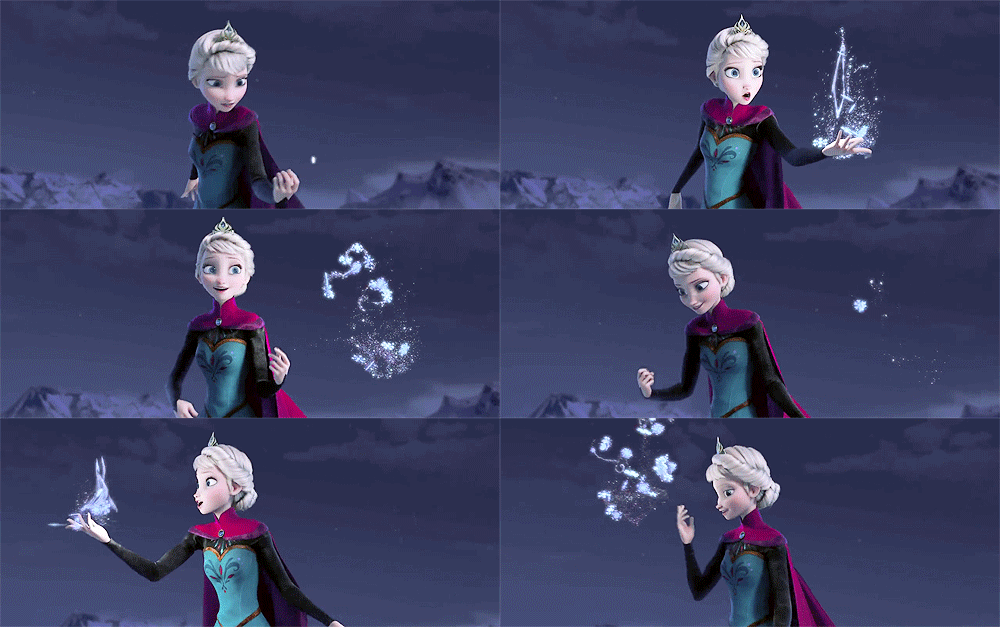
Essentially I need to go from this:

Frozen-image-frozen-36197023-245-158

To this:

Frozen-Elsa-Let-it-Go-snowflakes

*sigh*

Onwards…

Ten New Year wishes for my three year old daughter

Morning Pickleface!

We’re all feeling a bit the worse for wear today, and sadly it’s got nothing to do with partying but with things like fevers, snot and raging colds that Will. Not. Die. Not even on the promise of a wonderful new year! The buggers – oops, I mean, erm, boogers?

Anyway. While you sleep off the Calpol and I create a Matterhorn-sized pile of damp tissues, I have been rubbing my addled brain cells together to think of what I wish you for 2014. Of course, a list of ten can only ever be limiting, and I’m sure that many, hundreds, thousands more wishes of every size will present themselves to me before, oh, the end of the day, but here’s what’s on my mind, right now, as we blearily rub the crust from our eyes and gaze out on 365 fresh days of possibility.

1. I wish that you will crest through the fear phase and show more flashes of your fearsome, awesome side. The threenager period took me by surprise as my previously fearless daughter – who will still hurl herself off the sofa without a second thought and never has unbruised knees – suddenly started to fear things. Weird, random things. Bears. The pirates in Peter PanI Want My Hat Back. Anything new that hadn’t been thoroughly trailered and spoilered. The toilet! And those fears would come and go, and apply to some things and not others, and mean that you could go on Buzz Lightyear’s Laser Blast three times in a row and gleefully shoot at a huge, deafeningly loud Emperor Zurg, but you ran away from the telly when Toy Story 2 was on and he grimaced on screen. I mean, I get it – I’m a person with a bunch of weird fears myself, who can enjoy Expedition Everest but balks at the idea of ever doing Splash Mountain – a ride it took me until the age of 29 to brave – again. But I also want it to pass because I don’t want fear for you. Except a healthy fear of breaking all your bones, which is the one you don’t seem to have picked up…

2. I wish that you will finally nail this toilet training thing. I knew, like all the family from me and your auntie down to your cousins, that you would be around 3 when you cracked it because every single one of us has rocked up quite late to this party, but a recent burst of pre-schooler resistance has dragged this, erm, shit out way longer than necessary. We’re going to get a handle on this, and soon, right? Right. *high five*

3. I wish that you will continue to develop this growing interest in art and painting. I love how you’ve started to observe things and actually tried to draw what you see – do you know how hard that is?! Well obviously not and I’m not telling you because I don’t want you to think of things as hard, but it is. I also love how your passion for drawing has reignited something in your dad, and started me down a path of sketching and daubing that I’d seriously lost touch with. With two artsy parents, it’s inevitable you’ll be exposed to this stuff, and I really hope you find as much joy and satisfaction in it as we do – more, in fact, since I will always wish more of everything good for you.

4. I wish that you’ll keep up your beautiful manners. Seriously, I’m so impressed! I know you sometimes struggle to speak up when you’re shy, but your many pleases and thank yous are a joy to hear. I frequently second-guess my parenting skills, but no-one will ever be able to question this.

5. I wish that you’ll keep asking questions! My proudest moment reading your nursery ‘report’ wasn’t all the stuff you can do – I know you can write your name, recognise letters, count, build, draw, spell a bit – but the bit where A wrote “when she doesn’t know, she asks questions”. Kid, if you’ve cracked that now, the world is your sea creature of choice. Seriously. It’s so much harder than you think for adults, so if you can get in the habit now, you are So. Sorted.

6. I wish that you will never let me off the hook. Look, I know the job I signed up to. I love the job I signed up to. But it’s a total attention suck of the highest order. When you take my phone out of my hand and say “put it down, Mummy” you are doing a great service to me and yourself. But to make this wish happen I promise to really be with you when I’m meant to be. No more crafty little phone checks when I think you’re busy by yourself. I will mark out time to work and time not to work. I promise you that. No more excuses.

7. I wish that you will gain further understanding of your boundaries. I love that we’ve got into the habit of establishing your bodily autonomy, and you can be very clear about when cuddles, kisses and tickles are welcome and when they’re not. You’ve learned that we respect your opinion on this, and that we expect others to as well. Long may this continue.

8. I wish that you will keep playing Tickle Monster. Because the sound of your hysterical, unexpectedly deep and totally joyful chuckle literally pumps the blood through my heart.

9. I wish that you will keep surprising us. Whether it’s with your impressive vocabulary or your intense sweetness, your unfettered imagination or your madcap sense of humour, I hope you keep making us stare at each other and go “where did that come from?!”. Because that is never not brilliant.

10. I wish that you will watch anything other than Tangled. Please. For the love of God. I love it as much as the next person and Flynn Rider is, well, I think quite popular with many mums, but seriously, there are many not-scary films you could intersperse your 4 millionth and 4 million and first viewings with. That one time you agreed to The Aristocats gave us all hope, and I’m sure you’ll watch Frozen again when it’s out, but we need some variety yes? Good.

You know what, Stinky? I think we can achieve all this and much, much more. 2014, we’re ready for you.

With all my love,

Mummy x

10 ways Disney’s Frozen is female-friendly (SPOILERS)

I’ve been asked a few times about how I do the whole feminist thing and the whole Disney thing and they don’t implode in each other’s faces. It comes down to a couple of things really. One is selective fandom (there are things I enjoy and things I don’t, which with something as massively wide-ranging as the Disneyverse, is really the case for anyone) and the other is recognising that it’s possible to enjoy things that aren’t perfect.

do like to be constructive about celebrating when I feel like Disney, or any other company under fire from feminist groups, is talking more to people – okay, women – like me. I’ve already written about how much I enjoyed Frozen from the point of view of a film (and music) fan. But this post is really about all the things in it that I thought were really promising from the perspective of being a woman who cares about how women are represented. For another, also largely positive, perspective (though we see a few points differently), see Melissa Atkins Wardy at Pigtail Pals Ballcap Buddies.

A couple of disclaimers:

I. I am going to try not to be completely obvious where possible, but this is bound to contain a spoiler or two. I’m writing this shortly after seeing the film, but am delaying publishing until it’s been released in UK to try not to be That Guy. Or Gal. But still: spoilers. Probably.

II. I’m completely aware that The Snow Queen is very different, and that it is a very female-friendly narrative, and that this has been changed. Honestly, I don’t really care, because I’m not very attached to The Snow Queen and I think the reworking of this (and relative importance of characters like Kristoff) has been widely misunderstood or misrepresented. Regardless, if that’s your beef with the film, I ain’t going to convince you to give it a try, so thanks for sticking with me until here. See you next time, maybe.

Ten Ways Disney’s Frozen is Female-Friendly

1. There are two female protagonists. Admittedly there are still more men than women on screen, but the two women are the main characters – they dominate the screen time hugely, to the point that I actually slightly lamented one of the men not getting his due as a character.

2. It passes the Bechdel Test. Repeatedly. And not in the wicked stepmother kinda way.

3. (potential spoilers) The much-discussed love triangle is actually quite a subversive take on the ‘love at first sight’ narrative. It gently lampoons the suddenness with which characters in similar films act. More on this later.

4. a) The animation is changing. Much has been written about how slim the princesses still are, and that’s true, but I see a significant difference in style even since Tangled. The shift might still be fairly small at this point, but I’m hoping that we continue to see this move away from Glen Keane’s massively over-exaggerated wasp waists and baby seal eyes.

4. b) (potential spoilers) Interestingly, both characters also resist much in the way of overt sexualisation. Although in Elsa’s dramatic transformation she strips off a layer and adds a split in her skirt, it actually makes sense as part of her arc of self-discovery and new-found freedom – and I don’t believe that any hint of sexuality in a kids’ story is the same thing as sexualisation. She still remains pretty covered up (even for someone whom the cold never bothers, anyway). And – whether terrified or awed – people are consistently far more interested in what she does than what she looks like. Anna’s beauty is also little talked about, even by her love interests; her one love song is basically about how similar their personalities are. The only other song of hers that even mentions love – when Anna considers finally having a shot at romance – is largely comic, instantly scuppering the brief moments of longing: “I suddenly see him standing there / A beautiful stranger, tall and fair / I wanna stuff some chocolate in my face!” (She does). And Fixer Upper deliberately turns the notion of making over female characters on its head (even if it was a shame that the opportunity to give Kristoff a song in his own voice and words was lost).

Also, there is no moment, as in The Little Mermaid or Tangled, where the female character is lingeringly gazed upon by a man, to swelling music.

5. There is a female screenwriter. Jennifer Lee also wrote Wreck-It Ralph, which – not coincidentally, I feel – also has an excellent, stereotype-bending female character.

6. She was so awesome, they brought her on as a co-director. And she directed Get a Horse, the wonderful 3D short that debuted with the film in theatres.

7. (potential spoiler) The love triangle is part-red herring, part misdirection. It exists in order to further the plot which is explicitly about the complex but ultimately positive familial relationship between two women. Unlike, for example, Tangled‘s distressing family dynamic, there is a very pure, honest and real love between the two sisters. And it’s not a sub-plot. It is the plot. Both women are on a journey of self-acceptance usually seen in male characters in films like Aladdin.

8. (potential spoiler) The women save each other. On the occasion when a man appears to save one of them, all is not as it seems.

9. Happily ever after is not defined by a wedding, but by the sisters realising their long-cherished wish for freedom.

10. Though there is a romantic kiss near the end, just for the icing on the fairytale cake, the male character asks for permission to kiss the female character. Enthusiastic consent! In a cartoon! What is not to love there?

Frankly, if Frozen, Wreck-It Ralph and Brave are indicative of the direction Disney and Pixar films are going, I am definitely coming along for the ride. I can only see it getting better and better from here.

Bea Magazine: What we teach small children about consent

So, here’s a post wot I wrote for Bea, all about issues of everyday consent, being aware of children’s personal space and remembering the role of permission in setting boundaries for children.

It’s already spawned a really interesting conversation with Bea editor Keris and Rachel on Twitter about whether lack of pressure (or rather, lack of pressure as part of a passive aggressive approach / threat of abandonment) is another form of coercion. I definitely agree that it can be, which is why it’s so important to make “you don’t have to” an honest statement, and not include sulking or implied hurt or distance. But there’s definitely a whole other extended conversation to have about less obvious negative signals and being conscious of those.

Discussion of your experiences is very welcome. You don’t have to be a parent – we were all children once!


Monica, Monica, have a happy Channukah…

The best thing about having married Ashley is, you know, being married to Ashley, cos he’s all cute and funny and stuff. Then there are other good things on top, like him being a superbly talented designer and illustrator, and making a cup of tea exactly the way I like it (brewed but not too strong, splash of semi-skimmed, absolutely no sugar or sweetener under any circumstances).

An added bonus in our mixed up little family is that our daughter gets the benefit of two religious and cultural traditions that are basically steeped in food and family (and arguing). In the spring we get Seder and egg-smashing. In the winter we get candles, doughnuts and presents followed by carols, puddings and presents. For Ramona, it’s a win-win scenario, really, just on a fun and cultural level, but when she’s older she’ll also have a wealth of history and spirituality to plough through at her own pace.

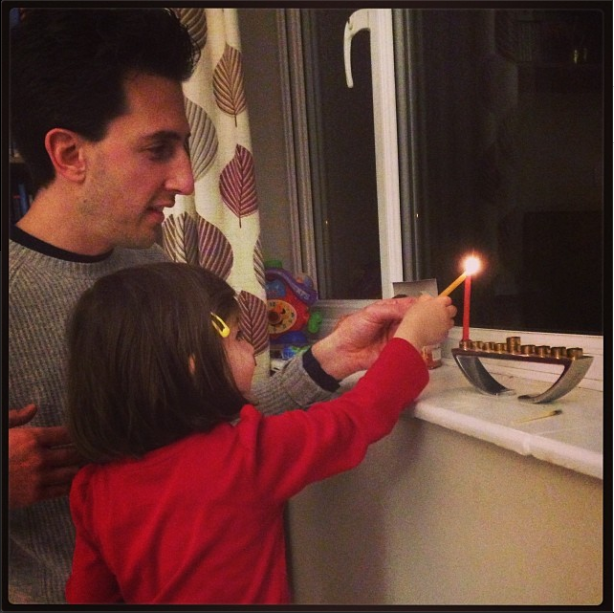
Anyway, here she is with Daddy, lighting the candles for the first night of Channukah, which came in on Wednesday. I might be biased, but it’s really quite adorable, no? Even the mess we’ve obviously shoved down to the end of the window sill.

channukah

We haven’t broken out the doughnuts and latkes yet, but surely will soon (I mean, a holiday that practically requires the ingestion of fried stuff? I might be Greek Orthodox, but I’m not passing that up). In the meantime, I wish all those celebrating a happy Channukah, and a light-filled year ahead.

Dogs Trust’s Freedom Project: How fostering a dog could help save a life

[Trigger warning: domestic violence]

In March 2008, I rocked up to a large, busy office in Islington for an interview with a dog charity. I’m a self-confessed cat person, but I really wanted to work for a non-profit and the role had loads of potential. I have no notion of how long it takes to get anywhere, plus a paranoid neurosis about being late, so I turned up about 45 minutes early. (This is not a recommended interview technique, and I should have holed up in Starbucks, but that’s by the by). I decided that there’s never such a thing as too much research, so I picked up an annual review from a heap on the table in reception.

That’s where I learned about the Freedom Project.

Dogs Trust, where I went on to spend four and half incredibly happy years, has always been clear on its core activity: rehoming dogs. But it has a number of other projects, and two outreach activities in particular, that reach much further than most people expect of an animal charity. The charity’s single-minded devotion to making life better for dogs extends, quite rightly, to making it better for owners, too.

The Freedom Project is a fostering service with a very specific goal. It takes dogs from families fleeing violence at home and finds them temporary homes (usually for 3-9 months); meanwhile, the family in question are helped by other services such as Refuge to escape to a safe space. Once they’re settled, their pets come home to them. Veterinary and food costs are covered by Dogs Trust – the foster carer just has to provide a little bit of love, security and day-to-day care. Dogs Trust and Refuge, plus a number of other groups from the RSPCA to the NSPCC, are members of the Links Group, which works to understand the relationships between the abuse of vulnerable adults, children and animals in order to inform the work of the many organisations working to prevent this and assist survivors.

The evidence is growing that abuse of animals and abuse of people are closely interlinked. It’s not immediately obvious to most people – me included – that someone might be partially prevented from escaping a violent home through fear of what will happen to a pet. Quite often, pets are an enormous source of solace, and the thought of them being left at the mercy of a violent individual is understandably terrifying. There can be substantial guilt involved, and projects like this can help break down one of the many – complex and varied – barriers holding someone in a cycle of violence and terror.

The project is not UK-wide, though there are other fostering services you can find out more about. Due to the resources available it operates in Greater London, Hertfordshire and Yorkshire at present (with assistance from Cats Protection in London who organise cat fostering). This week, Dogs Trust is committing its social media presence to drawing attention to the scheme and to raising funds. Here’s what you can do:

Anyone who needs further advice on these issues can also call the National Domestic Violence Helpline (24 hours a day) on 0808 2000 247.

Today is the International Day for the Elimination of Violence Against Women. While we aim for that essential result which cannot come fast enough, this is just one way of supporting women and children. If you prefer not to give to animal charities, then please note that the annual Refuge John Lewis Christmas List is now live.

Film review: Disney’s Frozen

Disney’s 53rd Animated Classic, Frozen is the story of Anna and her older sister, crown princess Elsa, who has some pretty unique talents. Following a catastrophic incident, the kingdom of Arendelle is plunged into perpetual winter, and Anna sets out to save the day, with rugged mountain man Kristoff and his genial reindeer Sven in tow.

Kristen Bell’s Anna is a charmingly clumsy and overexcitable heroine, a natural successor to Rapunzel from the team that created Tangled. Like her predecessor, she’s open-hearted and generous. While she’s accompanied by a man for much of her adventure, she mostly ends up bailing him out of trouble (perhaps it’s no coincidence that a female co-director, Jennifer Lee, came on board during production – having written the screenplay). Gruff ice salesman Kristoff, whose business is somewhat scuppered by the eternal freeze, is done great justice by the always excellent Jonathan Groff, but was really crying out for a big musical number of his own.

Idina Menzel crafts a perfect Elsa, whose triumphant declaration of independence Let It Go is the gut-wrenching pinnacle of the soundtrack. Featuring a score by Christophe Beck and songs by Robert Lopez and Kristen Anderson-Lopez, as a whole it actually reminded me a little of Wicked with its memorable but not exactly catchy tunes and piercing crescendos (I always think there are musicals where you can sing along and ones where you feel like you should leave it to the professionals – this is one of the latter). In fact, Elsa’s story arc is not entirely unlike Elphaba’s, which is possibly one of the reasons Menzel feels so right for the part.

One of Frozen‘s real strengths is the way it delightedly doles out the unexpected, from a summer-obsessed sentient snowman, Olaf, to a couple of surprising twists that I wouldn’t dream of spoiling. As a whole, it’s quite an intense offering, with a number of dark themes and scary moments, so Olaf’s sudden appearance in a cloud of goofy light relief – Josh Gad channeling a chaotic mixture of Patton Oswalt, Jesse Corti and Sarah Silverman – is very welcome.

If Anna was straight out of Tangled, the storytelling was very much in the spirit of woefully under-appreciated gem Wreck-it Ralph. It’s really an ensemble piece – the posters, featuring all the main characters, make that abundantly clear –  and all the better for it. A whirlwind of comedy, drama, action adventure and love story, Frozen simultaneously goes back to Disney’s roots in classic fairy tales (this time Hans Christian Andersen’s The Snow Queen) while ripping up the rule book on how those stories should be told. And of course, the animation is more gorgeous than ever. Seeing it in 3D is by no means essential, but it does add an even more breathtaking element to Elsa’s spectacular ice sculpting.

Verdict from me: A definite thumbs up for adults and especially kids of 5-11, who’ll enjoy the fast pace and humour. There are some intense moments, including some snarling wolves and a hulking ice monster, which might be a bit much for the younger types and those of a more sensitive disposition.

Verdict from Ramona (aged 3): That was really good. Olaf was really funny! And I like the bit where Anna goes “cold, cold, cold!”. But I didn’t like the scary snow monster. I really liked it, but I don’t want to see it again, because of the monster bits. [It was her first ever visit to the cinema, and she does get scared quite easily.]

Frozen UK trailer:

Olaf’s In Summer:

Disclaimer: I was invited along with Ramona to an advance screening of Frozen in Leicester Square today. We were given tickets to the film plus enjoyed some activities and treats beforehand, as well as a performance of Let It Go from Willemijn Verkaik, who is the Dutch Elsa and is also starring in Wicked in the West End. My opinion of the film is my own, and I was not paid for writing this.

Frozen is on general release in the UK from the 6th of December.

Blogger Outreach: The right way to do it?

It is not uncommon to have played multiple sides of the field in the influencer game. I’ve been a blogger for fun (hi there!) and for profit, a digital marketer and a community manager. While never working specifically in PR, many elements of the last two jobs in particular have seen reasonable overlaps between my role and that of a PR and communications department or agency.

Something I thought we’d all left behind when so many of us started batting for both teams  is the ‘us vs them’ mentality; bloggers endlessly berating PRs for bad practice, and PRs claiming unprofessionalism in the other direction. In a world where it’s very possible that half of the equation is doing what they do as a sideline, or even a hobby*, there is still a lot of suspicion about how to deal with each other.

Straight off I’m going to say I simply don’t think there is a one way to do this well. I’m slightly wary of “five steps to outrageously good influencer outreach” type posts because all influencers are people, as are all PRs and comms professionals, and people have to work within the nuanced world of, y’know, other people. It doesn’t take much imagination to realise that this is all based on relationships. You can think logically about supporting a good relationship – keep in touch between projects, RT that post – but it makes me very uncomfortable to think of gaming it.  I don’t believe it can even work in the long term, anyway; your inauthentic approach will eventually give you away. If you project frankness and reliability, you’ll get it in return; you might even end up with some new friends. Honesty is everything to bloggers – it’s pretty much all they have to build a reputation on, and I can’t see why that shouldn’t extend to brand partners, too.

Of course, sometimes things will go wrong. The ask won’t be quite right. The timing will be off. It’ll turn out that for some reason you couldn’t possibly have been aware of this was exactly the wrong person to ask. No-one gets this right all the time or even every time. But I think there are ways to avoid getting it actively wrong.

So having said I don’t think there’s a right way, there are some general common sense tips that I would like to think are a part of every decent strategy already. I repeat them because I find it’s sometimes all too easy to overlook the fundamental steps. Below are my observations, all of which I think could grease the wheels on this creaky cart of a parley.

Please note that all of this assumes you’ll have targetted your audience correctly and done your research.

1. Work out what you want

There is simply no point in doing anything if you don’t know what you want from it. Is it coverage? Is it target market research? Is it a review? Whatever it is, work this bit out first. If you don’t, you won’t know how to measure it and, crucially, what to ask for or how to ask for it.

2. Work out what they want

Bloggers are not a uniform crew. There are some that will only work for cash, and this is quite fair enough. Though, as someone who’s done her fair share of writing for free when it suited me, I don’t actually think it is or should be anathema to work without pay. Still it is unquestionably silly to request it of a blogger who sets out a rate card, unless you have a really, really good reason (even charities can stump up something, particularly the bigger ones). And if you’re working with a brand which looks like it should have budget, tread carefully.

If the particular project is a review and you can reasonably assume your chosen blogger is open to not-cash, then you can sail in with the stuff. The obvious starting point is a review sample, but try to sweeten the deal; if you have budget to add value, then do it, and put some thought into what you send so that it complements both the blogger and the brand. Not every blogger enjoys a giveaway, but giving the option – x amount of y if you think your readers would like it – is a nice added extra. I would always recommend pitching first rather than going for the surprise unsolicited gift, unless you’ve established a solid relationship with the blogger in question. It just avoids any possibility of it not being received in the spirit you’ve intended, but is also your chance to lay out your expectations for the project.

On the whole, I’d say that offering bloggers a chance to take part in a competition through blog posts is a shaky business. I’ve seen it work well, but I’ve also seen furious bloggers loudly slam brands for it. I think it can be done – if there is a gift or remuneration for all or everyone involved gets something unique like exclusive access to a product or event – but it can also be done really badly. Particularly for those bloggers for which this is a primary income source, asking them to compete for a prize is a bit like demanding someone puts hours of work into a pitch presentation for a job they didn’t apply for and might not even want.

3. Remember that less can indeed be more

There’s a temptation to think all blogger outreach has to be grand and dramatic, but thoughtfulness goes a long way. It takes a good deal of time to assemble a really nice pack or plan just the right event. Better to go small scale, use your budget wisely and work with just a few people to make something really effective and positive than to end up seeming indiscriminate. Basically, from an initial pitch email to the final denouement, anything that so much as offers a whiff of “spray and pray” will be treated with suspicion. And rightly so.

Having mentioned events, I do think these a particularly interesting area all on their own. I work largely with bloggers like me, and when approaching parents in particular I would consider the following questions before setting any plans in stone.

  • Is it offering something exclusive, unique or especially worthwhile? (Is dropping everything going to be worth it?)
  • Can the kids come? (Do I need to arrange childcare?)
  • Is there any budget to offer help with travel? (Are you giving me enough time to get cheaper tickets?)
  • Could it be held somewhere other than London? (For God’s sake, the world doesn’t end outside the M25…)

I’ve spoken to quite a few bloggers about this and these things come up time and time again. Although I live on the outskirts of London myself, I know many bloggers outside the Home Counties who get fed up with routine requests to drop everything at the last minute and bolt down to London, without any financial assistance.  It’s particularly irksome if this also excludes the very people they spend most of their time writing about – unless, of course, the whole point of the event is, for example, pampering time away from the kids.

In a way, I shall feel quite pleased if people get to the end of this post and think “I already knew that”, because it means that the job is getting done properly. I’d like to believe most of the criticism I see is because of the natural inclination to complain more than we praise, and I know there is really thoughtful and excellent outreach going on all the time. So in the spirit of that, I’d love to invite anyone reading, whether blogger or PR, to give some examples of really excellent influencer outreach that they’ve seen. I think spreading the love can only be a good thing in this industry, so let rip – in a good way!

*Contrary to popular belief, this does not preclude professionalism. No, really.