Consent and conversations with young children (or why I ask permission for cuddles at night)

The other day I ended up staying late at work and heading out for dinner with some colleagues (friends, really and all, for what it’s worth, currently child free). While we were waiting for food I got a text from my husband about how our daughter’s bedtime had gone, and it listed the number of cuddles and kisses I could give her when I got home.

I got some baffled looks at this, so I tried to explain. My daughter knows that the last thing I will do every night before I go to bed will be to stick my head around her door and check in on her. My commute is around an hour and a half long, so I inevitably miss a fair number of bedtimes, and therefore bedtime cuddles. She doesn’t want to miss out on these altogether, but also knows she’ll be asleep when I get in. So she gives me a certain number of cuddles and kisses I can deliver when I arrive. It’s usually hilariously specific yet not – “ten or eleven kisses, and two or three hugs” – and sometimes she’ll be super prescriptive about exact kiss placement on her face, and sometimes not. And I only ever carry out exactly what she says, though I’ll admit if she gives me a choice of numbers of kisses I’ll invariably go for the maximum.

I basically got a ‘but why?’ to all this, and I tried to elaborate. The main message I’m trying to get across to the kid is that her body is her own (as I’ve written about before) and that doesn’t change when she’s asleep. We’ve talked about respecting each other’s boundaries a lot during wakefulness – one of her favourite games is the ‘Stop Go Tickle Game’, where she gets to dictate exactly how much I tickle her tummy and around her neck – but now that she’s left the infant stage where she’s unable to communicate preference, I want to demonstrate to her that this respect continues 24 hours a day. Of course I could just pay lip service to it and then smother her little chubby cheeks in mummy kisses as soon as she’s out – she wouldn’t know I’d broken her trust, but I would. And it would be heartbreaking.

The reaction I mostly got was ‘that’s fascinating’, and I’ve no doubt it sounds a lot like weird, handwringing, liberal overthinking. Even if it is, I’d rather overthink this stuff than not think about it at all. When you’re raising a girl, one of the topics you cannot ignore is personal safety; we live in a world where female autonomy and bodily integrity is not sacrosanct. In the slightest. I was very much taught about the practicalities of navigating a life around this as a youngster and a teen – personal alarms, not walking alone, self-defence classes, holding keys as weapons. And while I think that teaching a few defensive strategies has an element of common sense to it, I also think that focussing entirely on that basically says “this is your responsibility, as a girl” – and it’s blatantly not. I cannot, in raising a girl, control what other people will do around her. But I can help fight a culture that suggests that she can. To me, the best way to do that is to continually reinforce her confidence in her own boundaries.

This makes it sound like we all sit there politely asking each other for cuddles as you might ask to pass the salt, and anyone who has ever seen our family in real life would find this pretty hilarious. We’re a seriously huggy bunch (as anyone who has ever gone drinking with me will know); we just place emphasis on the fact that the word ‘no’ is important. More recently we’ve also talked about non-verbal cues as well; when my daughter told me she sometimes wanted to say ‘stop’ in the tickle game but was laughing too hard, I suggested she use a gesture instead and she decided on holding her hand up like a traffic police officer. It’s a constantly evolving process and negotiation, because the paradox of being a child is being taught that you have agency but told you have to go to school, must have your jabs, should eat your greens and will go to bed by a certain time. Parents exist in the land of I Know What’s Best For You, and to my mind she will trust in me offering up this sometimes bitter medicine (we recently had a belated phase two of the MMR, and it was not fun) if the rest of the time the sweet, sweet sugar is confidence in her own autonomy and ability to make decisions and choices that feel right to her. I position myself as the guardian of her safety and health – my number one job as Mama, part and parcel with loving her more than anyone else in the world – and her as the guardian of her personal space. And it’s a partnership which involves her direction and leadership as well as mine, until she’s old enough to take the reins entirely.

Of course I second-guess myself occasionally. For example, does making an agreement beforehand convey consent when one is asleep? For the moment I go with it because on those occasions where we haven’t spoken for some reason so I just poke my head in and leave it at that, she’s disappointed at ‘missing out’ on cuddles when we speak the next morning. She often proactively announces to her dad, without being asked, how much affection she wants doled out when I get home. But eventually I guess my mad work schedule will differ and she’ll get older and less concerned with missed bedtimes and this will all change.

But what won’t change, ever, is my respect for her. So I will carry on having what might seem like needlessly complex rituals in order to reinforce this for her because I really believe it’s important.

Is this something you ever think or worry about with your children or relatives’ children? Do you have family routines and behaviours which seem baffling to others but underscore an important message from your perspective? I strongly suspect I’m not the only one…
Why it’s a great, brave, beautiful Tomorrowland (here be spoilers)

Other people’s opinions… who needs ’em, right? I jest, of course, but with a film like Tomorrowland (aka Tomorrowland: A World Beyond in the UK) there is bound to be an even more splintered variety. A publicity campaign that revealed very little about the story. A vision of retro-futurism that has to appeal both to baby boomer nostalgia and a brand new audience for whom 1964 is as far away from their birth as WWII was from their parents’. An ambitious anti-cynicism message – and here, I warn you again that, while I’m not going to wallow in spoilerific spoilerism, there are some things ahead that probably will give away more than you need to know. I really enjoyed going in blank, so if you haven’t seen the film yet but are expending a little of your generous curiosity towards me, perhaps bookmark this for later? I’ll still be waffling away when you’re done watching.

When I reviewed Tomorrowland, I made some references to the fact that it made important moves from a feminist perspective. On greater reflection, I think it actually goes further than I thought. There are really two strands here – character in the film and characterisation beyond the film – and both of them are extremely promising. I won’t repeat myself too much, but within the film you have two female characters that are independent, intelligent and resist female stereotyping. And it’s not by being a Strong Female Character, but by virtue of being a well-written character who happens to be female. There is also very little male gaze and romance, and such as there is (more on this in a moment) is really about friendship and shared vision. There’s some ass-kicking, but though it’s delivered by an incongruously shaped character – that of a 11-year-old girl – by then, you’re already aware that she’s not human.

So many times, when a physically or emotionally strong female character is delivered to us, it comes from a place of born exceptionalism, or pain. Now, Casey is repeatedly characterised as ‘special’, but it’s to do with her optimistic outlook, not her born or trained physical assets. She has woes and worries – her obsession with halting the dismantling of the NASA platform is more about saving her dad’s job than it is about advancing the ambitions of humanity to build a better world – and a clearly absent mother, but she is not defined by her father’s pain or her mother’s invisibility. Later on, she falls in with Frank because of what he can do for her, and when she helps him it’s out of basic human decency, and not because of anything she feels she owes him (to be honest, they never seem all that fond of each other beyond their shared goals and connection to Athena). There’s no Bella clumsiness, Katniss rage or Buffy strength powering Casey, nor flirty ditziness or emo contrariness. She has achieved what many male characters but few female ones do – a character arc that relies on her growing and becoming more confident in herself and her ability to get stuff done without any superhuman qualities or reference at any point to her physical appearance or romantic aspirations. We have Mikey Walsh levels of faith, here, and an Indiana Jones attachment to a hat – the latter of which is even used as a vehicle to deliver a broadside to the embittered narrative that’s meant to drive most heroes.

So what of actual romance? Well, there is some. And it’s between an ageing cynic and a robot child. Kind of. In one of the most powerful scenes of the film, two characters separated by a world of humanity and several decades have to reconcile their feelings towards one another – and one of them has only programmed emotions. Crucially, what we don’t have here is a robot that wants to be human (another female-ish character who is content in herself!), but in a very delicate, beautifully handled scene Athena and Frank have to deal with forty years of unresolved hurt and confusion and in doing so it is Frank who is mostly changed. And therein lies the other great female-friendly power of this film: all the rollicking emotional rollercoaster – all the feelings of love and betrayal – belong to a boy, and a man. In one movie, all the logical thought and optimistic foresight belong to female characters, a rare sight; even rarer, all the drama belongs to men. Between Frank Walker and David Nix we have characters who have, effectively, given up because they’re angry and bitter and feel slighted – one mostly by a single person, the other by the world at large. If there’s a statement as powerful as allowing women to be coolly logical, it’s surely allowing men to display real emotion.

And now, the world beyond. I think what often confuses people outside the Disneyverse is a sense of a bit of a disconnect between product and marketing. Let’s take Tangled as an example, since it’s one of my favourites. Rapunzel is actually a pretty kick-ass heroine, and even on the DVD cover she’s quite fierce – feet planted firmly apart, stern grin and frying pan aloft. But by the time you hit the merchandising – all iridescent princess dresses and batted eyelashes – it’s hard to convince anyone who hasn’t seen the film that she’s actually a pretty rounded and interesting character. I can watch Tangled til the cows come home, but as an adult I don’t really buy any merchandise associated with it because for me it doesn’t really reflect what I love about the film. With Tomorrowland, though, it’s hard to see where there can even be any opportunity for the marketing to be in any way different from the creative property. A few people have pointed out posters that just feature Frank but, despite being someone who’s had a few ‘where’s Natasha?’ moments, I actually think this is a good thing; there are two separate stories here, Frank’s and Casey’s, and I think it’s fine to have marketing devoted to each. And when it comes to merchandise, the most obvious piece – that glorious pin – is as gender neutral as it gets. If you get into costumes and appearance, Casey largely wears jeans, hoodies and a NASA cap. Athena has a couple of dresses, but they’re more retro-futuristic cosplay than tiaras and sparkles (no, there’s nothing wrong with tiaras and sparkles, it’s just nice to have a change). I’m all for backpacks that look like jetpacks, you know? I simply can’t see where this could possibly do anything other than celebrate the gorgeous vintage World’s Fair design inspiration and the general sense of optimism and adventure that is so key to the film.

And therein lies the last part of why I think Tomorrowland is, on the whole, pretty ace. When was the last time you can remember a high stakes potential blockbuster – one without franchise surety, but with star power and a hugely respected directorial force – with such an unambiguously positive message? Morality in Tomorrowland is embedded within having an optimistic vision for humankind, and then – importantly – taking the next step to work towards it. It’s a hell of a sermon – Lindelof has admitted he’d like people to feel a bit guilty – and though there was only one point in the film where I felt it was laid on a bit thick, it’s a bloody important one. It’s a message I’d like my daughter to hear, to take action on. Even though I already want to be a decent human being, which to me means at least trying to put kindness and compassion at the centre of everything, I was unsettled into thinking I’m probably not trying hard enough. The spring’s big tentpole release already covered the ambiguities of riding roughshod over other people’s misgivings when you’re focussed on creating a better tomorrow, but the difference between Tony Stark’s megalomania (I will protect the Earth!) and Casey Newton’s inclusive forward thinking (what can we do to fix this?) is patently obvious. And, much as I love me a complex, morally uncertain superhero narrative, sometimes an undiluted shot of positivity to the arm is exactly what’s needed as an antidote to a pervading sense of the world going to hell in a handbasket.

Sometimes you watch a film and love it, but later can’t quite quantify what it was that made you love it. With Tomorrowland I’ve had the opposite with an increasing sense of certainty that its detractors – and there are a few, especially in the Twitter Disney echo chamber that I sort of love and am fearful of at the same time – are either missing these strengths or considering them unimportant. Since arguing the case on Twitter is a 140 character exercise in frustration, I thought I’d be better served by simply laying it all out here – where I have a hope in hell of landing my point.

If you’re still with me, congratulations, you’re a great big nerd. I like great big nerds, whether or not they agree with me, so let’s talk. Go.

A day out in Bexhill-on-Sea: the De la Warr Pavilion, the Little British Tea Shop and Eras of Style

This post is actually long overdue. It was (gasp) MARCH when I footled off to Bexhill to spend a day with a good friend and explore the loveliness of a classic British seaside town. But it hasn’t left me, because – especially for a born Londoner who has only managed to take herself further away from water by moving to the Home Counties – there is something so very lovely about the British coast, the jumbled mix of hipster-chic and genuinely crumbling, the proliferation of junk shops and charity outlets and the immediate sense of letting out a big breath you didn’t know you were holding the moment you leave the city. Bexhill isn’t one of the classic treasures (usually in Wales or Cornwall) that you see dotted around tourist websites, all vying for a Portmeirion-esque chocolate boxness that is very, very pretty but somehow unconvincing as a living town. Bexhill is not a town of summer homes. Even in the cold, damp English springtime it was alive and well, keeping calm and carrying on.

Memories of Ladybird - a truly excellent story!

Memories of Ladybird – a truly excellent story!

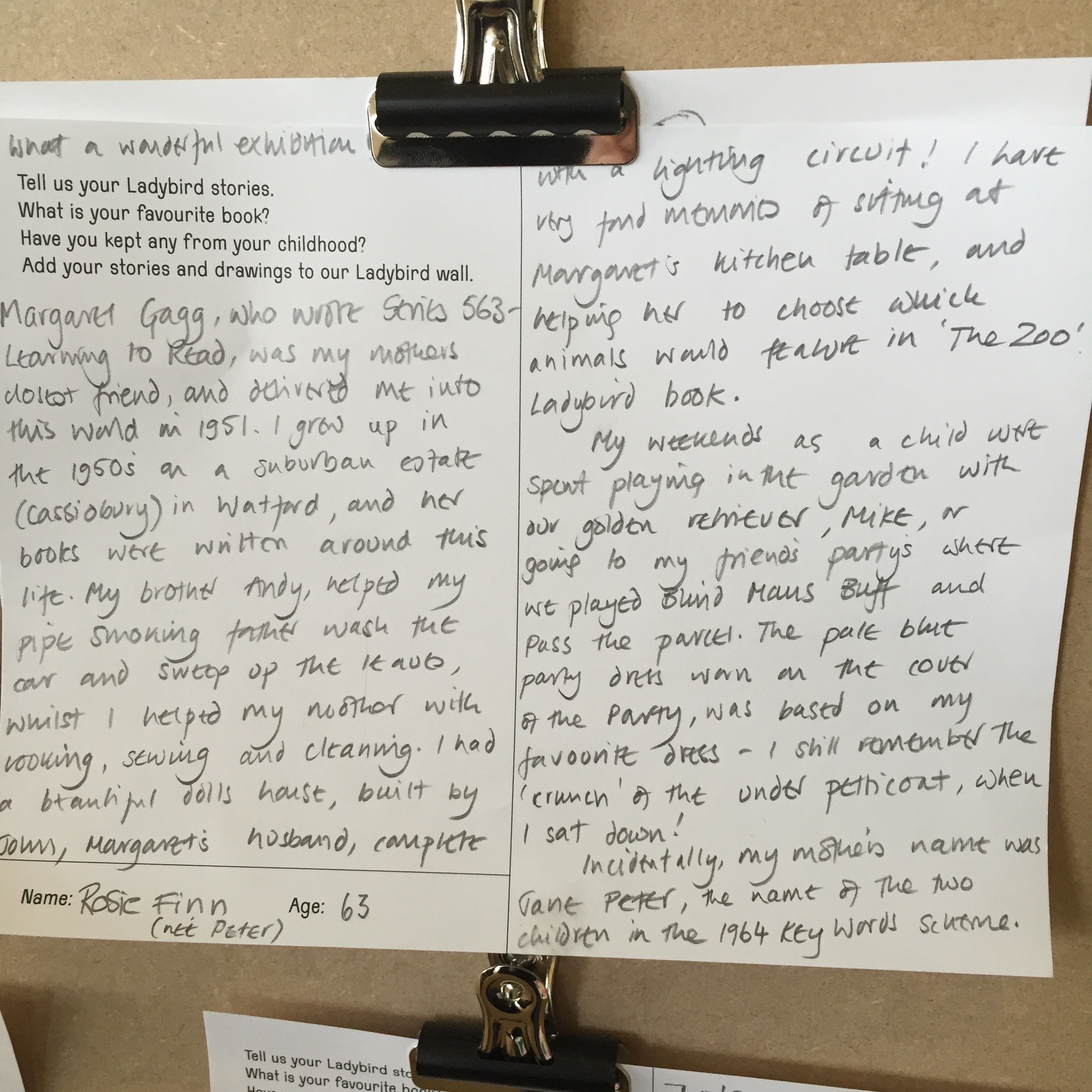
Our ostensible reason for meeting there – K’s parents live in Bexhill but she’s actually based in St Leonard’s – was to visit the Ladybird by Design exhibition at the De la Warr Pavilion, which was absolutely wonderful, and – though it has completed its run in Bexhill –  is due to arrive in London in July. I’d recommend a visit to the DLWP any day, whatever the exhibits – it’s a lovely space, beautifully situated. Go in, have a coffee, browse the little shop crammed tastefully with quirky prints, arty bags and cute knick-knacks. There are lots of planned family activities too; for the Ladybird exhibition there was an entire wall covered with memories and experiences of Ladybird books from visitors aged 5-95. My favourite (pictured) was a wonderful note from a woman who had, as a child, become the basis for some of the classic illustrations!

Having spent a couple of hours digging around the wonderfully curated galleries and picking up a few treats at the gift shop (an amazing late 50s living room print now hangs over my retro dressing table), we considered what we could do with the rest of our day. That led us to the Little British Tea Shop, which was practically guaranteed to appeal to me on every single score. Vintage decor and mismatched crockery? Check. Bountiful savoury options (including a savoury only tea)? Check. A proper, lengthy, loose leaf tea menu with everything from builder’s to oolong? CHECK. We sat in the kitschest and cutest of window seats and shared a crumpet smeared with salty butter and a delicious cuppa and it was glorious. I was wearing a 1960s fuchsia Lane Bryant suit skirt from my vintage collection, but bitterly regretted not having a 40s number and pin curls  in (I haven’t mastered Victory rolls yet). The service is friendly and warm and practically out of a film. And the prices are distinctly un-London at around £14.50 for afternoon tea for two.

Much of the rest of the day was spent wandering around the shops; I picked up a lovely fabric shoulder bag for our holiday to Florida, and a birthday treat for myself of a shrink plastic watercolour octopus brooch. There is what I can only refer to as an embarrassment of charity shops – then again, the intersecting local high streets in Bucks where I live have nine of them within a mile radius – and independent shops crammed with a mixture of local arts and crafts and general souvenir tat. A bit like walking into Not on the High Street (on the high street)…

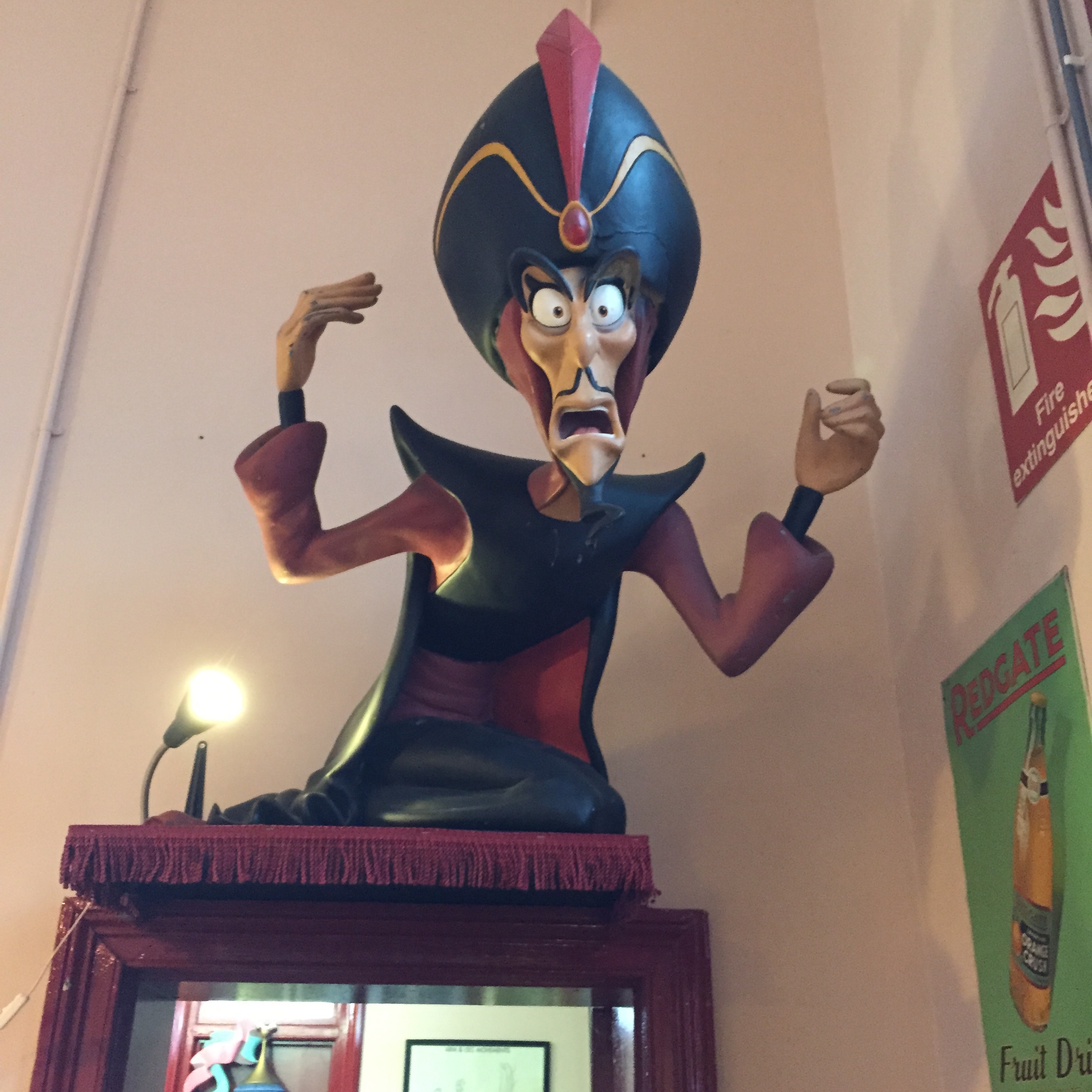
Jaf-argh!

Jaf-argh!

That was when K suggested we pop to the antiques warehouse up past the police station; it was a short walk out of town, but entirely worth every minute. I want to go back with a truck and someone else’s credit card. Eras of Style is a mammoth two-story treasure trove packed to the gills with vintage furniture, records, toys… you name it. It’s a little light on clothing, but crammed with practically everything else. I fell in love with at least three separate tables (so. much. G-Plan.) and I adored the more random bits and bobs like the 60s fairground attraction car and some crazy bits of Disney memorabilia like Jafar here, hanging out in the coffee shop. The cafe is itself worth a visit, with nice tea, multiple cake options – I spotted gluten-free ones, too – and apparently now a specialism in bagels (I am SO going back).

Sea air, wonderful places to have tea, art and vintage style. And the wonderful thing is that this kind of footprint is repeated readily across Britain, and should be loved and treasured for what it is. I do worry that one too many hipsters like me and the places risk being gentrified; then again, a lot of these towns have suffered rising unemployment and could do with an investment of cash and love (preferably from people with an interest in staying in, rather than exploiting and running from, the area). I often wish I could travel further, wider and more often (how ungrateful that sounds after a trip to Florida!) but I also forget that there are little jewels on my doorstep – a drive or cheap train trip away. I’m aware that, especially from a distance, I’ve romanticised things a bit, but I do want to make it a habit to explore more of what’s right in front of me, and make the most of the beauty of home.

What’s your favourite hidden (or not so hidden) British treasure? Where should I visit next?

Film review: Tomorrowland: A World Beyond European Premiere

Me in my genuine 1940s finery with my genuine, erm, 2015 Haunted Mansion souvenir.

Me in my genuine 1940s premiere finery with my genuine, erm, 2015 Haunted Mansion souvenir.

For a film about the future, Tomorrowland: A World Beyond sure feels like stepping into the past. In this joyful retro-futuristic romp, The Incredibles director Brad Bird and LOST co-creator Damon Lindelof have created a relentlessly upbeat, Spielberg-reminiscent family adventure with its eyes on creating a great, big, beautiful tomorrow.

It’s 1964, and young Frank Walker is enjoying the sights and sounds of the World’s Fair, including Walt Disney’s It’s a Small World and Carousel of Progress. Everyone is looking ahead to a world of gadgets and gizmos aplenty; Frank himself is toting a new invention to enter into an innovation contest.

Fast forward 50 years, and Casey Newton (Britt Robertson), eternal optimist and tech nerd, is battling the closure of the NASA platform where her dad works and the negative attitudes of her peers and teachers, all forecasting doom and dystopia. It’s not looking good – until a strange vintage pin turns up in her possession…

Hugh Laurie making people laugh? Never.

Hugh Laurie making people laugh? Never.

Tomorrowland (to use its simpler US title), rests on the premise that at some point post-1970 our outlook on the future went from chasing dreams to ducking nightmares. And looking at some of most popular and successful franchises around today – although, yes, dystopia in cinema is nothing new exactly – it’s hard to disagree. Somewhere along the line, our vision became more universally dim; less Jetsons, more genocide. And the disaster is invariably man-made. No meteror extinguishes our old-fashioned thinking; we’re dinosaurs on a collision course with our own greed – or worse, apathy. Tomorrowland explores what the world could be like if we rediscovered that spark of enthusiasm – and what that could mean for humanity now. But to have nostalgia for an imagined future, you have to go back to the place that future was envisaged from, and in doing so Bird has also tapped into the childhoods of his core audience; I felt more than anything like I was watching some of the classics of my own upbringing – but for the first time and without the dated haircuts. It was Flight of the Navigator, War Games… maybe even ET, only new and shiny.

Okay, I squeed a little.

Okay, I squeed a little.

In many ways, it’s a shame to give too many details away about Tomorrowland. To me it felt primarily like an old-school family adventure movie – although my daughter, not yet five, is not the key audience, I wouldn’t actually have any problem with her watching it – but also like a film made by Disney fans for Disney fans (but enjoyed by everyone else). Certainly a ride on It’s a Small World will never feel exactly the same… Crucially, though, Tomorrowland doesn’t just revisit the past for the sake of it and then wallow in nostalgic baby-boomery; it does attempt to move the discussion along beyond rediscovery, into action.

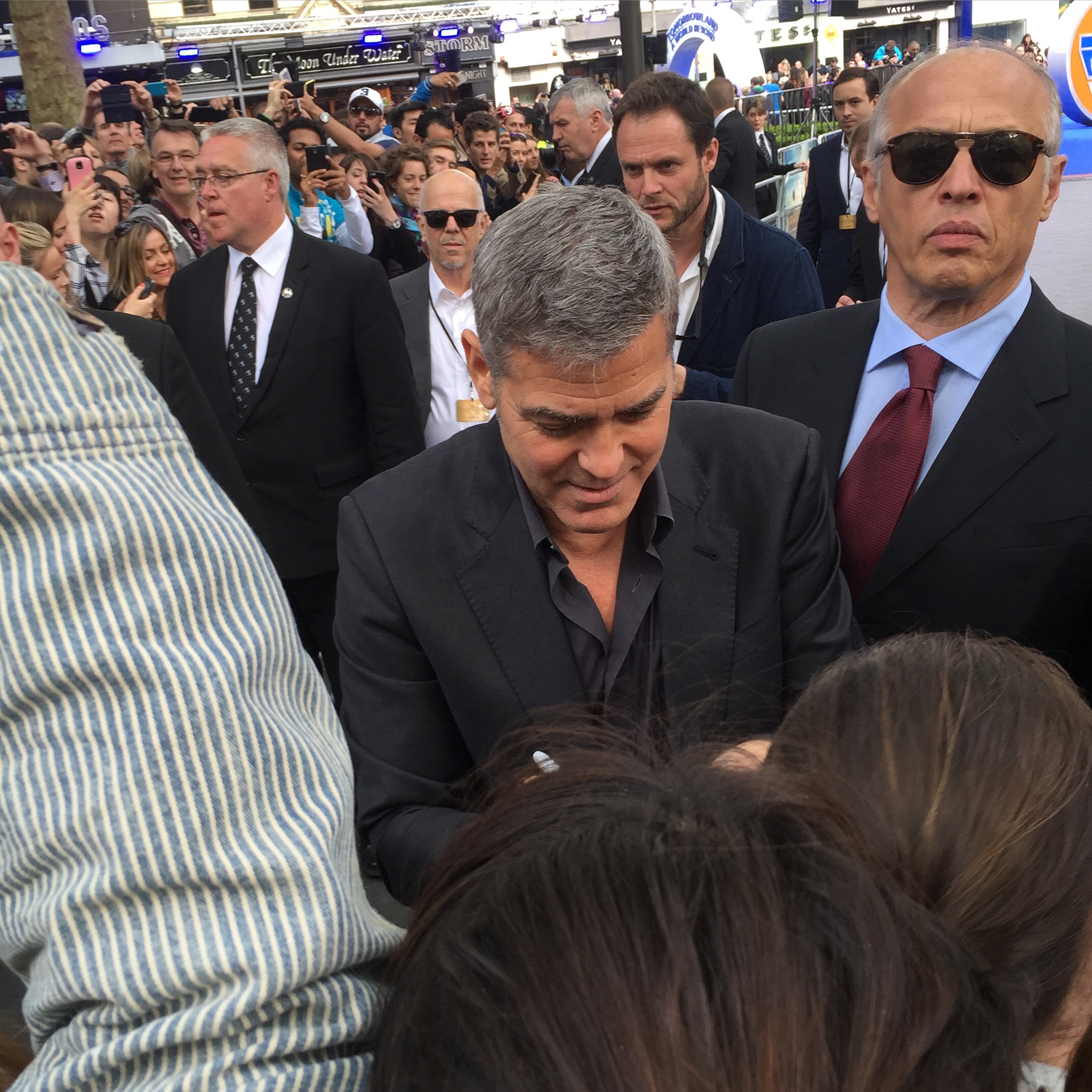
Clooney! The guy on the right = joy.

Clooney! The guy on the right = joy.

Just over four weeks ago, I was actually sitting in Walt Disney’s Carousel of Progress – and it was a really weird experience. For one, it was one of the few classic attractions I couldn’t remember from childhood; I’d completely blanked it out (or maybe we hadn’t visited? Seems unlikely, though; I remember every version of the Spaceship Earth narration since 1984 – we were that kind of family). Despite frequent updates until the early 90s, it hasn’t aged as spectacularly well as one might hope; progress by this definition largely meant technology – not people. All innovations are presented – as well they might be in view of the domestic preoccupations of 1964 – in terms of household convenience. Women are generally sewing or losing weight or gossiping on the phone, right up until the most modern, forward-thinking scene. It’s all a bit old-fashioned in a generally uncomfortable way. In Tomorrowland, the very essence of futuristic thinking is rooted in humanity, and progress is from the earth to the stars, not from the kitchen to the living room. Besides which, humanity is embodied primarily not in Frank – in spite of Clooney’s global star power – but in the body of a young female character who is not sassy or ditzy or seeking male approval or especially representative of anything other than being an intelligent teenage girl.

Do I look worried because Alex Zane is about to tap-dance on my husband's head?

Do I look worried because Alex Zane is about to tap-dance on my husband’s head?

Better yet – and here, I shall be deliberately vague – key relationships in the film revolve around another female character, the mysterious Athena (Raffey Cassidy). Impressively she is both the lynchpin of which the emotional core of the film and its coolest, most logical mind; it is Walker’s adult male that is the most unhinged and uncontrolled. When is the last time we’ve seen that kind of dynamic presented to young girls? I remember watching what is still one of my favourite films, Jurassic Park, and being utterly frustrated that seven-year-old Lex of the book, who had good reason to be scared due to her young age, had been turned into a snivelling teenager on screen, reassured about “veggiesauruses”. In Casey and Athena we have a couple of bright, shining examples of how a female character can be a character first and female second.

Few films are perfect, and Tomorrowland has its flaws – though I’d argue that most are a direct consequence of its strengths. For one, it is so invested in character and delivering its message that plot can feel a bit rushed; fully three quarters of the film is devoted to setting up what turns out to be a pretty fast pay-off. Still, I didn’t actually notice that until later, when Ramona asked me about the story (she’s something of a Joe Friday about these things). Unsurprisingly for a movie based on a themed land from one man’s dream, there’s a strong emphasis on individual, special visionaries needed to inspire the rest of humanity that I’m not entirely sure I agree with, but it did force me to think about it. Interestingly, the villain here – Hugh Laurie’s David Nix – is not actually outright evil for the most part; to be a bad guy here is to have had the optimism kicked out of you (bad news for Eeyore, I guess). When introducing the film, Bird had difficulty defining the genre into which it fits, because there isn’t just one; while that can be jarring at times, when the film takes an unexpected turn, it’s also refreshing.

Smug people are smug.

Smug people are smug.

In the end, I found myself unwilling to pull at Tomorrowland‘s threads too hard because I enjoyed the whole fabric so much; it’s such a cosy blanket of positivity and hope that I couldn’t bear the thought of trying to unravel it. Also, I really, really want one of those badges.

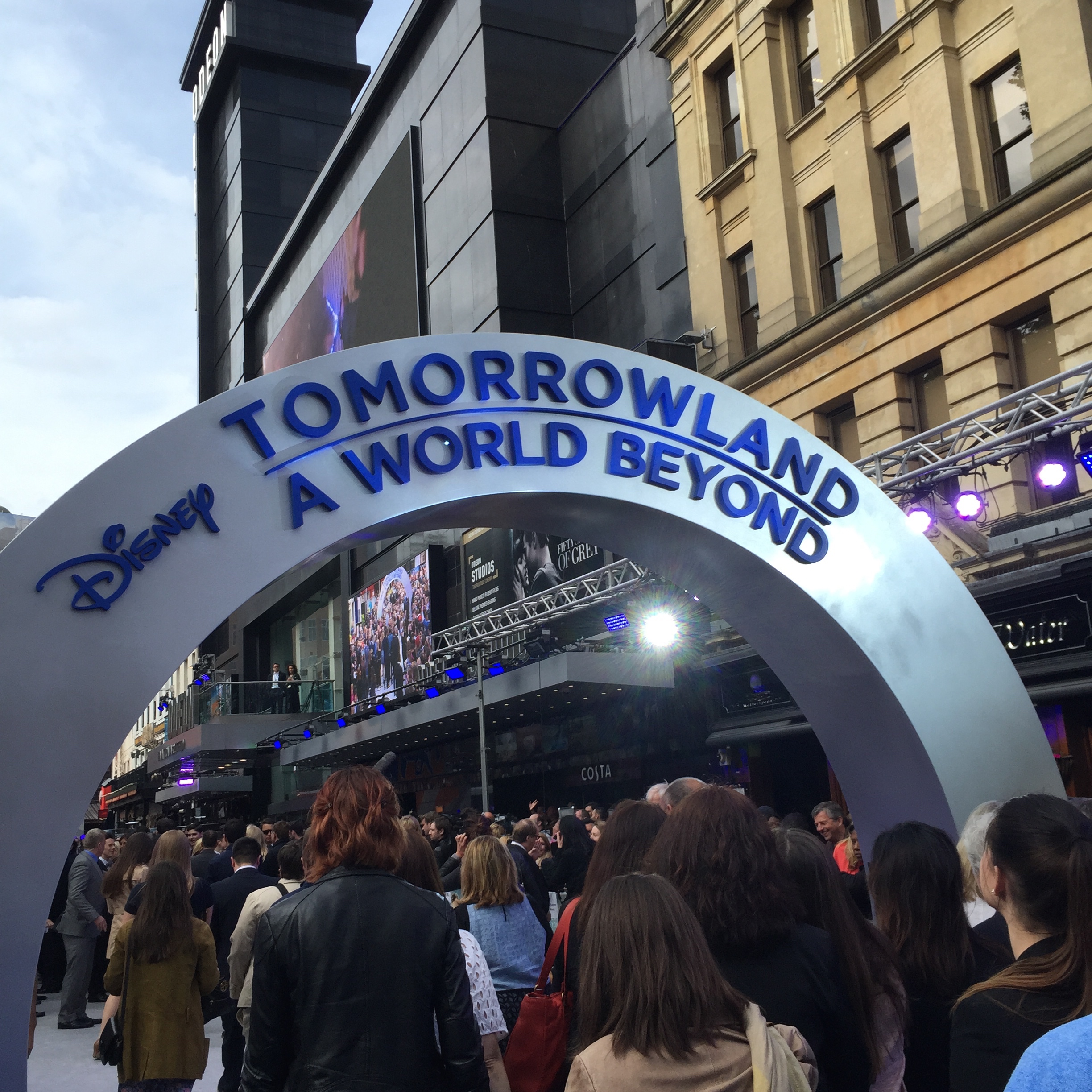
Disclosure: To make the entire experience altogether more amazing, I was privileged enough to be able to see it at the European premiere, where I edged past Clooney and Laurie on the blue carpet (sadly nowhere near Bird, of whom I am entirely in awe) to the strains of There’s a Great, Big, Beautiful Tomorrow whilst wearing my favourite vintage dress and a Haunted Mansion scarf because apparently I CAN DO THAT NOW. I am very grateful to the lovely team at @Disney_UK who invited me along and made my week. However, I can assure you the thoughts above are entirely my own (and indeed, who else would want to claim them?).

Update: I’ve had MOAR THOUGHTS about Tomorrowland, and specifically the feminism and insight therein But there are spoilers. So tread carefully.

Ten Tips for Surviving Walt Disney World with Young Children

I’ve slightly irritated myself before I’ve even started this post by putting ‘surviving’ in the headline. To be honest, I’ve done it to pander to the kinds of ways I see people talking about this (ergo, perhaps, searching for it). Let me reassure you, there is no survival involved, although you might occasionally get a bit shirty with one another. It is, genuinely, meant to be fun. Sure, there’ll be at least one moment where you’ll threaten to sell your kids to Mickey for a Dole Whip and five minutes’ peace, but come on. You’re in Walt Disney World. You are not suffering. That happens when you get home.

So, that said, there are certainly ways to make the process smoother and ensure that more of the family gets to tick off the things on the wish list without too many rows. Continue reading →

Non-spoilery thoughts about Avengers: Age of Ultron

I think of all the films that I’ve been excited about so far this year – and there have, ahem, been a few –  the one that I’d invested with the most lip-biting enthusiasm was this one. And here it is, and us British types got to see it A WEEK BEFORE the US (not over how long it took to get Big Hero 6 yet)… and I still haven’t actually written anything about it.

There are reasons. The first is that, as with The Avengers / Avengers Assemble (pick your favoured regional variant), the first viewing was more about getting my head around what the hell was going on; I’ll need to go again to really make sense of things, I think. The second is that practically all the things I want to talk about come with Veronica-sized spoiler warnings. I guess I’m safe enough letting those out of the bag now… Though I won’t.

Mainly, I came out of the cinema feeling like there had been some thrilling moments, some funny moments, some genuinely very touching moments and only a couple of really irritating moments (superhero territory: no matter how good the cast, crew, script etc, there’s going to be at least one clanging great sexist moment or something like it to really get up your nose; also, if Tony Stark is in the film it will involve him because on paper and on screen he is a truly awful person). I really liked that despite SO MUCH GOING ON, SO LOUDLY there was time and space for it to be surprisingly intimate. This was needed, since a mechanical villain is never going to have the emotional draw of a human(ish) bad guy whose motivations can be more complex, more personal and, perhaps, more forgiveable. Well, until he unleashed space-hell’s firey Godzilla-bildschnipe on New York, anyway. And there was the small matter of all those people he killed before that… wait, what was I saying?

Intimate, yes. Sometimes having your hand forced is a joy; being able to reinvent Wanda and Pietro’s background, removing Scarlet Witch and Quicksilver from specific associations with X-Men and Magneto, meant that that part of the story – and the reasons for the siblings’ dubious allegiances – could feel oddly real and plausible. For a film with an Internet robot and a flying city, anyway.

It’s funny, because people who know me IRL will know I can bore people stone cold sober with natter about these films (one poor soul got my full Shakespearean thesis on Thor by text) but it’s awfully hard to be remotely coherent when I try to make my writing sound more like a review and less like some really meandering observational routine from the graveyard shift at the comedy club. Obviously not trying that hard on this occasion, to be fair.

Anyway, sod it. It’s my blog, not a film magazine. I can write whatever I like. So I’ll end with a short and slightly disappointing story:

After the film, we went for a really nice meal in a Turkish restaurant we’d never tried before (no, we didn’t have schwarma). The waitress heard us talking about it and asked me if I could tell her who the voice of Ultron is since her flatmates are all crazy about this film. “James Spader,” I said, with the warmth that only having been alive to be in love with James Spader between 1986-1994 can achieve. “Who?” she replied. And I was just a little gutted.

That has nothing to do with the film per se, but that feeling of love and possessiveness being mildly punctured by someone else’s complete lack of immersion in the landscape? Sort of how it feels to talk about this stuff with people who don’t do superhero movies. So it’s felt pleasantly cathartic to write a little about it here where I have no idea if you care or not, but I’ve got to assume you were interested enough to get past the headline.

Right. Time to book take two, I think…