







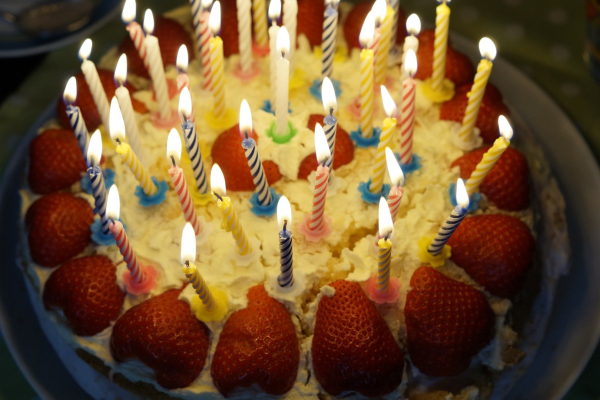


Spotted on Under the Paw.
Yesterday was clearly social media day. Well, given my job, every day is social media day but I don’t usually have a half day seminar about all things digital in the morning followed by an nfptweetup after work. Let’s take ’em one at a time.
I went along to the seminar in place of the Digital Marketing Manager. To be honest, we were both quite suspicious that it would be an extended sales pitch, but we needn’t have worried. The salesy part was thoughtfully kept to a 5 minute add-on at the end. There were four conveniently succint presentations but the seating was more round table which made the Q&A at the end a little less pressured; everyone prefers an intimate roundtable to being the kid putting their hands up to ask another question, right?
The sessions were on:
The Online Power Cycle – A lovely 80s themed summary of the power of iterative and cyclical testing in marketing campaigns, courtesy of Richard Kirk.
Trolls, Lurkers & Evangelists – An introduction to online communities and identifying and building those communities in view of the fact that 90% don’t contribute. A useful case study of the new USA Today Kindness community and why the speaker, Drew Davies, suspected it would not succeed (I agreed).
S0cial Fundraising – A Case Study – A look at Diabetes UK’s challenges site with useful statistics from the first six weeks (70 challenges, £50,000 pledged, £1,500 banked), from Dan Martin. Diabetes UK is of course a client of CN.
HTML 5 – Barney Stephens took us through the long term implications on HTML 5 and where we can start to plan ahead and gently implement rolling changes to be in line with the new technology when it happens (in 2022…).
If the first session sounds interesting to you, then I recommend a 3-day trip to the IDM to do the introduction to Digital Marketing course I wrote about before, because it will cover this subject in far more depth. But if you’re really brand new and nervous, then a session like this with CN will push you in the right direction.
I could also have ditched the communities session because it was at a slightly basic level given our experiences using and building social networks – they pitched to the centre, quite rightly so – but found Drew an approachable type who quite clearly feels very passionate about this area; he’s someone I would talk to about the subject in the future.
The post-coffee break bit was where it was at for me. I enjoyed hearing a case study I was unfamiliar with, with a bright, simple idea implemented well. But the real jewel in the crown was the final session on HTML 5. It’s the first time a digital marketing / social media based session has gone even a little bit techy. And it’s important. Because even if you never build a website in your entire life nothing saves you money, time and grief more than knowing what the designers / developers are talking about and being able to give them a well-considered, thoughtful and knowledgeable brief.
While it might seem like HTML 5 implementation is light years away, we all know it’s harder to suddenly bring something up to date than to start planning for it in advance. Okay, I won’t be raring to use Canvas yet, but the potential to have lightweight graphics, dynamically updated on web pages (the text to which can be edited by any user just in their browser) is exciting. I’ll probably blather on about this in a bit more detail in a future post, as I want to get on to tweetup thoughts while they’re still fresh, but it was great to be able to get to grips with the geek in me.
Two people from Chameleon Net I’ve followed before now are Jon Dytor and Ross Miles. They have two of the most different tweeting styles you can imagine. They both came to the nfptweetup. More below…
This was the first tweetup at which I’d tried to lend a helping hand with the organisation; both Jacqui and I felt we’d taken lots from previous events and it was time to give back.
The agenda was to have a short presentation critiquing a Twitter feed. I was to do a corporate one (or two, actually) and Steve Bridger picked a charity feed he was relatively unfamiliar with – Diabetes UK again! – to give his thoughts. Then there were break-out discussion groups around the subjects that come up time and time again: Fundraising, Communications, Campaigns, How To… and Integration (with other media online and off).
We ended up going with our strengths; I did a short presentation on what @paulhenderson rightly described as “one of the great loves of my life”, Disney, and Jacqui facilitated the group about Comms strategy since she has the perfect mix of traditional and digital experience. Our not-so-newbie-now Lo and I then ran around helping the fantastic Beautiful World team (who organise the event along with generous sponsors JustGiving) in tweeting updates from the different discussion groups.
I’m not going to recap on all the learnings because you can do that by reading through the @nfptweetup twitter feed and searching the hashtag #nfptweetup – although I will pick out one or two points in a moment. Firstly what I will say is what I enjoyed particularly about this event.
1. The Format
I think we’ve finally cracked the nut and found something that works (although as with cyclical testing, maybe it’s good to keep tweaking, eh?). Just enough presentation time that people can warm up and get their heads around things but not so much that they’re asleep – it is in the evening after all.
2. The Venue
Okay, we were ridiculously lucky to be invited to the East Winter Garden for part of Chain Reaction, but the different kinds of seating, small room, and general informality really helped to get the discussions feeling less like tutorials and more like the information-swapping, networking and learning events they should be.
3. The Subjects
They were chosen based on Beautiful World’s feedback after every event, and they were spot on. These are the things people wanted to talk about. Almost every group also had a discussion on tone, which made the critique at the beginning quite relevant.
Now, thoughts…
One thing that came out of the integration discussion was scheduling tweets. Now, there’s a time and a place for this. If you’re pitching to an audience when it’s in a different time zone. If you want to make sure something will go out at a certain time without forgetting or because you’ll be away / in a meeting. Use judiciously, I can see it being useful. Until last night I’d never heard of anyone exclusively tweeting that way. Ross Miles surprised me. He once to help Chameleon Net be seen as thought leaders, and therefore goes painstakingly through his RSS every morning, scheduling carefully spaced out tweets linking to posts on a variety of relevant topics. At 1:30pm, every day, he drops in one related tweet about CN – no more, as he doesn’t want to spam. He is a big NFL fan and has a whole other feed just for that. There is also a general @Chameleon_Net stream.
Now, I understand why he does it – lack of time, resource, etc. But I now feel a little bit like I wasn’t following Ross! I’m a great believer in tweets with personality. In fairness to Ross and his ability to write an interesting tweet, I obviously hadn’t noticed he was doing this, so he has taken the time to inject some personality. And, again in fairness to him, he does reply to tweets and respond unplanned whenever he can. But now I know, I think it does explain why I spend far less time tweeting Ross than his colleague Jon, who is very much himself, ad hoc and at random. Should Ross be saving the scheduled tweets for the main CN stream and give a little more insight into himself (NFL an’ all) as he fits in to the bigger CN picture? I think I would prefer that. I talked about this with him at the event, by the way, in case you think this is a bit of a passive-aggressive way of communication. During the course of the evening, Steve B. responded that he thought scheduling was not a path a charity should go down. I agree.
Onto something else.
I was actually quite hard on Disney considering how much I love it. But I think it’s quite silly that a company that has such evangelical adoration attached to it has a relatively personality-free and distant @disneyparks feed, but also employs wonderfully personable, interesting and sweet people like head of the Disney Moms Panel, @lauraspencerone. It baffles me that a company full of such – pardon the pun – characters would want to have a stream that feels quite cold. And that still hasn’t answered a question I asked several days ago. I know there is a streamed video of last night’s event which I will link to when I know where, so you can tell me if you think I was harsh.
Once again, the nfptweetup has come into its own as a useful place to challenge assumptions, get tips and learn something about the wider world of the big T. Come along next time; we can always keep learning.
I received the following from my friend Sam, who contacted Decoy Kitten Rescue about the 60 kittens in need of homes that the Daily Fail Mail had said were due to be killed if homes were not found. He got the reply directly from a volunteer at the centre:
I am a volunteer at Decoy Kitten Rescue.
Anyone wishing to donate money can send a cheque made payable to: C.Hardwicke (Decoy Kitten Rescue) and send it to:
Decoy Kitten Rescue
40 Keyberry Park
Newton Abbot
DevonTQ12 1DF
Please note that we never spoke to the daily mail or ANY of the tabloids.
NONE of our animals were going to be destroyed… we rescue NOT kill. [my emphasis]
All the cats that are ready for rehoming have been allocated and homes are ready and waiting for our little ones when they are ready too.
I appologise for people not being able to get through on the phone but we have been experiencing high call volumes.
We do have a Facebook page… just type Decoy Kitten Rescue in the search box to find us.
You can also message Claire Hardwicke directly on Facebook.
I hope this helps
thankyou
kind regards
Lisa
So, the upshot is, the kittens have homes (possibly, in fairness, thanks to the publicity afforded to them by the Mail, even if they did add a crucial detail the centre claims not to have told them) and they were not on death row.
Phew.
Seriously, Facebook; we need to talk.
The suggestions. The news feed vs live feed. The nonsensical Events blocking… it’s got to stop. There’s got to be a way out. I’m a regular user, logging in every day like clockwork. I am an admin for a page with over 57,000 members, on which I post at least five times a week. But you’re treating me like I’m disinterested at best and a spammer at worst. Not so pleasant for someone who has both personal and professional reasons to use the site.
Let’s look at the last week.
The Suggestions
In the last week, you’ve suggested I reconnect with someone who passed away barely ten days ago, and my own husband. While I can understand that you can’t tell from an active profile if the person is actually still running it or not, the relationship status should be an easy one to read. I’m sure I’ve heard tell of possible memorial pages, too…?
My mother doesn’t even tell me which of my friends I should be getting in touch with again. It’s creepy, and completely unnecessary.
The Events
I’m very spam-aware. When I was creating the Christmas events for the Dogs Trust Facebook Page, I even stated to the members on the page that I would be as careful as I could not to spam them and could they please bear with me. I was happy to see it was not a required step to publish the events to the news feed; neither was it necessary to invite anyone. So I deliberately didn’t publish them and didn’t invite anyone. Ergo, no spamming.
You sent a big, rude, red message up on the screen saying I was spamming and risked having my account blocked. Please rework your algorhythms to take into account that you cannot spam people if they can’t see what you’re adding in their updates or invites.
Live Feed vs News Feed
Seriously, are you kidding me? My friends have to like something and I have to start ‘liking’ and commenting just to be considered to be engaging? I can’t read something anymore? Sometimes I don’t comment etc because I don’t want the updates coming to my phone’s Facebook app and the emails clogging up my inbox. I genuinely want those notifications when I am bothered enough to comment, and I understand you want more site stickiness and engagement, but assuming you know what I’m interested in is a step too far.
My friends like lots of stuff I don’t. I like lots of stuff they don’t. Don’t force me into fiddling with settings etc to get the people I want included. At best, the news feed ought to be an optional setting that you can arrange for yourself, including a select group – a bit like Lists on Twitter. Facebook just isn’t as clever as Google at working out what I’m interested in, and while the other options are there it still smacks of telling instead of offering.
I’m not going to lie; like most people change can annoy me just by its nature. But I’ve watched one thing after another change for the worse and it’s really getting irritating now. I can but hope that I will start to get used to Facebook’s overbearing parenting, but – fairly or not – I find myself increasingly comparing it to Twitter. Twitter doesn’t always get it right (I’m still baffled by the enforced blocking of replies to people you’re not following) but it does seem to be more led by by user choice. Facebook instead chucks auto-customisation at you and forces you to tweak it.
The problem is, many don’t bother. As a charity page admin, I now worry people who are genuinely interested but just not auto-clickers and commenters will be missing out on news. We are careful to post in a non-spammy way, but now that hardly makes any difference.
Ah, well.
 If you’re thinking of getting a cat, and can get to Devon, think harder, think faster, and do it by Wednesday.
Look, I’m so serious, I’m even linking to the blinkin’ Daily Mail.
The Decoy Kitten Rescue in Newton Abbot is closing down and the likes of the RSPCA (who use it as an overspill centre) are obviously too full to take them. I have no idea if anyone’s been on to Cats Protection, but I can’t imagine they’re any less full (they’re brilliant by the way).
Call 01626 205755 to ask about a kitten – or a cat, for that matter, as there are some adult ones too. I can’t bear to think of them dying while there are homes out there.
You would think that the survey was the ultimate piece of social interaction. After all, you’re asking the person their opinion in an open way. But of course it’s not that simple. Research into surveys has thrown up all sorts of issues, such as people giving the answer they think people want to hear, or different answers from the same person to the same essential question asked three different ways.
That’s not to say surveys are completely unhelpful; they’re not, if they’re conducted intelligently and without the sense of having the results lined up and using the survey to fit the hypothesis (which isn’t really a hypothesis as you’ve already decided the result – following me?).
But surveys about social media are a dime a dozen these days, and few of them are remotely helpful to either social-savvy employees or potentially social-wary employers – or anyone in between, for that matter.
Take yesterday’s gem from The Telegraph about social networks costing the economy billions in lack of productivity, as reported in Social Media Today. The survey is rightly lampooned as it implies social networks are the only form of office timewasting – and before you ask, I’m writing this in my lunch break and rarely take the whole hour! – and relies on people estimating both their own usage and their colleagues’. I don’t know about you, but I take is as given that people are generally phenomenally bad at estimating anything. For example in that survey people estimated their own time spent on online networks at being about a third of the time their colleagues spent on them; the survey used the bottom number but really, aren’t they both shots in the dark?
I’ve been asked a number of times at conferences to say how long I use each network professionally for per week or per day. The answer is as long as is needed. Some days Twitter gets five minutes, if that, some days it gets two hours. Likewise Facebook, etc. If there are questions to be answered, comments to be responded to and news items to be shared, then that happens, in order of urgency, every day, no matter how long – or how little – it takes. Of course that’s professional, not personal use, but even then I struggle to estimate the percentage of my time it takes as opposed to updating our websites, building microsites, running AdWords campaigns, writing presentations etc etc. So how utterly rubbish would I be at estimating my personal usage? Let alone Jacqui’s or Lo’s? Extremely, let me tell you. And I can only imagine those whose jobs have nowt to do with digital marketing are much the same.
The sole commenter on SMT points out a survey pointing in the other direction: Social media keeps [sic] employees’ heads in the game, screams the headline (‘media’ is plural. Hard to remember, even by me, but I at least try to check the title). This is duly commented on and gushed over… but is actually no more useful than The Telegraph’s alleged churnalism.
All it really says is that employers are using the established social tools, such as blogs, in place of the old emails and meetings. That gives people more of a right to reply, but doesn’t really tell you if as a result of doing that employees are any more productive or better informed. Perhaps there’s an argument for more engaged, but if you’re not asking the employees, how do you know for sure? It doesn’t sound like there’s any actual metric – of the kind we need to use to see how supporters are responding to professional networks – to base these results on other than, once again, poorly remembered anecdote. Take the meat of the results:
Nearly 80 percent (79%) of respondents said they use social media to frequently engage employees and foster productivity. Tools such as company blogs and discussion boards even outranked e-mail (75 percent) as means of keeping employees’ heads in the game.
Okay – they’re using it. Does it work?
I’m not trying to be difficult here, as it’s in my interest to support the latter kind of survey; the more people that are online during the day, the more people I can reach, professionally and personally. And I recognise that one survey is not really an answer to the other, as one is focussing on estimated personal use and the other on professional use internal to organisations (although that means opening access and accepting that personal use will happen as a result).
I just can’t help feeling that, positive or negative towards social platforms, these surveys just muddy the waters and confuse already hesistant senior management teams further. Blanket statements and ‘proofs’ like these just lead to the situation I see coming up over and over again where teams are either told “we need a Facebook page” with no sense of the whys and wherefores (though isn’t that just whys and, erm, whys?) or told that it’s all a distraction, a fad and completely lacking in usefulness. What they really need is case studies and examples of the myriad ways companies in their sector are using social tools, and working out what’s good for them and where they can afford to experiment. There’s a massive wealth of this kind of resource for charities online, for example, but I’m still asked time and time again ‘how we convinced our managers’.
It wasn’t using linkbait, press-chasing surveys, that’s for damn sure.
By ‘the Internet’ I mean, of course, people on the Internet. Not the Internet itself. That would be weird.
Anyway, this is my Personas result:

I like it. Slightly surprised domestic isn’t a larger chunk given how many people find their way here searching for icing…
Not so long ago, I wrote about what I thought of as “Disney for Good” and how I thought that there’s a whole exciting room for engaging Disney folk in work for non-profits beyond VoluntEARS – community outreach, if you will.
And here it is. The new 2010 promotion: Give A Day, Get a Disney Day. Give a day to help a participating organisation, get a free day in a Disney park.
I knew they’d have something up their sleeves. I’m glad this was it.
On Monday, Tuesday and Wednesday of this week, I scuttled to the wilds of Teddington (South West London) for the Institute of Direct Marketing’s Complete Digital Marketing course. While the IDM offers some of the few respected qualifications for marketing in Europe, this particular course was not a qualification but an intensive, ambitiously comprehensive introduction to the foundations of digital marketing.
Of course, I am already a digital marketer, having been doing it for a year. But I had no marketing background and a lot of the time knew what I was doing and that it worked, I just didn’t know why. And I didn’t have an entirely confident grip of what I should be testing and how. This course aimed to begin to address this, and now I’m thoroughly set on doing the Certificate in Digital Marketing qualification as soon as I can find out whether there’s anything left in the training budget (if not, I’ll work out a way to do it privately).
The CDMC (as I shall henceforth refer to it) is three days covering the tools in the digital marketer’s arsenal – email, mobile, display / banner ads, etc – as well as the techniques they can use to keep honing their methods, always aiming at best practice.
Some of it is covered at breakneck speed, and it was unfortunate that email marketing and constructing a solid digital campaign plan were rushed through at the end (with a session on online-offline integration not being covered at all). Search Engine Marketing (SEO + PPC, basically) was covered in just two hours with some very crowded slides. But then I understand that the IDM is up against it; any longer than three days and it feels like too much effort, yet there’s so much more to cover every year. I did wonder if it would be worth cutting down the initial introductory segment, or having one extra optional day to cover the areas that get missed.
The course tutors are generally excellent, field leaders who have worked with the IDM for years and know their onions. Though there was a slight lack of interactivity, bar one useful card-sorting exercise with Tobias Misera of user experience specialists Foviance, discussion was encouraged. Main course tutor David Hughes of Non-Line Marketing is engaging, interesting and invites any question or challenge.
The best session was probably a toss-up between one focussing on the importance of testing (David Hughes) and a rather complementary session from Matthew Tod of Logan Tod on web analytics. The latter really did serve to open my eyes about just what I’m tracking and why I’m tracking it.
The weakest session was probably one from Eric Mugnier of Inside Mobile who, to be scrupulously fair, had not been the original speaker and had to fill in at the last moment for his MD. Mobile’s been the future for, oh, the last ten years, and although Eric convincingly argued for its eventual dominance, he also ended up assuming a level of understanding about the mobile marketing arena that most of the course attendees (myself included) didn’t have. That said, it was a worthwhile two hours, even if I was left believing that there’s still a way to go before we as an organisation will find a really effective use for mobile marketing.
The most useful thing I learned was a good sense of how to implement a constantly moving, rolling series of tests and improvements. I hope to be able to put that into practise soon!
In the end, despite some hasty sessions and content compromises that had to be made to fit the format, this was still a very useful way to spend three days away from my inbox. The facilities of the IDM are comfortable and more than fit for purpose. The comprehensive set of slides that are given as both paper copies to annotate and later sent as electronic copies are very useful. The booking process for the course, which costs roughly £1,400 is swift with judiciously timed follow-ups by post, email and text (as well they might be, given the source, eh?).
In short, if you’re new to digital marketing or don’t have a formal background in it, this is an excellent choice.
I’ve just had my hair cut, so I thought I’d get Ashley to take a few photos of me that I can use for this footlin’ bloggin’ thing. Here are my favourites:

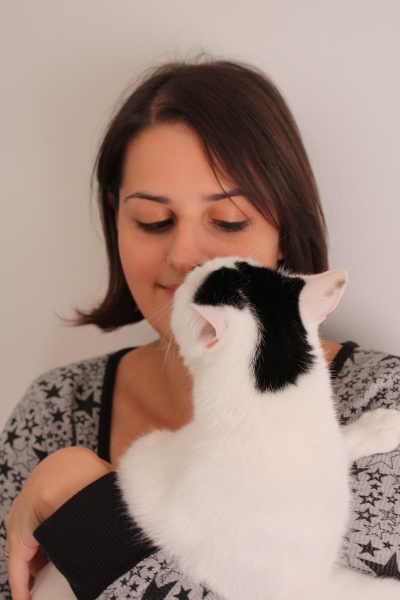

I thought Snaffle was very obliging in the second shot considering he usually doesn’t sit still for more than three seconds together and generally doesn’t like me. But he seems to like the smell of my mineral foundation and even licked my chin. Kitten breath is not as cute as it sounds…
 MOKUSKA