Whoops! Baking blogging is delayed…

I promised cake blogging… and it hasn’t happened yet. But it will. Along with some pictures of the truly astonishing hen do decorations designed and made over several painstaking weeks by the hostess.

In the meantime, I’m doing my day job, which involves sorting out things like setting up a Dogs Trust Twibbon, getting our Education department set up on Twitter, and adding lots more content, images and so on to the new website that will launch one of these days, honest Guv.

Cakes shall return. Oh yes, they shall.

My first Disney visit: 1984

Magic Kingdom, 1984

Magic Kingdom, 1984

Picture it, Orlando, 1984.

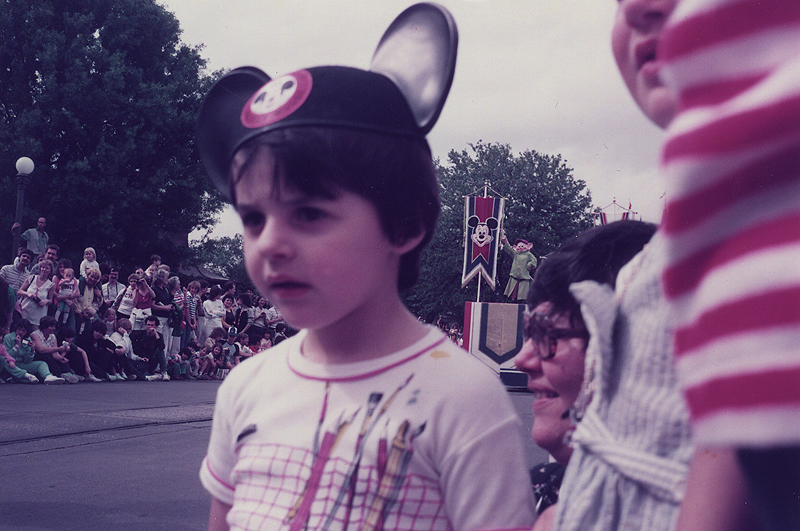
Disney had cemented its utter takeover of central Florida. The other attractions were still scrabbling to make a presence, Epcot (then EPCOT Center) was barely two years old and post-70s optimism was on the up. And there I was, four years old, utterly transfixed by the afternoon parade.

The Magic Kingdom, to my young eyes, was quite simply the most magical place on Earth. Although I’ve since transferred my allegiance to Epcot somewhat, I still literally squeal with delight when pulling in to the Disney car parks and preparing to board the monorail to the Transportation and Ticketing Centre. That look of gobsmacked immersion has never quite left me – I’m sure if anyone had taken a similarly candid photo when we were watching the Spectromagic Parade in April this year I would have looked similarly entranced (and, admittedly, gormless).

There’s a reason why people are so utterly Disney-mad. And for me it all exists in the picture above. I still have the personalised Mouse Ears somewhere…

Magic Kingdom, 2009 (taken by me)

Magic Kingdom, 2009 (taken by me)

#disney

But she can’t be one of them

Ashley and I went with his best man and his wife to kosher stalwart Solly’s this evening. The restaurant’s beginning to take the piss a bit, with poorer service and smaller portions of side dishes (though typically delicious huge main courses), but that’s by the by. There was a couple sitting at the table behind our friends. I paid them not the slightest bit of notice but Ashley was clocking their behaviour…

I habitually wear a cross, generally my late maternal grandmother’s silver cross. It’s not particularly big, but being metallic and unusual in that part of town (in spite of the Greek Orthodox Church across the road) it probably does attract attention. Apparently the couple opposite were turning round to quite openly stare at my chest repeatedly. At first Ashley wasn’t sure why – I suppose because he’s used to living with my religious paraphernalia, as I am with his various kippot, chanukiah and mezzuzah which we really ought to get around to re-sticking by the door one of these days. After he twigged, however, he began to get annoyed. He thought about saying something, but being, like me, naturally non-confrontational, was ready to just roll his eyes and forget about it.

He ended up smirking.

As the couple paid up and left, he heard the man commenting as he headed out of the door: “But she looks so Jewish!”.

Love it.

Hill & Knowlton Social Media Round-Table July 2009

Last night I was invited to the stunning Soho Square offices of Hill & Knowlton, to talk social media with a bunch of non-profit types. This was quite different from the ‘usual’ gatherings in a number of interesting ways.

1. The attendees were far more senior than usual– heads of digital, working with CEOs, in one case charity founder. This was really positive, as internal buy-in is a relentless struggle for many a community manager. These are the people that need to sit around a table with the likes of me, who actually do the day-to-day job and be convinced that it has value and that the risks can be addressed.

2. It was, therefore, not the usual suspects. All of us knew H&K a different way; we started developing a relationship with them through @CandaceKuss who’s a dog lover and former breeder of guide dog pups and who admires what we do online given our limited size and resources. We’re used to seeing some familiar names and faces on the discussion circuit now, and these weren’t them.

It was the first time, for example, I’ve come across a member of the Stonewall team, and there was also someone from the Royal Albert Hall. Fascinating, because of course we have different issues – it’s easy to say ‘let go of the product/message’ when it’s yours, but in the case of the RAH, of course, it’s not THEIR product.

3. It seems to have spawned something even more useful. While there was a certain unavoidable lack of focus in such a broad discussion, steps were taken by the lovely Sara Price and Gaylene Ravenscroft to plan where to go next – they were prepared to throw the format out if it didn’t work. Instead, preliminary decisions were made to have more structured workshops in the future, beginning with a focus on metric – hallelujah!

Metric really is the key to everything social media – and so it should be. It should be an integrated part of communications and we wouldn’t dream of trying any other comms strategy without it. It is the key to knowing if you’ve achieved your objectives, it is the tool with which you persuade the reluctant, it is the essence of communication. And despite the plethora of free goodies out there, most conversation-tracking tools are swingeingly expensive for a charity our size. A workshop that helps us get the very best out of what we can get our hands on – and turn that into fundraising, volunteering, rehoming and other engagement stats – would be very helpful indeed.

In fact, my only disappointment with the session was with the ‘listening guide’, which was designed for pure novices (“go to Twitter.com and click Get Started”); apart from Blogpulse I heavily used all of the tools mentioned – in fact, if I didn’t, I wouldn’t have been involved in the discussion in the first place. It would be good to see this taken further – perhaps an Advanced Guide? – moving forward.

Learning something new is what I live for – I look forward to doing that in the next session.

This is why I love my husband…

…and also why he should heed my calls to start a blog himself. We were having an email conversation about where to go for a short break this summer and I got the following by email:

Unless of course there is somewhere that springs in your mind? I am all ears.

Well, of course, not ALL ears. That would be freaky. But probably would have me in great demand from the medical establishment for those poor unfortunate souls who have lost THEIR ears…perhaps as a result of some dreadful agricultural incident involving a wheat thresher.

At least, it would take the pressure off those rather put-upon lab mice who have ears genetically springing from their backs. Although I dare say it gives them an added advantage when it comes to escaping predators. Do you think that perhaps other mice use their services, stationing them along the edges of their mice homes, much as we strung out radar installations along the southern coastline during World War II to warn us of the advance of the Luftwaffe? I bet they’d make a fortune if they charged for their services. The mice that is, not the Luftwaffe. They’d be up to their eyes in cheese. And ears too, I’ll wager.

Media Trust Twitter for Charities Event (July 2009)

Yesterday Jacqui and I pootled over to Millbank for a Twitter for Charities event organised by Media Trust and chaired by the voice of common sense, Rachel Beer. If you’re on Twitter and want to follow Media Trust events, search the hashtag #mtevents. It serves for all.

This was an exceptionally good conference for a number of reasons:

  • It was short, sweet and to the point
  • It was focussed on one tool, which made it easier to keep on topic
  • The speakers, Rachel Beer and Daren Forsythe (formerly of the BBC & Media Trust) were excellent
  • Fellow members of the panel, Carly from Elephant Friends and Fliss from Media Trust had great case studies to mention
  • The questions were intelligent and prompted good discussion
  • A member of senior management was there! Joy!

I honestly believe that the next stage is holding conferences not just for the people who are using the tools – surely those should be practical workshops, really – but for those who need to be convinced that their team should be using them. We need to be talking metrics, successes, importance and, yes, pitfalls with the people who have ultimate responsibility for communications, fundraising and marketing.

Anyway, here were some things that came out of the day that I thought were worth mentioning as they are critical to understanding the role of social media and using social tools effectively:

  • You don’t necessarily need a social media policy (though some comms guidelines are fine). You do need an integrated, comprehensive and positive policy for communications, fundraising and marketing.
  • Twitter is not an objective. You use Twitter as a tool among many to meet your objectives.
  • If you’re unclear about your objectives, wait until you know what they are before using the tools.
  • Having a positive statement of what you can do online (perhaps an ‘our voice’ statement instead of a ‘policy’) is much better for all concerned than a negative policy. Rachel here sited Intel’s example of rules of engagement.

All of this, once again, proves that my conviction that social media is another avenue for responsive customer service is well-founded. And I’ll continue to believe that until I have any sort of compelling reason not to.

Conferences: Institute of Fundraising South West and Gorkana Sky News Briefing

Thursday and Friday saw two very different kinds of professional exchange about social media. On Thursday around 75 non-profit based delegates came to Bristol’s light and airy Southville Centre to exchange their knowledge. On Friday, a cluster of PRs came to listen to Sky News online editor John Gripton and last-minute no-show ‘Twitter Correspondent’ Ruth Barnett (@ruthbarnett) talk about scanning networks for news. These are my thoughts.

Although Jacqui presented a case study at the IoF’s southwest gathering that’s much the same as the ones we’ve done before, the questions were surprisingly different. As we do the Q&A together, I found myself talking far more about how we decide which networks we break which stories on, the penalties and privileges of running our own network and the cons and – in my opinion non-existent – pros of sending automatic messages on Twitter. Even better, we also got to hear case studies that we haven’t seen listed on the conference circuit thus far.

The most interesting of these was from Comic Relief. Of course as a one-off event every two years (with newer Sport Relief in between), fundraising is far more straightforward for the team than it is for a 365 operation. But interestingly, having harnessed the power of social networks to spread the word, the Comic Relief crew discovered that this obliged them to create a 365 persona: a huge crew of supporters is now waiting to be treated as long-term partners, not brief donors. They also found the online giving through networks was not that high (online giving generally was, but that was the inevitable movement from phone lines to broadband). And though their social media strategy seemed finely honed and planned, a lot of it was ad hoc and working it out as they went along, with help from agencies.

That was thoroughly heartening. For a start it means that even a big organisation that deals in many, many millions at a time doesn’t get everything right first time. But much of what they did was not expensive or complicated, it just required a lot of tenacity and perhaps the clout of a big name. Now they’ve opened the doors – getting mobile networks talking about customisable phone donations, for example – why shouldn’t any other charity with a creative, committed team not benefit? A huge budget is not required, or even desirable. Networks are far more about awareness, marketing and customer service than they are about fundraising, but occasionally the two can come together for the benefit of all concerned.

There was also an opportunity to listen to a talk about The Big Give, an innovative donation-matching scheme pioneered by recruitment don Alec Reed. Matching major donors with projects – not, crucially, charities – it also runs a fundraising drive where the first £1m of donations is matched by The Big Give pot. This, they’ve found in their research, makes supporters (isn’t ‘donors’ a loathesome word? So cold, and almost inaccurate) more generous. This year they’re trying a slightly more complicated scheme where the charities raise a certain amount before the major drive, it’s matched and then there’s the big fundraising event with more to be matched – read about it on the site, it makes sense eventually! Since the last Big Give raised £2m in 45 minutes, it’s definitely one to watch.

Friday’s gathering was very different, and a little disappointing. On the one hand, it was a great opportunity to get an idea of the best way to contact Sky’s online team and get interesting stories to them. On the other hand, much of it was very much common sense e.g. don’t call to ask if someone’s got your email. That’s PR 101 and it’s old-fashioned ‘get on the phones’ bosses that need to be told that, not the jobbing PRs caught in the middle. Also, it was disappointing that there were no specifics about how they scan social networks for news. In a handy pre-recorded interview to make up for her unavoidable absence, Ruth said people should carry on doing their stuff online and she’d see it and decide if it was interesting enough to broadcast. But HOW would she see it? There’s so much out there. I tweeted her afterwards asking which tools, apart from hashtag searches and trending topics she used to search. We use the great Twilert, but are always keen to know of other conversation-tracking tools and would love to know how to get attention in all the noise on Twitter! That was on Friday and she’s not replied yet, but she does have to have weekends off, I guess!

Tools are the big focus for me, going into my second year at Dogs Trust. Tools for conversation-tracking, for influence-tracking (because that shows awareness – being seen as leaders is great and a bonus, but this is about doing our best for our charity). Solid metrics that are not only about the cash but about those sometimes hard to define marketing goals. We can’t fall into the fluffy charity trap. I’m also hoping to do some marketing qualifications and put into formal terms some of those things I already instinctively know, not to mention rack up some new things. It’s an exciting, forward-thinking time, where social media needs to be seen not as discreet, but as another avenue for good marketing and customer service.

Childfreeonline and the inevitability of tribal thinking

We all like to join tribes. Whether we’re joining online groups, heading to a meetup or even just gossiping with friends, we like to divide the world into ‘them’ and ‘us’. I’m certainly not the first person to observe this and I undoubtedly won’t be the last. What baffles me (and, I’m sure, myriad others) is why you would make a tribe out of something that is an individual choice…

I guess stories about kids are interesting me more than they otherwise might because I’m getting closer, slowly, to making a decision about when to have them myself. I’ve known for years I want to be a mother, and apart from some vague feelings of uncertainty in my early 20s, I’ve pretty much never changed my mind. I have known people to be obsessed with having kids from childhood, or resolutely uninterested in breeding for years only to change their minds and I know people who will undoubtedly stay sans littleuns for all their lives. Somehow I’ve been friends with all of them without it really becoming an issue. But if you do a quick search of the web it’s apparent that there are entire movements on either side of the equation. How utterly bizarre.

For example, I was followed by @childfreeonline on Twitter. Strange, but hey, I get followed by a lot of random peeps; it’s all good. On the first page of tweets I saw, they claimed not to ‘hate kids’ and just to want respect for a childfree choice. But also tweeted “I am pregnant” and “I mommy blog” (do you have to read it) as turn-off words, and linked to articles all about how terrible parents are for nicking all the best holidays at work. Today they link to a story about  a man not loving his child.

Now, here’s the thing. I understand that it’s got to be extraordinarily annoying and insulting to be questioned on your choice of whether or not to have children by other people. But… who the hell DOES that?! I can only assume that I’ve never come across such outstanding rudeness because, if the subject’s come up at all, I’ve always said I do want kids one day. Seriously, I can’t blame childfree parents for being affronted by such behaviour. But there’s no need to take it out on all parents either, guys. After all, you don’t like all being tarred with the same brush based on your choices, right? Blaming every mother for Carol Sarler’s ignorance and extreme inanity is taking a pot and kettle and comparing dark colours.

Equally, I see plenty of comments from people going “I couldn’t care less about babies / children etc so don’t tell me about it”. Well, children are a huge part of any parent’s life. Not all your friends are going to have exactly the same interests as you all the time, and major life events are going to colour what they talk about. Any friend who goes on about themselves all the freakin’ time is worthy of a sit down and a chat about narcissism – people who talk about children incessantly included. I mean, I want them but you think I want to hear about them constantly? A good, non-self-obsessed friend will stay that way, no matter whether they (or you) have no children or six.

The third line of anti-parental (and sometimes anti-kid) attack seems to be at work.  Carol Midgley (what is it about being a journalist called Carol and writing nonsense about parents?), a mother herself, wrote an article about the childless being the core of the workforce. This was almost, though not quite, as daft as Carol Sarler’s assertions, because it basically complained that childfree people have to work extra to make up the workload for parents who swan off on holiday all the time. One might argue that at least the childfree don’t HAVE to travel during school holidays, but given it’s a choice to have children I’ll throw that argument out of the window. The fact is, if the parents in the company are bagging the holidays first, you’re too slow. Whatever happened to first-come, first-served? If they’re not planning for a holiday absence, they should be disciplined – at work you’re an employee, and the fact that you’re a parent should only be important in a true emergency; just as a childfree person would be sent home if their partner were unable to care for themselves, so a parent needs to be excused in those situations. But not doing your work or adequately preparing for planned absences is terrible, whether you have a brood or not. Finally, if you’re working Bank Holidays, it’s probably not because you’re not a parent; I’ve never had to work a Bank Holiday because someone with a sprog wouldn’t.

My manager has a theory. If you can’t get the job done in the time allowed, then you need an assistant or a time management course. Sounds like people working all hours need to blame either the lack of staff or their poor organisational skills, not the parents in their office.

Pretty much the only criticism of parents I’ve heard recently that had any leg to stand on was someone commenting on Twitter that bringing an infant into the office is distracting and annoying. That’s true, it is. And the blame there has to fall with both the parent and the office managers. The parent should be more thoughtful, and the managers should insist that if you come in to show off a child you do so in a non-work area – a kitchen, a meeting room – and people come to you rather than disturbing the work environment. But I’d still lay the blame on the parent more.

So coming back to tribes. I believe it’s counterproductive to have a Child Free Month / Day whatever, and to form a tribal unit. Because instead of putting your decision about children back where it belongs – in private, where no-one has the right to comment on it – you’re making it into the definition of who you are. Then, of course, people WILL be lead to criticise, debate and comment. It’s like Peter Cook in his Greta Garbo parody, being wheeled down the street on a flatbed truck shrieking “I vant to be aloooooone” into a megaphone. And if you want respect for your choice, then try respecting parents. You had some, after all, and I don’t think you’d appreciate anyone being so dismissive of THEM. If they refuse to return your respect, then walk away – you don’t need rude and impolite people in your life.

Parental tribes are, of course, far less interesting. I’d be just as perplexed if parents formed support groups that indulged in sly asides at the ‘barren’ (that was deliberate – I don’t really think of childfree people as barren. Tone of voice is a challenge when blogging). But, I guess, in the end I’m always confused by any group of people who want to band together to advertise a personal choice. The only tribes I want to join are about work, play, pets or other interests. Flying the banner for being a potential mother or not being a mother at all is bewildering, because that’s too personal to want shared ownership with anyone but my partner for life.

Live and let live, say I. Or, at least… try?

Not dying by degrees: illness misconceptions 101

I’ve been unusually quiet on this blog of late, and this time it’s not laziness. No, I’ve been feeling pretty rough, and running lots of tests in order to find out why. My excellent family doctor first examined me for a funny cough and tiredness, worried (since he knows my family history backwards) initially about blood clots and then about a virus. My temperature went on a rollercoaster ride of rising and falling, and initial tests showed disturbed liver function. The obvious choice of diagnosis was Hepatitis A.

Now, it turned out that it wasn’t Hep-A. On that basis I was sent to a specialist who ordered more tests which are now showing suspected (though not confirmed) Glandular Fever (aka mono) and unrelated gallstones. But what I discovered very quickly moving from one diagnosis to the other is how little is understood about either.

The word ‘Hepatitis’ seemed to strike terror into the hearts of many who heard it, at least until it was thoroughly (and repeatedly) explained to them. Never mind that Hep-A is the most common form and one which eventually fully goes away leaving you with lifelong immunity from developing it again. No, the minute the syllable ‘hep’ comes out of your mouth, people respond with abject horror. Now, while it’s not helpful there either I can understand people doing this if it’s HIV, cancer or even Hep-C with its long-term ramifications. But they don’t even listen long enough to understand what A’s all about. Nasty? Yes. Sometimes a bit long-winded? Yes. But not that dangerous or serious in the vast majority of cases.

Even my mother, who’d spent 24 hours reading up on Hep-A, actually cried with relief when the tests came back negative. I began to wonder if I wasn’t taking it seriously enough but, really, I was beginning to feel better and merely expecting to feel a bit slow and under the weather for some more time until it properly cleared up.

Now there’s Glandular Fever (although, as I said, it’s not officially confirmed) to contend with. I came back into work though people are saying to me “but it’s infectious” -mainly not people at work, to their credit. Yes, it is. But I’m not planning to cough on anyone. I said this to a friend only to be greeted by “but that’s not how you get it anyway”. Oh really? Are you a doctor? Cos, actually, despite its common transition by adolescents through snogging, it’s also carried in airborne droplets, making open-mouth sneezes and uncovered coughs a perfectly possible way of catching them. Since I’ve not kissed anyone but my husband for over two years and he’s fine, just what are  you suggesting about me? Or him, for that matter?

People always think that what they’ve heard is the full story. One acquaintance was confused by my symptoms. I don’t have a sore throat and raised glands because in GF older sufferers often just have disturbed hepatology, fever and fatigue. But no-one knows that there’s often a difference between older sufferers – I’m in my late 20s – and teenagers.

My very best friends and most of my family have taken this exactly as seriously as they should – not very, though concerned that I’m feeling under the weather. They know I’ll be knackered for a while, but fine. But it’s the shocked or knowing comments of a few that stick with you and make you wonder how many other people out there who are suffering from far more serious or misunderstood conditions are having to deal with other people’s ‘helpful’ comments right at a time when they’d actually like to feel normal.

I’m not a social media consultant (or a plastic bag)

Although I’m more than happy to consult. Does that make sense?

I’m a social media practitioner. A community builder. A conversation manager. A customer services spokesperson. I am the person who actually communicates with the public.

As a result I do, of course, have a lot of ideas about metric and strategy. It would be shortsighted and counterproductive in the extreme not to have a healthy grasp of the bigger picture. But I reject the word ‘consultant’ because there’s just so many people out there who belittle the task that the real consultants do. It’s hard work to win over the ditherers, give them case studies and examples to take back, support them with internal buy-in and then help them find their voice. These are real people, who just want to do the best for their business or charity, and seek guidance. So publishing a billion articles on ‘truths’ and ‘rules’ of social media is definitely unhelpful.

There’s only one social media ‘truth’ that applies to everyone, everywhere in every business (with the sole exception of parody / character accounts, and even then it partly applies): be honest. Be authentic. Be truthful and respect the bullshitometers of your readers.

I guess, really, I AM a consultant. But the word is almost as tainted as ‘feminist’ now (one of those, too. Old style, where you respect women, men and choices. I know, right?!). So what do I call myself without creating another meaningless or slightly spurious buzzword?