Film review: Home (Digital HD release)

One of the great advantages of my daughter now being a much more independent small person is that I’m getting to indulge a lot more of my pre-motherhood interests again. I’ve probably seen more films and read more books in the first six months of this year than I did in the three years before that; some of that is down to the fact that we now enjoy lots of those things together.

Perhaps because I’ve been writing and tweeting more about films, the kind folks at Fox Home Entertainment sent the two of us a very cute party pack and a copy of DreamWorks’ Home to watch while we celebrated the release of the film on Digital HD.

So this weekend we got our party together and settled down to watch the story of well-meaning but disaster-prone alien Oh (The Big Bang Theory‘s Jim Parsons), whose Boov brethren have colonised Earth in one of the most genial invasions ever captured on film. Attempting to make friends, Oh accidentally sends a message which could pinpoint the Boovs’ location to their dreaded enemies, and in escaping the rage of his fellow aliens takes up with a lone girl, Tip (Rihanna) -who has accidentally been mistaken for her cat, Pig, and therefore failed to be swept up alongside her mother and relocated to one of the remaining human areas of the planet. The unlikely partnership forces them to learn a bit more about each other – and themselves – in order for both of them to find the family they treasure.

Home is as genial and good-natured as its main character overall; the plot is occasionally a little meandering and chaotic, but it dashes along at a fairly breakneck pace, and the level of humour was spot on for my almost-5yo (there is one particular knock knock joke I think we’ll be telling for weeks). She was particularly charmed by the dancing scenes (“my hands are in the air like I just do not care”) and cackled gleefully at the odd helping of toilet humour.

For me, the main plus points were the small but significant nods the film made towards greater inclusivity. In a world where the bulk of big-ticket animated features is still very white and tends to be rather male-dominated (unless royalty is involved), it was a breath of fresh air to see a film where a substantial amount of screentime was given over to a sparky, intelligent girl of colour –  and one who wasn’t particularly defined by being a girl at that. Tip’s mother, desperate to find her, describes her to a Boov guard, uttering the line “she has beautiful brown skin”  – something that’s just lovely to hear. To top it all, the animation allows Tip to have a fairly normal, childlike body.

We actually missed Home in the cinema as we were off on holiday just after it was released, and my daughter was quite gutted – so to get the opportunity not only to watch the film but to do so with bunting strung up, snacks to nibble on and a garden tent to sit in (although we were indoors!) filled her with excitement. While I wouldn’t say it’s gone straight into our list of favourites, I suspect we’ll watch it again at some point as it was sweet, enjoyable and made for a fun family afternoon. I think it’s a particularly strong choice for the younger members of the family, being lighter and less developed than DreamWorks favourites like the excellent How to Train Your Dragon (and with fewer fart jokes than Shrek).

Home is available now on Digital HD.

Disclosure: I was sent a review copy of Home, along with a party pack, by Fox; however, this is not a paid review and all opinions are my own. 

Why it’s a great, brave, beautiful Tomorrowland (here be spoilers)

Other people’s opinions… who needs ’em, right? I jest, of course, but with a film like Tomorrowland (aka Tomorrowland: A World Beyond in the UK) there is bound to be an even more splintered variety. A publicity campaign that revealed very little about the story. A vision of retro-futurism that has to appeal both to baby boomer nostalgia and a brand new audience for whom 1964 is as far away from their birth as WWII was from their parents’. An ambitious anti-cynicism message – and here, I warn you again that, while I’m not going to wallow in spoilerific spoilerism, there are some things ahead that probably will give away more than you need to know. I really enjoyed going in blank, so if you haven’t seen the film yet but are expending a little of your generous curiosity towards me, perhaps bookmark this for later? I’ll still be waffling away when you’re done watching.

When I reviewed Tomorrowland, I made some references to the fact that it made important moves from a feminist perspective. On greater reflection, I think it actually goes further than I thought. There are really two strands here – character in the film and characterisation beyond the film – and both of them are extremely promising. I won’t repeat myself too much, but within the film you have two female characters that are independent, intelligent and resist female stereotyping. And it’s not by being a Strong Female Character, but by virtue of being a well-written character who happens to be female. There is also very little male gaze and romance, and such as there is (more on this in a moment) is really about friendship and shared vision. There’s some ass-kicking, but though it’s delivered by an incongruously shaped character – that of a 11-year-old girl – by then, you’re already aware that she’s not human.

So many times, when a physically or emotionally strong female character is delivered to us, it comes from a place of born exceptionalism, or pain. Now, Casey is repeatedly characterised as ‘special’, but it’s to do with her optimistic outlook, not her born or trained physical assets. She has woes and worries – her obsession with halting the dismantling of the NASA platform is more about saving her dad’s job than it is about advancing the ambitions of humanity to build a better world – and a clearly absent mother, but she is not defined by her father’s pain or her mother’s invisibility. Later on, she falls in with Frank because of what he can do for her, and when she helps him it’s out of basic human decency, and not because of anything she feels she owes him (to be honest, they never seem all that fond of each other beyond their shared goals and connection to Athena). There’s no Bella clumsiness, Katniss rage or Buffy strength powering Casey, nor flirty ditziness or emo contrariness. She has achieved what many male characters but few female ones do – a character arc that relies on her growing and becoming more confident in herself and her ability to get stuff done without any superhuman qualities or reference at any point to her physical appearance or romantic aspirations. We have Mikey Walsh levels of faith, here, and an Indiana Jones attachment to a hat – the latter of which is even used as a vehicle to deliver a broadside to the embittered narrative that’s meant to drive most heroes.

So what of actual romance? Well, there is some. And it’s between an ageing cynic and a robot child. Kind of. In one of the most powerful scenes of the film, two characters separated by a world of humanity and several decades have to reconcile their feelings towards one another – and one of them has only programmed emotions. Crucially, what we don’t have here is a robot that wants to be human (another female-ish character who is content in herself!), but in a very delicate, beautifully handled scene Athena and Frank have to deal with forty years of unresolved hurt and confusion and in doing so it is Frank who is mostly changed. And therein lies the other great female-friendly power of this film: all the rollicking emotional rollercoaster – all the feelings of love and betrayal – belong to a boy, and a man. In one movie, all the logical thought and optimistic foresight belong to female characters, a rare sight; even rarer, all the drama belongs to men. Between Frank Walker and David Nix we have characters who have, effectively, given up because they’re angry and bitter and feel slighted – one mostly by a single person, the other by the world at large. If there’s a statement as powerful as allowing women to be coolly logical, it’s surely allowing men to display real emotion.

And now, the world beyond. I think what often confuses people outside the Disneyverse is a sense of a bit of a disconnect between product and marketing. Let’s take Tangled as an example, since it’s one of my favourites. Rapunzel is actually a pretty kick-ass heroine, and even on the DVD cover she’s quite fierce – feet planted firmly apart, stern grin and frying pan aloft. But by the time you hit the merchandising – all iridescent princess dresses and batted eyelashes – it’s hard to convince anyone who hasn’t seen the film that she’s actually a pretty rounded and interesting character. I can watch Tangled til the cows come home, but as an adult I don’t really buy any merchandise associated with it because for me it doesn’t really reflect what I love about the film. With Tomorrowland, though, it’s hard to see where there can even be any opportunity for the marketing to be in any way different from the creative property. A few people have pointed out posters that just feature Frank but, despite being someone who’s had a few ‘where’s Natasha?’ moments, I actually think this is a good thing; there are two separate stories here, Frank’s and Casey’s, and I think it’s fine to have marketing devoted to each. And when it comes to merchandise, the most obvious piece – that glorious pin – is as gender neutral as it gets. If you get into costumes and appearance, Casey largely wears jeans, hoodies and a NASA cap. Athena has a couple of dresses, but they’re more retro-futuristic cosplay than tiaras and sparkles (no, there’s nothing wrong with tiaras and sparkles, it’s just nice to have a change). I’m all for backpacks that look like jetpacks, you know? I simply can’t see where this could possibly do anything other than celebrate the gorgeous vintage World’s Fair design inspiration and the general sense of optimism and adventure that is so key to the film.

And therein lies the last part of why I think Tomorrowland is, on the whole, pretty ace. When was the last time you can remember a high stakes potential blockbuster – one without franchise surety, but with star power and a hugely respected directorial force – with such an unambiguously positive message? Morality in Tomorrowland is embedded within having an optimistic vision for humankind, and then – importantly – taking the next step to work towards it. It’s a hell of a sermon – Lindelof has admitted he’d like people to feel a bit guilty – and though there was only one point in the film where I felt it was laid on a bit thick, it’s a bloody important one. It’s a message I’d like my daughter to hear, to take action on. Even though I already want to be a decent human being, which to me means at least trying to put kindness and compassion at the centre of everything, I was unsettled into thinking I’m probably not trying hard enough. The spring’s big tentpole release already covered the ambiguities of riding roughshod over other people’s misgivings when you’re focussed on creating a better tomorrow, but the difference between Tony Stark’s megalomania (I will protect the Earth!) and Casey Newton’s inclusive forward thinking (what can we do to fix this?) is patently obvious. And, much as I love me a complex, morally uncertain superhero narrative, sometimes an undiluted shot of positivity to the arm is exactly what’s needed as an antidote to a pervading sense of the world going to hell in a handbasket.

Sometimes you watch a film and love it, but later can’t quite quantify what it was that made you love it. With Tomorrowland I’ve had the opposite with an increasing sense of certainty that its detractors – and there are a few, especially in the Twitter Disney echo chamber that I sort of love and am fearful of at the same time – are either missing these strengths or considering them unimportant. Since arguing the case on Twitter is a 140 character exercise in frustration, I thought I’d be better served by simply laying it all out here – where I have a hope in hell of landing my point.

If you’re still with me, congratulations, you’re a great big nerd. I like great big nerds, whether or not they agree with me, so let’s talk. Go.

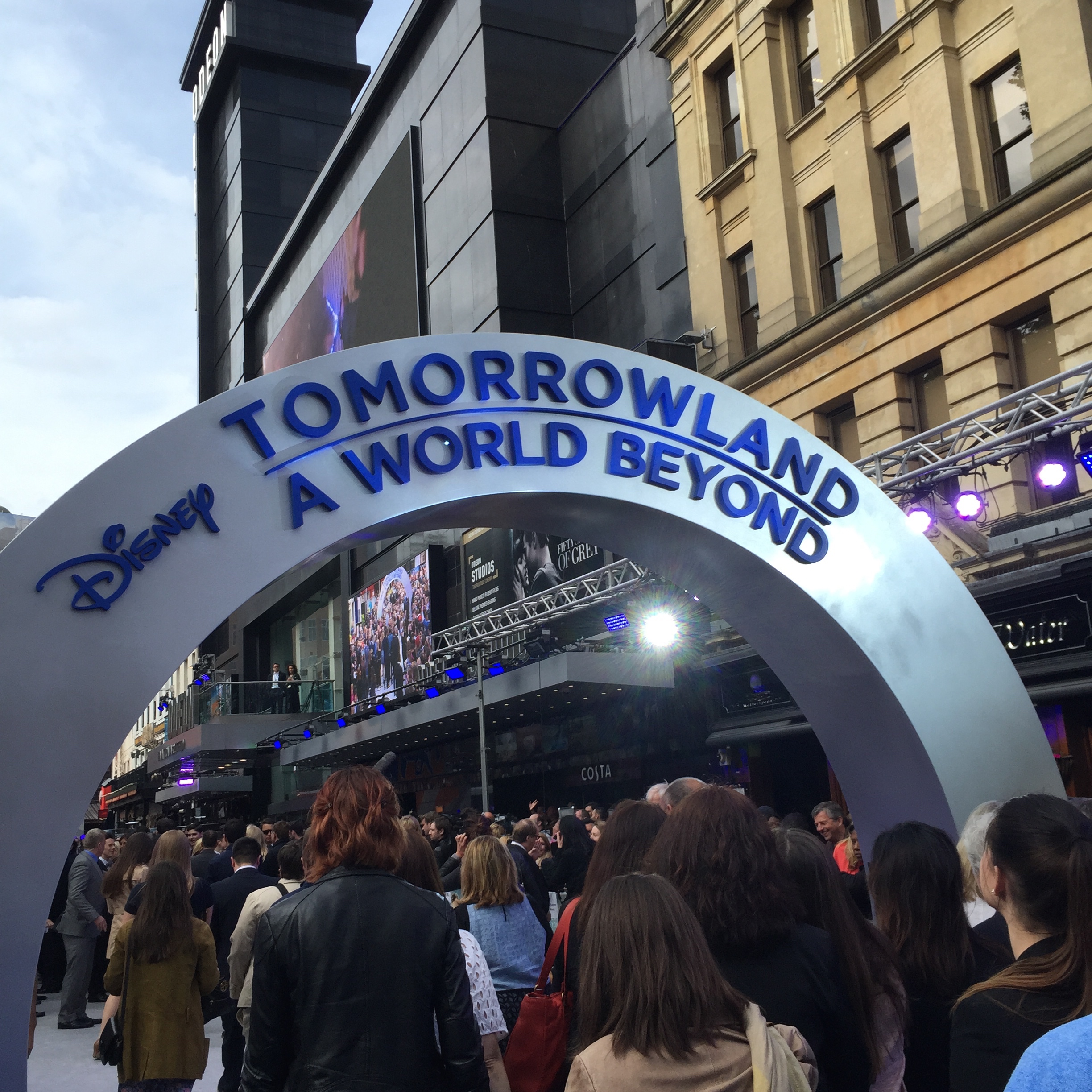
Film review: Tomorrowland: A World Beyond European Premiere

Me in my genuine 1940s finery with my genuine, erm, 2015 Haunted Mansion souvenir.

Me in my genuine 1940s premiere finery with my genuine, erm, 2015 Haunted Mansion souvenir.

For a film about the future, Tomorrowland: A World Beyond sure feels like stepping into the past. In this joyful retro-futuristic romp, The Incredibles director Brad Bird and LOST co-creator Damon Lindelof have created a relentlessly upbeat, Spielberg-reminiscent family adventure with its eyes on creating a great, big, beautiful tomorrow.

It’s 1964, and young Frank Walker is enjoying the sights and sounds of the World’s Fair, including Walt Disney’s It’s a Small World and Carousel of Progress. Everyone is looking ahead to a world of gadgets and gizmos aplenty; Frank himself is toting a new invention to enter into an innovation contest.

Fast forward 50 years, and Casey Newton (Britt Robertson), eternal optimist and tech nerd, is battling the closure of the NASA platform where her dad works and the negative attitudes of her peers and teachers, all forecasting doom and dystopia. It’s not looking good – until a strange vintage pin turns up in her possession…
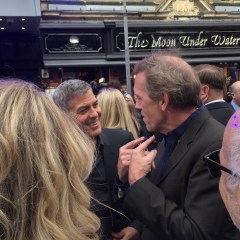
Hugh Laurie making people laugh? Never.

Hugh Laurie making people laugh? Never.

Tomorrowland (to use its simpler US title), rests on the premise that at some point post-1970 our outlook on the future went from chasing dreams to ducking nightmares. And looking at some of most popular and successful franchises around today – although, yes, dystopia in cinema is nothing new exactly – it’s hard to disagree. Somewhere along the line, our vision became more universally dim; less Jetsons, more genocide. And the disaster is invariably man-made. No meteror extinguishes our old-fashioned thinking; we’re dinosaurs on a collision course with our own greed – or worse, apathy. Tomorrowland explores what the world could be like if we rediscovered that spark of enthusiasm – and what that could mean for humanity now. But to have nostalgia for an imagined future, you have to go back to the place that future was envisaged from, and in doing so Bird has also tapped into the childhoods of his core audience; I felt more than anything like I was watching some of the classics of my own upbringing – but for the first time and without the dated haircuts. It was Flight of the Navigator, War Games… maybe even ET, only new and shiny.

Okay, I squeed a little.

Okay, I squeed a little.

In many ways, it’s a shame to give too many details away about Tomorrowland. To me it felt primarily like an old-school family adventure movie – although my daughter, not yet five, is not the key audience, I wouldn’t actually have any problem with her watching it – but also like a film made by Disney fans for Disney fans (but enjoyed by everyone else). Certainly a ride on It’s a Small World will never feel exactly the same… Crucially, though, Tomorrowland doesn’t just revisit the past for the sake of it and then wallow in nostalgic baby-boomery; it does attempt to move the discussion along beyond rediscovery, into action.
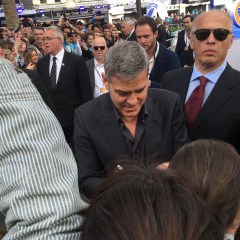
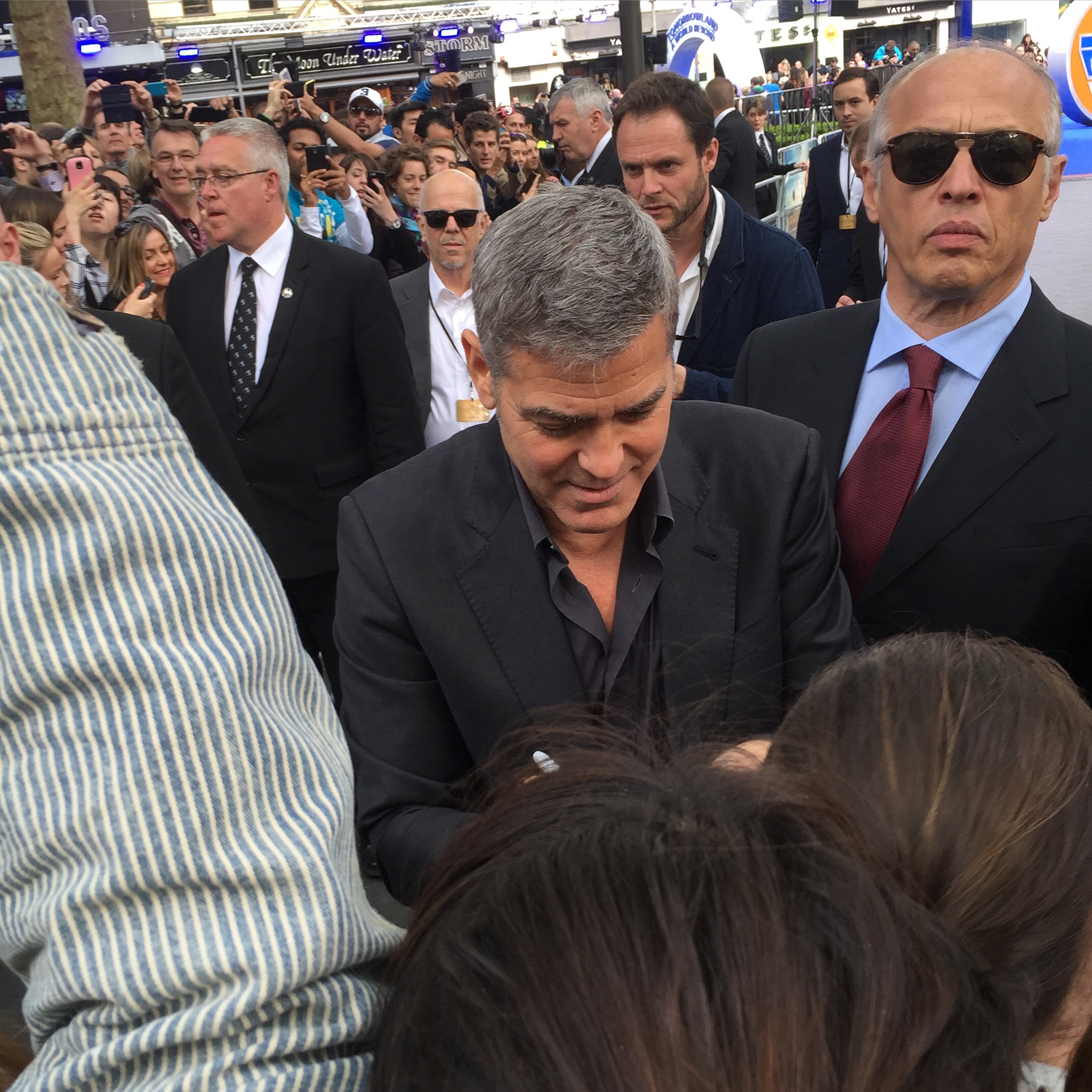
Clooney! The guy on the right = joy.

Clooney! The guy on the right = joy.

Just over four weeks ago, I was actually sitting in Walt Disney’s Carousel of Progress – and it was a really weird experience. For one, it was one of the few classic attractions I couldn’t remember from childhood; I’d completely blanked it out (or maybe we hadn’t visited? Seems unlikely, though; I remember every version of the Spaceship Earth narration since 1984 – we were that kind of family). Despite frequent updates until the early 90s, it hasn’t aged as spectacularly well as one might hope; progress by this definition largely meant technology – not people. All innovations are presented – as well they might be in view of the domestic preoccupations of 1964 – in terms of household convenience. Women are generally sewing or losing weight or gossiping on the phone, right up until the most modern, forward-thinking scene. It’s all a bit old-fashioned in a generally uncomfortable way. In Tomorrowland, the very essence of futuristic thinking is rooted in humanity, and progress is from the earth to the stars, not from the kitchen to the living room. Besides which, humanity is embodied primarily not in Frank – in spite of Clooney’s global star power – but in the body of a young female character who is not sassy or ditzy or seeking male approval or especially representative of anything other than being an intelligent teenage girl.

Do I look worried because Alex Zane is about to tap-dance on my husband's head?

Do I look worried because Alex Zane is about to tap-dance on my husband’s head?

Better yet – and here, I shall be deliberately vague – key relationships in the film revolve around another female character, the mysterious Athena (Raffey Cassidy). Impressively she is both the lynchpin of which the emotional core of the film and its coolest, most logical mind; it is Walker’s adult male that is the most unhinged and uncontrolled. When is the last time we’ve seen that kind of dynamic presented to young girls? I remember watching what is still one of my favourite films, Jurassic Park, and being utterly frustrated that seven-year-old Lex of the book, who had good reason to be scared due to her young age, had been turned into a snivelling teenager on screen, reassured about “veggiesauruses”. In Casey and Athena we have a couple of bright, shining examples of how a female character can be a character first and female second.

Few films are perfect, and Tomorrowland has its flaws – though I’d argue that most are a direct consequence of its strengths. For one, it is so invested in character and delivering its message that plot can feel a bit rushed; fully three quarters of the film is devoted to setting up what turns out to be a pretty fast pay-off. Still, I didn’t actually notice that until later, when Ramona asked me about the story (she’s something of a Joe Friday about these things). Unsurprisingly for a movie based on a themed land from one man’s dream, there’s a strong emphasis on individual, special visionaries needed to inspire the rest of humanity that I’m not entirely sure I agree with, but it did force me to think about it. Interestingly, the villain here – Hugh Laurie’s David Nix – is not actually outright evil for the most part; to be a bad guy here is to have had the optimism kicked out of you (bad news for Eeyore, I guess). When introducing the film, Bird had difficulty defining the genre into which it fits, because there isn’t just one; while that can be jarring at times, when the film takes an unexpected turn, it’s also refreshing.
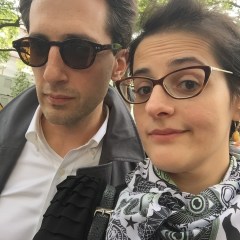
Smug people are smug.

Smug people are smug.

In the end, I found myself unwilling to pull at Tomorrowland‘s threads too hard because I enjoyed the whole fabric so much; it’s such a cosy blanket of positivity and hope that I couldn’t bear the thought of trying to unravel it. Also, I really, really want one of those badges.

Disclosure: To make the entire experience altogether more amazing, I was privileged enough to be able to see it at the European premiere, where I edged past Clooney and Laurie on the blue carpet (sadly nowhere near Bird, of whom I am entirely in awe) to the strains of There’s a Great, Big, Beautiful Tomorrow whilst wearing my favourite vintage dress and a Haunted Mansion scarf because apparently I CAN DO THAT NOW. I am very grateful to the lovely team at @Disney_UK who invited me along and made my week. However, I can assure you the thoughts above are entirely my own (and indeed, who else would want to claim them?).

Update: I’ve had MOAR THOUGHTS about Tomorrowland, and specifically the feminism and insight therein But there are spoilers. So tread carefully.

Non-spoilery thoughts about Avengers: Age of Ultron

I think of all the films that I’ve been excited about so far this year – and there have, ahem, been a few –  the one that I’d invested with the most lip-biting enthusiasm was this one. And here it is, and us British types got to see it A WEEK BEFORE the US (not over how long it took to get Big Hero 6 yet)… and I still haven’t actually written anything about it.

There are reasons. The first is that, as with The Avengers / Avengers Assemble (pick your favoured regional variant), the first viewing was more about getting my head around what the hell was going on; I’ll need to go again to really make sense of things, I think. The second is that practically all the things I want to talk about come with Veronica-sized spoiler warnings. I guess I’m safe enough letting those out of the bag now… Though I won’t.

Mainly, I came out of the cinema feeling like there had been some thrilling moments, some funny moments, some genuinely very touching moments and only a couple of really irritating moments (superhero territory: no matter how good the cast, crew, script etc, there’s going to be at least one clanging great sexist moment or something like it to really get up your nose; also, if Tony Stark is in the film it will involve him because on paper and on screen he is a truly awful person). I really liked that despite SO MUCH GOING ON, SO LOUDLY there was time and space for it to be surprisingly intimate. This was needed, since a mechanical villain is never going to have the emotional draw of a human(ish) bad guy whose motivations can be more complex, more personal and, perhaps, more forgiveable. Well, until he unleashed space-hell’s firey Godzilla-bildschnipe on New York, anyway. And there was the small matter of all those people he killed before that… wait, what was I saying?

Intimate, yes. Sometimes having your hand forced is a joy; being able to reinvent Wanda and Pietro’s background, removing Scarlet Witch and Quicksilver from specific associations with X-Men and Magneto, meant that that part of the story – and the reasons for the siblings’ dubious allegiances – could feel oddly real and plausible. For a film with an Internet robot and a flying city, anyway.

It’s funny, because people who know me IRL will know I can bore people stone cold sober with natter about these films (one poor soul got my full Shakespearean thesis on Thor by text) but it’s awfully hard to be remotely coherent when I try to make my writing sound more like a review and less like some really meandering observational routine from the graveyard shift at the comedy club. Obviously not trying that hard on this occasion, to be fair.

Anyway, sod it. It’s my blog, not a film magazine. I can write whatever I like. So I’ll end with a short and slightly disappointing story:

After the film, we went for a really nice meal in a Turkish restaurant we’d never tried before (no, we didn’t have schwarma). The waitress heard us talking about it and asked me if I could tell her who the voice of Ultron is since her flatmates are all crazy about this film. “James Spader,” I said, with the warmth that only having been alive to be in love with James Spader between 1986-1994 can achieve. “Who?” she replied. And I was just a little gutted.

That has nothing to do with the film per se, but that feeling of love and possessiveness being mildly punctured by someone else’s complete lack of immersion in the landscape? Sort of how it feels to talk about this stuff with people who don’t do superhero movies. So it’s felt pleasantly cathartic to write a little about it here where I have no idea if you care or not, but I’ve got to assume you were interested enough to get past the headline.

Right. Time to book take two, I think…

A brief personal history of Walt Disney World, with pictures

No-one who knows me IRL can fail to have heard about my family’s upcoming trip to Walt Disney World. It’s going to include quite a few members of my extended family, all packing our noisy selves into a villa barely seven miles from the Epcot parking lot.

I. AM. SO. EXCITED.

Now, I could write a whole lot of actually useful stuff about using My Disney Experience (excellent customer service when something weird – not Disney’s fault – went wrong with the tickets), booking FP+, making our Advance Dining Reservations including a date night at Le Cellier… but, you know, the world is already heaving with places to find that information. I’m totally happy to answer questions and share tips, but there are people who devote their entire lives to WDW holiday planning (not least the Disney Parks Moms Panel) – more people than you can shake a stick at, frankly. And instead, I just want to share my excitement through photos.

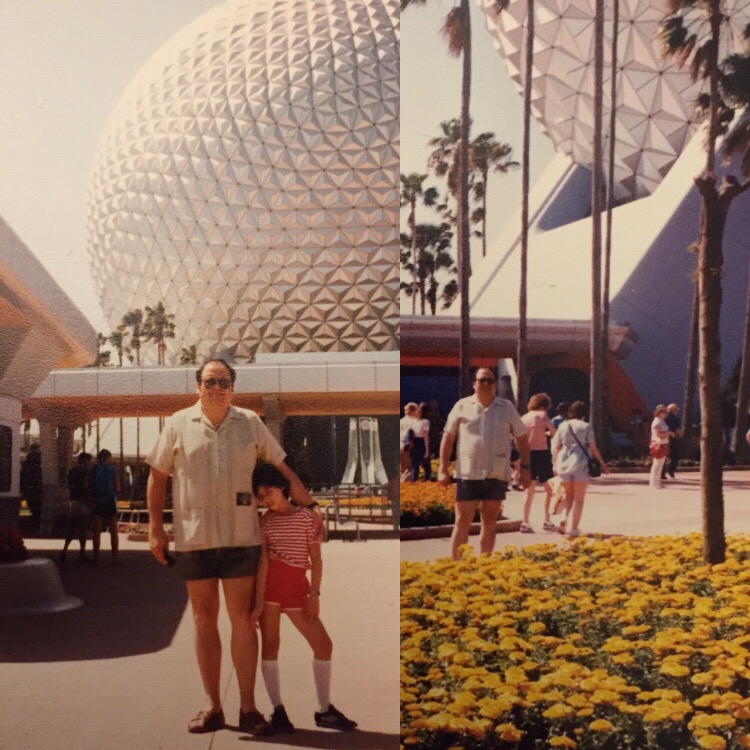
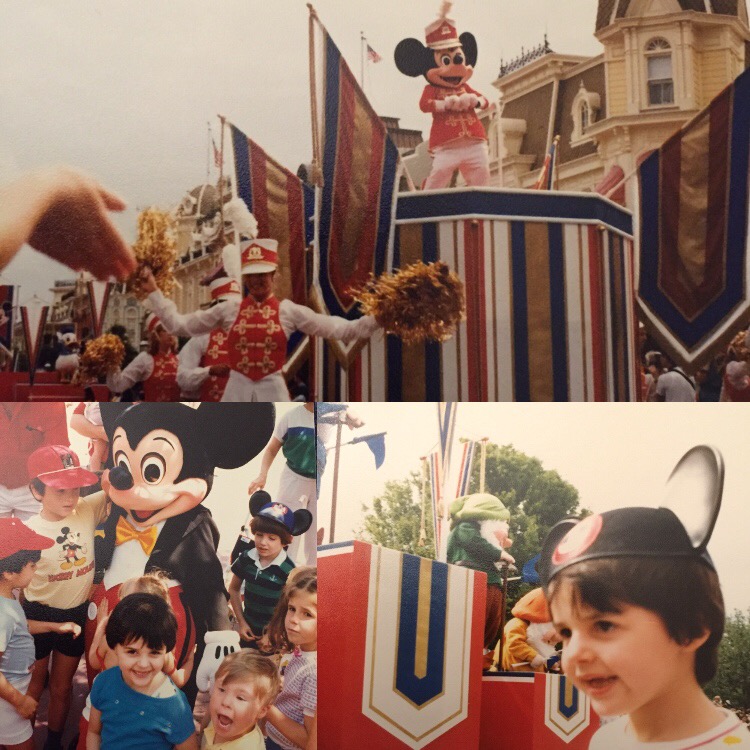
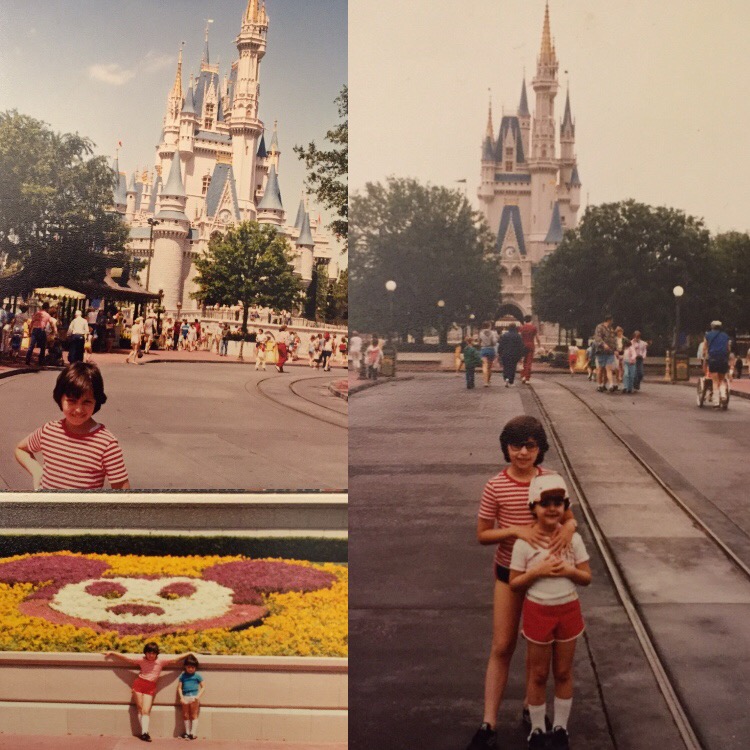
Don’t get me wrong, I know things have changed. Obviously things have changed. I mean, my Dad labelled one of the photos below as “E.P.C.O.T. Center” (yes, with the unnecessary dots and yes, he can still tell you what it stands for). There are attractions that are never coming back (we don’t have to name The One; come to think of it, maybe we all have a different One). There are attractions that are changed beyond recognition, sometimes for the better, sometimes not. The place that I fell in love with when I was four is not the same place that my daughter, aged four, will now fall in love with. There’s a part of me that’s a little sad about that, but it’s a mistake to ever try to recreate your experience in your child; you are not the same people. It is not the same time. And, as for yourself – well, you can never really go back. I’ve made my peace with that.

But I’m also aware – and, honestly, grateful – that I will carry with me the rose-tinted specs of 1984 and see things through that lens. The new memories I create will be drawn on the top of the ones that are already inked on me, a hundred hidden Mickeys stamped all over, invisible but indelible, each layer smudged, blurred but never wiped out over time.

This week, I found these photos from my first visit. They are the set which went with this one.  They make me very, very happy. I cannot wait to have the uniquely wonderful experience of seeing it all unfold through R’s eyes; I got a hint of it at Disneyland Paris, but this is it – the Mother Ship!

And no, I will not be wearing short shorts.

IMG_5179

IMG_5180

IMG_5181

Film review: Cinderella and Frozen Fever

Ramona meets a prince and checks out a glass slipperIt feels faintly confessional to declare I bloody love Kenneth Branagh. I do. I think he’s great. I love his acting. I love his direction. I love that he brought us Thor (and, via the marvellous Wallander, Tom Hiddleston). I love that he was married to Emma Thompson. And even though I really, really wanted Toby Stephens to be cast as Gilderoy Lockhart, I love that he’s a part of the Harry Potter film universe. So I didn’t need a whole lot of convincing to watch his take on Cinderella.

And to top it all, I got to be among the very first people in the UK to get to see Frozen Fever, which has nothing to do with Kenneth Branagh, but is basically me bragging. Sorry. Ish. More on this later (or you can just scroll to the bottom).

Branagh’s Cinderella is a live action retelling of the fairytale; it doesn’t have a particular  alternative spin, a la Maleficent, and – wisely, in my opinion – it doesn’t really seek to do much more than reinvigorate a well-loved tale. Disney’s animated classic, still looking gorgeous at 65, is one of the gentlest of the whole stable, with relatively little peril and a liberal sprinkling of glitter and stardust – in fact, it’s said Walt’s favourite bit of animation was the dress transformation. Branagh restrainedly doesn’t attempt to layer too much onto that and goes instead for a very traditional family movie, marrying a sweet, intimate script peppered with British quirk to the visual sumptuousness of a Hollywood blockbuster.

Ramona gets her nails painted a glittery blueIn fact, so lavish is the imagery – particularly the mindblowingly gorgeous costume design – that only an excellent cast could avoid being swallowed up by it. While Lily James is a bit too breathless for my preference – kindness doesn’t have to mean a lack of gumption – Richard Madden is appropriately charming and Cate Blanchett, in the accurate words of my husband “becomes more beautiful and more intimidatingly talented with every role”. Her Lady Tremaine is wonderfully nuanced and even a little sympathetic, swinging smoothly from uncontrolled bursts of rage to icily arresting viciousness. In this she’s ably assisted by the secondary villain, a megalomaniac aristocrat brought to scheming life by Stellan Skarsgard (yep, love him too) and Holliday Grainger and Sophie McShera in gloriously grotesque form as Anastasia and Drizella – in fact, I could have done with even more of the latter pairing.

Ramona, the Prince and me.The show is, however, stolen by the special guest star; Helena Bonham Carter opts for feather-light British eccentricity with a touch of sly humour as the Fairy Godmother; her soft voice shepherds us through the heavily narrated action and her eventual appearance involves plenty of daft physical comedy, making gleeful use of elements like her bizarre choice of vehicular vegetable. She lifts the pace of what is a surprisingly long movie and keeps it from sagging at the centre, providing the off-beat heart of the film. Injecting a little more drama into the magic also sets up a lively and welcome stroke-of-midnight set piece, which, with its ‘princess’ trapped in a shrinking pumpkin, has more than a whiff of Alice about it.

From the largely home-grown cast to the indulgent little asides (a Rob Brydon cameo that wasn’t for me, but that seemed to land well with the rest of the audience), this felt like a very British effort, and it’s that layer of deliberate quirk that brings it to life and makes it a highly watchable, sweet and very, very pretty family film.

The four-year-old’s verdict: It was good. I think it’s better than the cartoon. Cinderella was nice. It was a bit long though and I got tired. There were some funny bits [she laughed during the painter scene, and at the animal transformations].

Family note: Aside from two – very gentle – depictions of death and, of course, Lady Tremaine’s acerbic treatment of Cinders, there’s little to worry about here for even the most sensitive child. Definitely a full family friendly film (I like alliteration).

Cinderella is on general release in the UK from March 27th.

—–

And now, Frozen Fever. Well, it certainly has its moments! Without wishing to give too much away, the action unfolds on Anna’s birthday where Elsa’s attempts to give her a celebration to remember go a little awry (think Tangled Every After with more snow). There’s a new song to enjoy, and plenty of Olaf gags, plus cameos from practically every character you’d want to see. Ramona watched avidly and chuckled out loud a few times, as did I. And it was nice to hear Jonathan Groff sing a little about something other than reindeer…

Disclosure: The kind folks at Disney UK provided screening tickets including the funtimes shown above; thoughts about the film, however, are entirely mine.

Big Hero 6: The four-year-old’s verdict (and the merchandising)

IMG_1264

(For my review of the film, pop over here)

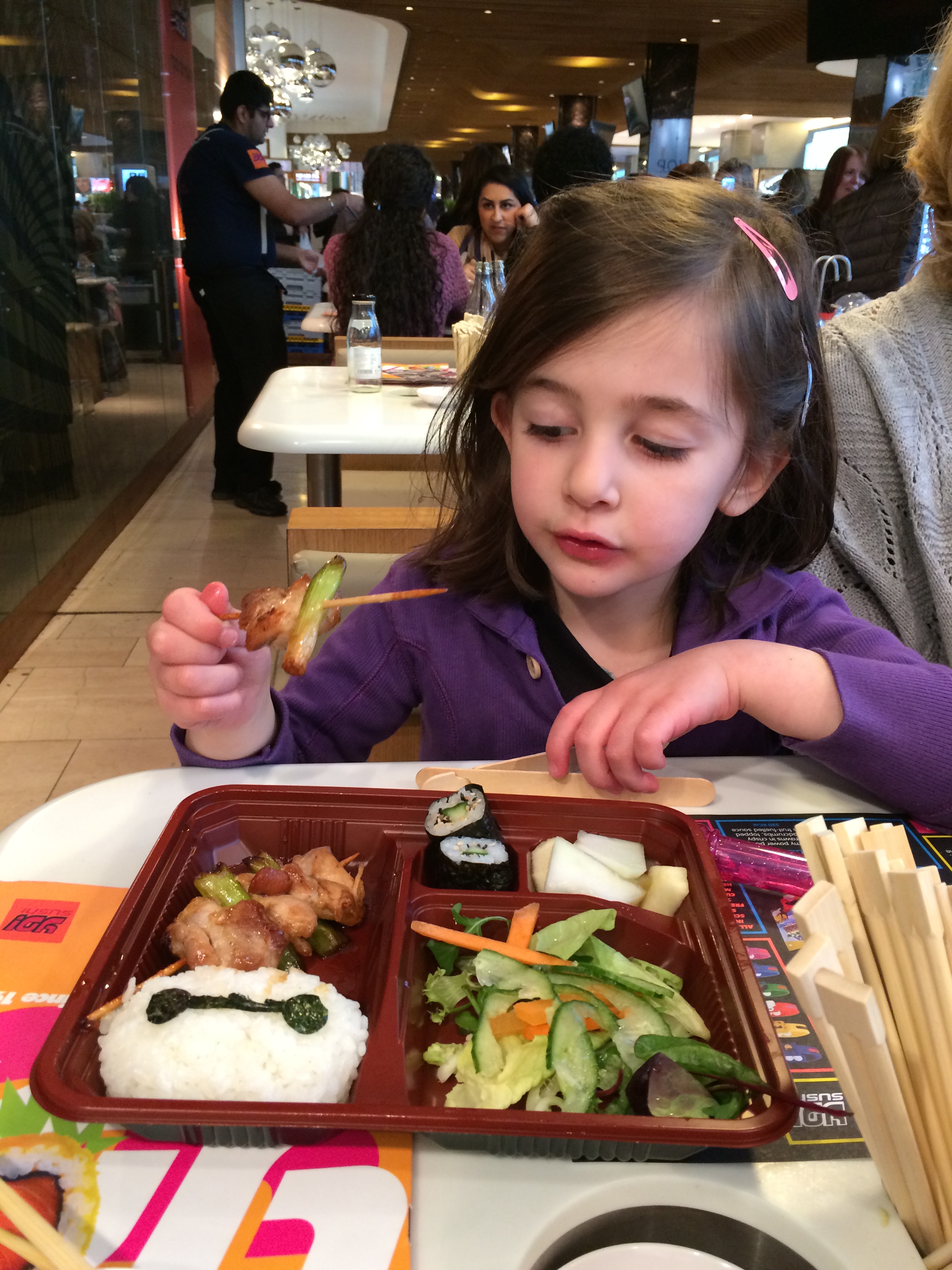
Children are often a peculiar mix of heart-stopping fearlessness and weird phobias, and mine is no different. Although given half the chance she’d be an unrepentant square eyes for huge periods of the day, she’s very up and down about new films and tends to be a bit wary of the cinema. This weekend, I tempted her into a viewing of Big Hero 6 using popcorn as bribery and the promise of a little reward afterwards if she was brave; it was also our opportunity to use a Yo! Sushi voucher we’d be given for a themed meal, and she was already proudly wearing a yellow GoGo Tomago wristband.

These were her reactions:

“That was funny when that robot hit that man in the face!”
“Wow!”
*waves her arms around dramatically* “I’m being GoGo Tomago – like on my bracelet!”
“Imagine if you could fly like that, Mama…”
“Is ‘Lemon’ Honey’s last name?”
*lots of giggles*
“I thought that was really COOL!”
I’d primed her that she could look away or duck out if it got too much for her, but she only dived into my arm once, for less than a second, at a close up on the villain’s slightly creepy kabuki mask.

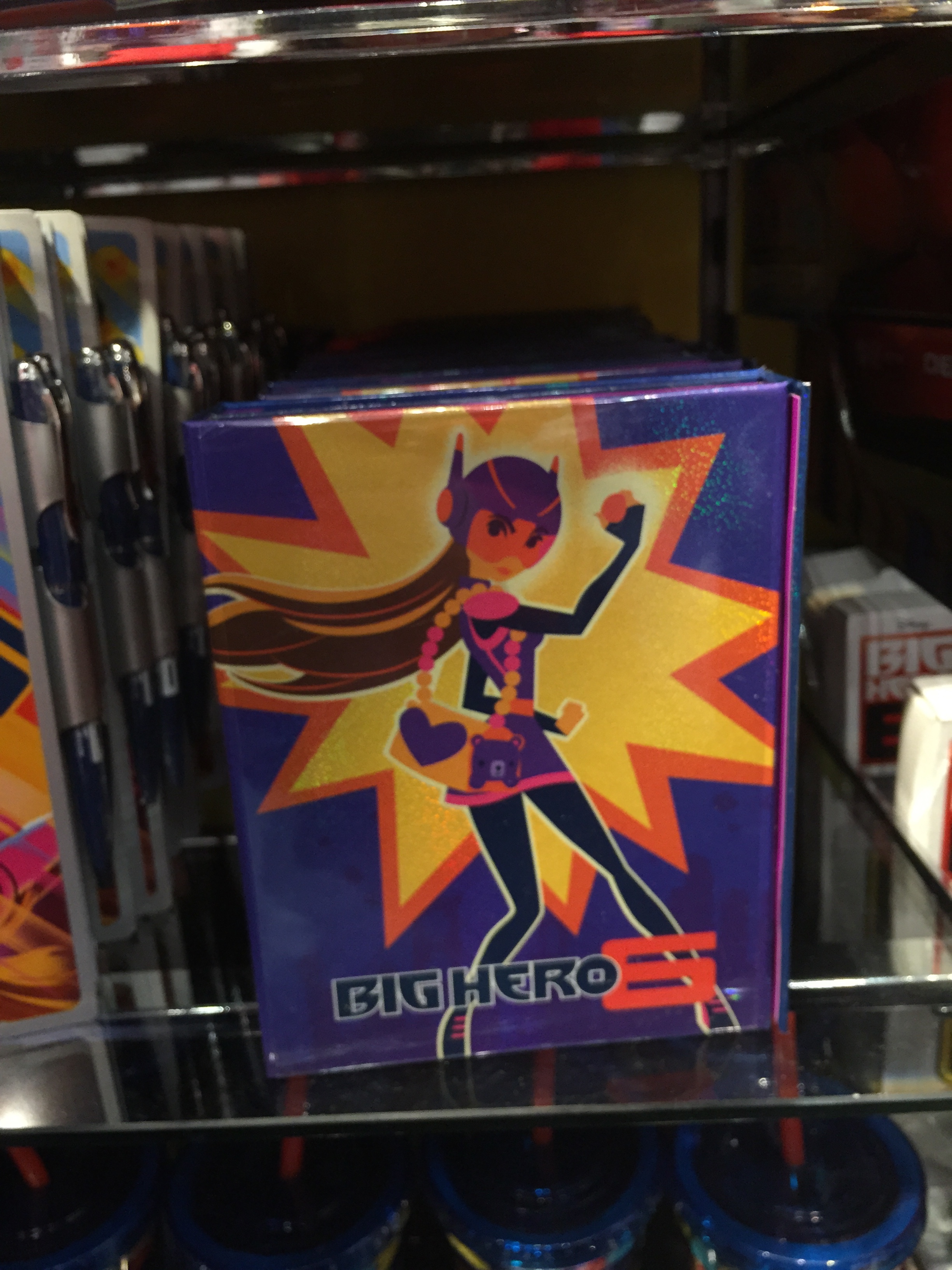
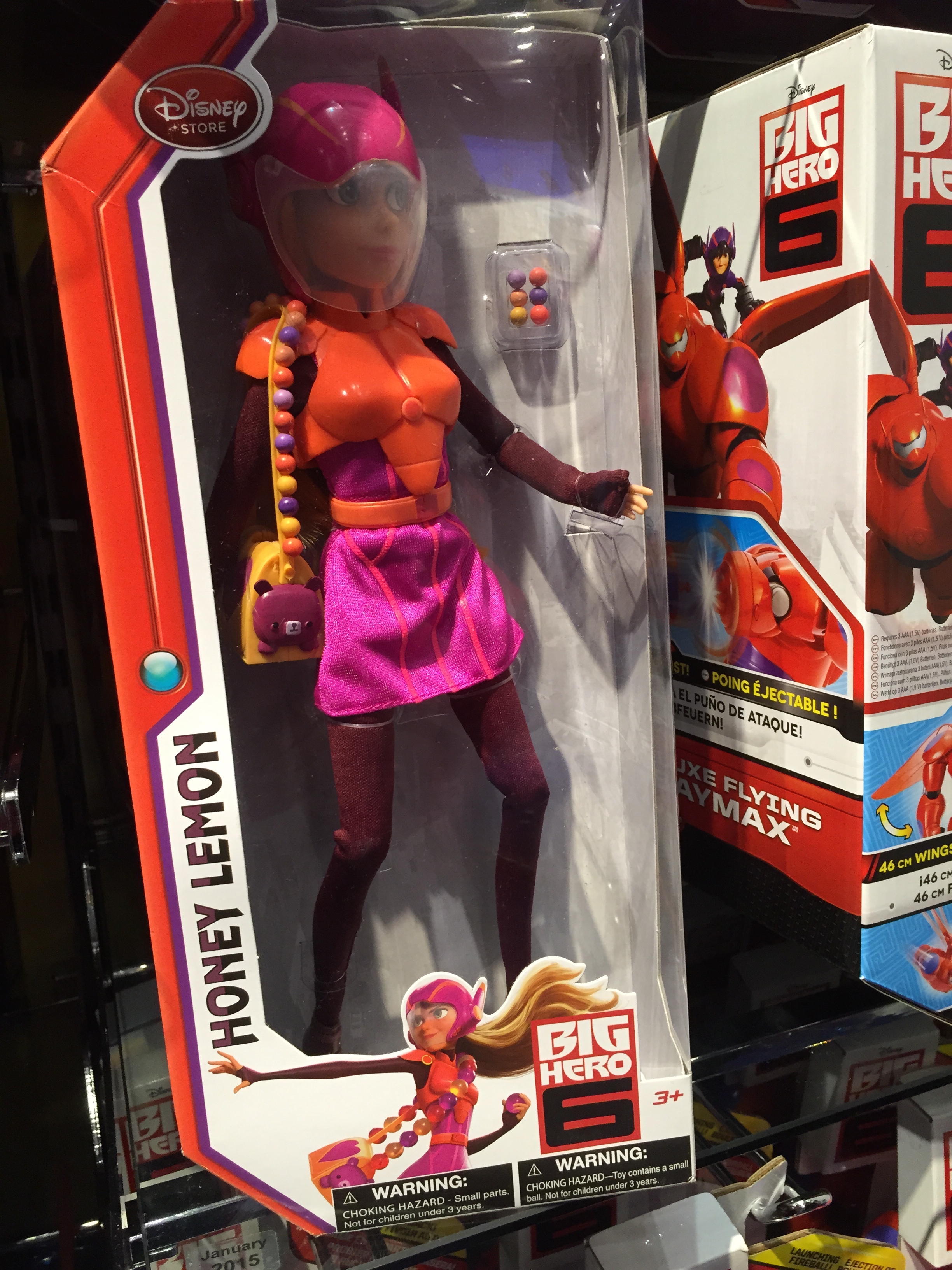
Afterwards, we popped into the Disney Store, where she chose a small Honey Lemon figure to play with (not the one below). I’ve mentioned before that the women of Big Hero 6  are in general more diverse and widely represented than in previous films; having my daughter play with in a brave, kind Latina scientist who is applauded for what she does, not how she looks, feels good. Casting an eye over the shelves was also reassuring – although Frozen and Marvel superheroes were at opposite ends of the store, all the Big Hero 6 merchandise was together, female and male characters mixed up, with the women shown in action poses on the packaging. I was pleasantly surprised to find a journal set with Honey Lemon on the cover that wasn’t sequinned or pinkified. GoGo’s doll figure was sold out this time, but I’ve seen it before with properly built up leg muscles to reflect both her animation and the fact that she’s a runner and cyclist. When you visit the website, the t-shirts and pyjamas are simply labelled “for kids” (and FYI Disney, this adult would LOVE a Baymax t-shirt if you’d consider sizing up in the UK and not just the US; maybe not this one though, given my proportions…).

IMG_4685  IMG_4686

Disclaimer: This was just a family day out, but the Yo! Sushi kids’ meal was courtesy of the screening goodie bag at which I first saw the film.

Film review: Big Hero 6

IMG_4577By now, it’s likely you will have seen posters featuring Baymax, a portly inflatable robot, and probably watched the trailers of him footling gently behind a football that remains just out of his reach. The question, of course, is if this evidently charming and unlikely superhero’s sweetness can provide a solid core for the latest Walt Disney Animation outing- and the first to use one of their Marvel properties.

In a word: yes. In a few words: a thousand times yes. Baymax (voiced gorgeously by Scott Adsit) is a beautifully realised creation – a ‘personal healthcare companion’ created by idealistic nerd Tadashi Hamada and inadvertently bequeathed to his younger brother  Hiro  (Ryan Potter) after a terrible tragedy. Baymax’s relationship with a slowly recovering Hiro forms the essential core of a film that – while it has many fast-paced sequences and explosive exchanges – is in many ways a tender love story. It packs in the brilliant irreverence and humour of a Marvel adventure, but tempers it with lashings of heart. In fact, what it reminded me of most was ET.

IMG_4590The beautiful setting of San Fransokyo, a near-future East-meets-West mashup, is somewhere I instantly wished I could visit, crammed with touristy cable cars and cherry blossoms but also with a seedy backstreet or two so that it felt just real enough. Hiro’s life is also a welcoming mixture of the mundane (familiar forms of transportation) and the ridiculous (his carbon-fibre 3D printer). The film eagerly champions geekery and also acknowledges the inevitability of failure; at some point every character finds themselves in a bind they have to think – not just blast – their way out of. And there are plenty of fanboy references to keep the nerdiest fan entertained (I can’t have been the only person who flashed on Tom Fitzgerald’s Horizons legacy when Hiro announces of a new invention that “if you can think it, they can do it”).

IMG_4576A review of this would be incomplete if it failed to mention one of the things I was most heartened by, which is that Big Hero 6 does more to advance the position of women in the Disney Animation stable than anything that has come before – even Wreck It Ralph and, yes, Frozen. The latter certainly did its bit to advance the princess narrative but in the case of Big Hero 6 there are strides made in abundance. The title refers to a superhero crew made up of a ragtag band of nerds from a university science programme; two of them are female, and each in her own way defies expectation. While Honey Lemon (Genesis Rodriguez) is fond of stilettos and pink, she is also obsessively pedantic about science and unashamedly smart and capable. Speed-obsessed Go Go Tomago  (Jamie Chung) bats the boys out of the way, demonstrating her impressive physicality and barking at them to “woman up”, but never becomes a Strong Female Character stereotype, showing a full range of emotions.

This trend continues outside the heroic sextet. Hiro and Tadashi’s Aunt Cass (Maya Rudolph), raising them since the loss of their parents, is a loving parent but not necessarily a natural one; she also sinks time, passion and love into running her own business. Dropping in to Tadashi’s lab for the first time, Hiro ambles past quite a few women tinkering away alongside the men – and a number of experienced scientists featured in the film are female. Best of all, I’ve already noticed this reflected in the merchandising, with the female characters displayed among the men, in fighting poses, and with their physical features represented – such as Go Go’s muscular legs. And as for the boys? Well, most of them are shown as eschewing unnecessary violence, offering affection and exhibiting fears; my favourite, Wasabi (Damon Wayans, Jr) is a welcome and genuinely funny mixture of insecurity and swagger.

Given that this balance is at the core of each character, its no surprise that the real power of Big Hero 6 lies in its essential humanity. Every element of it is rooted in relationships – in love, in loss, in revenge and in redemption. These are weighty themes for the most youth-focussed of Marvel outings, but in many ways the naive directness of childhood is what makes it so perfect a medium for this message.

Beautiful, smart, moving and funny; I couldn’t recommend it more.

Big Hero 6 is on general release in the UK on January 30th. It is preceded by an insanely adorable short, Feast.

Parental advisory: I have a nervous 4-year-old who needs gentle leading into some films so I pre-vet them for her. In terms of scary moments this is quite manageable; there’s a spooky-looking villain and a lot of loud fights, but no teeth-and-claws scariness. There is a great end-credit sequence worth getting through the wriggling for.

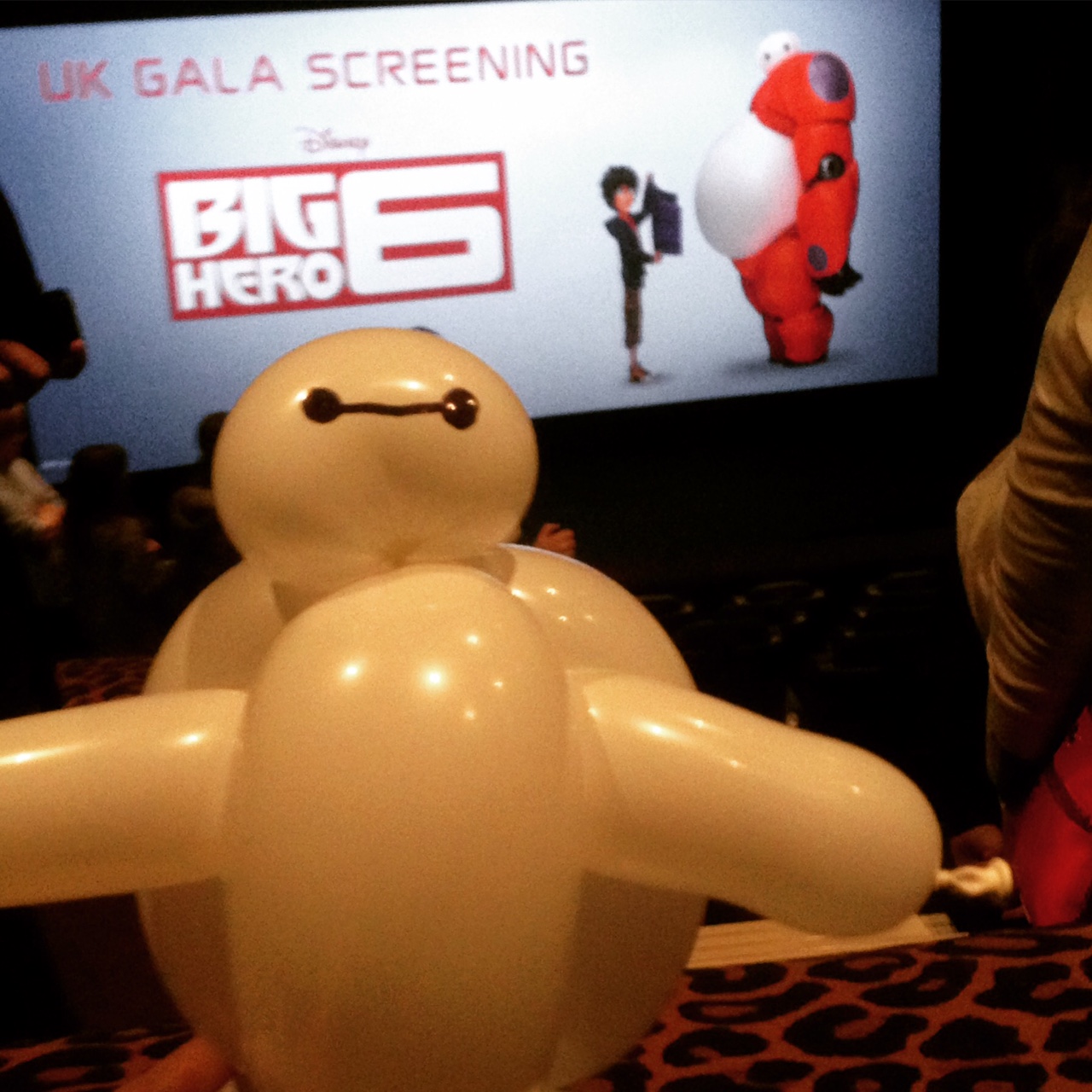
Disclaimer: Disney UK kindly provided tickets for the UK gala screening where the above funtimes were had, and there were some cute snacks provided by sponsors. Opinions are entirely my own.

Film review: Into The Woods

It’s almost impossible in the world of teasers, trailers and special features to go into a film without knowing much about it. Even harder when the film is an adaptation of some other property – in this case a well-known and well-loved Sondheim musical. However, as with all people I have some black holes in my cultural references, and this was one of them. I was hugely excited to see a film where I didn’t know much more than  a) it was a musical with fairy tale elements and b) a whole bunch of incredible people had been corralled together to do it – all in the UK in and around Shepperton, no less.

Usually, going in blank is an incredible bonus; here, unfortunately, I think it confused me because I left still not entirely sure I understood the film as a whole. Not the plot – that’s clear enough – but the overall vision stitched together out of gleaming but very distinct threads.

The tale is of a Baker (James Corden) and his Wife (Emily Blunt) who set off into the woods to obtain elements from different stories – the collective power of which will restore their ability to have a child, following a curse laid on the Baker’s house by the mother of the local Witch (Meryl Streep). As their desperate search unfolds, they cross paths with a precocious Little Red (Lilla Crawford), a dim-witted boy with a propensity for stealing from giants (Daniel Huttlestone) and an indecisive Cinderella (Anna Kendrick), among others…

There are at least two excellent stories here; one, the tale of a marriage reacting to the stresses and strains of infertility and the promise of parenthood in the shadows of an unfortunate past, is driven by a constantly watchable Emily Blunt, whose voice and presence are beautifully dominant. When she leaves the screen it’s like a light going out, and it’s quite funny to consider the position she was in the last time she shared a screen with Streep. Mixed in with this is a stirring, darkly funny satire about fairy tales, in which a brace of preening princes – “I was raised to be charming, not sincere” – flounce their way through the forest in scenes that wrung belly laughs from the audience. Chris Pine in particular is an absolute revelation; I’ve always been a bit so-so about his Kirk, but he won me over completely here. Somewhat unsurprisingly, given the calibre of the cast, performances across the board were great, with the big stand out for me being 13-year-old Lilla Crawford, imbuing the precociously dreadful Little Red with real depth of character – and occasionally showing some of the adults how a real belter of a musical number works. I did keep thinking young Huttlestone was going to burst into an audition piece of Consider Yourself, but enjoyed his scenes with his overbearing mum (the always marvellous Tracy Ullman).

In terms of key musical moments, hearing that Stay With Me has been bringing people to tears left, right and centre is no surprise – it’s beautiful. Pine and Billy Magnusson’s Agony is hilariously perfect, and, if it’s not obvious yet, I was pretty much sold every time Blunt was on screen. I think I might want to be her when I grow up.

If I had a problem with the whole, it was in not quite understanding how it all hung together in terms of pace and tone. I could practically see the scenes as they would be rendered on stage – this little cluster of dialogue under a spotlight here, suddenly switching to a group over there, then back and forth – but I couldn’t quite get to grips with these sudden jumps on screen. I think this is something of a hallmark of Rob Marshall’s films – he applies his wealth of theatrical experience to a film and sometimes it really, really works (Chicago) and sometimes I’m not sure it does (Memoirs of a Geisha). I’m left dying to see a stage production so I can understand this in its natural habitat, and really get to the heart of Marshall’s vision.  I now understand this differs in substantial ways to the original production, albeit with Sondheim’s blessing; I’m a great believer in being quite brutal with adaptations if it fits the intended medium better, so I just wonder if Marshall could have sliced and diced even further. I do think the film is at its best in a cinema; it needs the grandness of the dimmed lights and the group experience to really bring out its best.

In the end I was left feeling intrigued, and surprisingly uncertain; I’m usually very opinionated on what I’ve seen but this left me outside my comfort zone – no bad thing, in fairness. I am very glad I’ve seen it plus I haven’t really stopped humming since (warning for Sondheim newbs – it’s the continuous-recitative-with-breakout-numbers type of musical, not the dialogue-interspersed-with-songs type; nothing wrong with that, but you should know if you have any strong preferences in this area). I’m really curious to see how the general reception goes in the UK, given it’s slamming through box office records in the US where it opened back on Christmas Day.

Into The Woods is on general release in the UK from Friday, 9th Jan.

Disclaimer: my thanks to @Disney_UK, who provided two tickets to the screening last night. Thoughts and opinions are my own.

2015: My Film Year

So, 2015’s Year of Asking is already shaping up rather nicely. I’ve used it to book into catch up dates with three people I’ve been doing the “let’s do tea” dance with for far too long. I contacted a brand with a cheeky request and it paid off. Basically, we’re a week in, and it’s all looking pretty good.

So, for a more fun resolution, or goal (the word we use when it’s not a resolution, just a goal, like it’s not a diet, it’s a healthy eating plan) or just general hope for the year, I’ve realised that film – something I used to be seriously into, but which kind of fell by the wayside with time and parenthood – has muscled its way back into my sightline. Okay, it’s far more blockbusters and far fewer indies (not because I don’t like them, but just because time means I have a more superficial grasp of what’s happening – and since Ramona there’s a certain amount of misery I can no longer take). But who cares? This is my year of film, and I don’t need to justify my taste or choices to anyone other than myself, and whichever poor sap I force to come with me.

So, here is my list of things I want to see this year. It will grow, undoubtedly, and I’ll try to remember to come and tick things off as they happen, or link to reviews if I scribble them. Although they’re simply in alphabetical order (projected release date order just got too messy), the ones in bold are the ones I’m OMGSUPEREXCITED about, so are the most likely to actually get watched asap… though it also assumes that those in the latter part of the year will see their UK release before 2016.

Ant-Man – watched
Avengers: Age of Ultron – thoughts
Big Hero 6 reviewed
Birdman – watched 
Cinderella reviewed (plus Frozen Fever)
The Dreamer (now known as Walt Before Mickey)
The Fantastic Four
Far From the Madding Crowd
The Good Dinosaur
High-Rise – reviewed

Inside Out – reviewed
Into The Woods – reviewed
The Jungle Book
Jurassic World – watched
Mistress America – not reviewed but utterly marvellous
Mockingjay Part 2 – watched
Mr Holmes – watched
Pan

The Peanuts Movie – watched and loved
Star Wars VII: The Force Awakens  – watched
Suffragette – reviewed after the BFI Opening Night Gala
Testament of Youth
The Theory of Everything – thoughts (with thoughts on Only Lovers Left Alive)
Tomorrowland – reviewed after the European premiere! Also some (slightly spoilery) further thoughts
Trumbo – reviewed after the BFI LFF gala

Am I missing something really obvious you think I would like? Bear in mind that I do also like quiet, lovely or clever little films (as well as loud, explosive or clever big films) but can’t really be dealing with horror (soz Crimson Peak – Hiddleston almost won out, but no). I’d love to hear suggestions that would help broaden the list a bit or introduce me to something I might not otherwise have thought of watching.