Dogs Trust Waggy Walks launched with help of Prettier Pixels

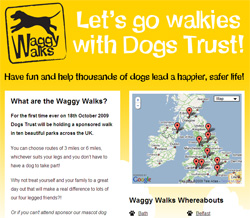
Waggy WalksJust over a month ago, a web designer called Alex sent us a message through his @prettierpixels company account on Twitter, offering to volunteer some time and help us build a WordPress blog. Somehow, five or six weeks later, we have a beautiful new website, Waggy Walks, promoting a big sponsored dog walk for Dogs Trust. I’ll be there, and am negotiating to have my husband on a collar and lead, so do go and visit the site to find out more / sign up to take part…

WaggyWalks was built on MicroSimple in the end – a new CMS being developed by Jamie Knight which is ridiculously easy to edit. This was helpful as there would be multiple non-web savvy users needing to add updates and the more straightforward the better.

Alex spent quite a few hours reconstructing the design from flyers another designer had produced, putting the site together, redirecting URLs, sorting out registration forms, setting up and testing emails, making last-minute changes to the original brief and getting it all working beautifully for us. He also found time to advise and help Jacqui and me as we re-built the website for the International Companion Animal Welfare Conference (ICAWC).

We’re so grateful for Alex’s hard work and expertise, and would recommend Prettier Pixels for any design and development work (particularly using WordPress) that you need. He’s incredibly helpful and fitted all this into the day job. Although he volunteered his help this time, his rates are really reasonable considering the amount of effort and perfectionism he puts in.

Many thanks must go to Alex and also to Jamie for the use of MicroSimple. Now we’re just looking forward to seeing more and more people sign up for the Waggy Walks event. You don’t need to have a dog (if you check out my blog header you’ll notice I don’t!) and if you can’t come to any of the 10 nationwide events you can still take part by sponsoring the Mascot Dog, whose name, chosen by our online communities, will be announced shortly.

Media Trust Twitter for Charities Event (July 2009)

Yesterday Jacqui and I pootled over to Millbank for a Twitter for Charities event organised by Media Trust and chaired by the voice of common sense, Rachel Beer. If you’re on Twitter and want to follow Media Trust events, search the hashtag #mtevents. It serves for all.

This was an exceptionally good conference for a number of reasons:

  • It was short, sweet and to the point
  • It was focussed on one tool, which made it easier to keep on topic
  • The speakers, Rachel Beer and Daren Forsythe (formerly of the BBC & Media Trust) were excellent
  • Fellow members of the panel, Carly from Elephant Friends and Fliss from Media Trust had great case studies to mention
  • The questions were intelligent and prompted good discussion
  • A member of senior management was there! Joy!

I honestly believe that the next stage is holding conferences not just for the people who are using the tools – surely those should be practical workshops, really – but for those who need to be convinced that their team should be using them. We need to be talking metrics, successes, importance and, yes, pitfalls with the people who have ultimate responsibility for communications, fundraising and marketing.

Anyway, here were some things that came out of the day that I thought were worth mentioning as they are critical to understanding the role of social media and using social tools effectively:

  • You don’t necessarily need a social media policy (though some comms guidelines are fine). You do need an integrated, comprehensive and positive policy for communications, fundraising and marketing.
  • Twitter is not an objective. You use Twitter as a tool among many to meet your objectives.
  • If you’re unclear about your objectives, wait until you know what they are before using the tools.
  • Having a positive statement of what you can do online (perhaps an ‘our voice’ statement instead of a ‘policy’) is much better for all concerned than a negative policy. Rachel here sited Intel’s example of rules of engagement.

All of this, once again, proves that my conviction that social media is another avenue for responsive customer service is well-founded. And I’ll continue to believe that until I have any sort of compelling reason not to.

Conferences: Institute of Fundraising South West and Gorkana Sky News Briefing

Thursday and Friday saw two very different kinds of professional exchange about social media. On Thursday around 75 non-profit based delegates came to Bristol’s light and airy Southville Centre to exchange their knowledge. On Friday, a cluster of PRs came to listen to Sky News online editor John Gripton and last-minute no-show ‘Twitter Correspondent’ Ruth Barnett (@ruthbarnett) talk about scanning networks for news. These are my thoughts.

Although Jacqui presented a case study at the IoF’s southwest gathering that’s much the same as the ones we’ve done before, the questions were surprisingly different. As we do the Q&A together, I found myself talking far more about how we decide which networks we break which stories on, the penalties and privileges of running our own network and the cons and – in my opinion non-existent – pros of sending automatic messages on Twitter. Even better, we also got to hear case studies that we haven’t seen listed on the conference circuit thus far.

The most interesting of these was from Comic Relief. Of course as a one-off event every two years (with newer Sport Relief in between), fundraising is far more straightforward for the team than it is for a 365 operation. But interestingly, having harnessed the power of social networks to spread the word, the Comic Relief crew discovered that this obliged them to create a 365 persona: a huge crew of supporters is now waiting to be treated as long-term partners, not brief donors. They also found the online giving through networks was not that high (online giving generally was, but that was the inevitable movement from phone lines to broadband). And though their social media strategy seemed finely honed and planned, a lot of it was ad hoc and working it out as they went along, with help from agencies.

That was thoroughly heartening. For a start it means that even a big organisation that deals in many, many millions at a time doesn’t get everything right first time. But much of what they did was not expensive or complicated, it just required a lot of tenacity and perhaps the clout of a big name. Now they’ve opened the doors – getting mobile networks talking about customisable phone donations, for example – why shouldn’t any other charity with a creative, committed team not benefit? A huge budget is not required, or even desirable. Networks are far more about awareness, marketing and customer service than they are about fundraising, but occasionally the two can come together for the benefit of all concerned.

There was also an opportunity to listen to a talk about The Big Give, an innovative donation-matching scheme pioneered by recruitment don Alec Reed. Matching major donors with projects – not, crucially, charities – it also runs a fundraising drive where the first £1m of donations is matched by The Big Give pot. This, they’ve found in their research, makes supporters (isn’t ‘donors’ a loathesome word? So cold, and almost inaccurate) more generous. This year they’re trying a slightly more complicated scheme where the charities raise a certain amount before the major drive, it’s matched and then there’s the big fundraising event with more to be matched – read about it on the site, it makes sense eventually! Since the last Big Give raised £2m in 45 minutes, it’s definitely one to watch.

Friday’s gathering was very different, and a little disappointing. On the one hand, it was a great opportunity to get an idea of the best way to contact Sky’s online team and get interesting stories to them. On the other hand, much of it was very much common sense e.g. don’t call to ask if someone’s got your email. That’s PR 101 and it’s old-fashioned ‘get on the phones’ bosses that need to be told that, not the jobbing PRs caught in the middle. Also, it was disappointing that there were no specifics about how they scan social networks for news. In a handy pre-recorded interview to make up for her unavoidable absence, Ruth said people should carry on doing their stuff online and she’d see it and decide if it was interesting enough to broadcast. But HOW would she see it? There’s so much out there. I tweeted her afterwards asking which tools, apart from hashtag searches and trending topics she used to search. We use the great Twilert, but are always keen to know of other conversation-tracking tools and would love to know how to get attention in all the noise on Twitter! That was on Friday and she’s not replied yet, but she does have to have weekends off, I guess!

Tools are the big focus for me, going into my second year at Dogs Trust. Tools for conversation-tracking, for influence-tracking (because that shows awareness – being seen as leaders is great and a bonus, but this is about doing our best for our charity). Solid metrics that are not only about the cash but about those sometimes hard to define marketing goals. We can’t fall into the fluffy charity trap. I’m also hoping to do some marketing qualifications and put into formal terms some of those things I already instinctively know, not to mention rack up some new things. It’s an exciting, forward-thinking time, where social media needs to be seen not as discreet, but as another avenue for good marketing and customer service.

Childfreeonline and the inevitability of tribal thinking

We all like to join tribes. Whether we’re joining online groups, heading to a meetup or even just gossiping with friends, we like to divide the world into ‘them’ and ‘us’. I’m certainly not the first person to observe this and I undoubtedly won’t be the last. What baffles me (and, I’m sure, myriad others) is why you would make a tribe out of something that is an individual choice…

I guess stories about kids are interesting me more than they otherwise might because I’m getting closer, slowly, to making a decision about when to have them myself. I’ve known for years I want to be a mother, and apart from some vague feelings of uncertainty in my early 20s, I’ve pretty much never changed my mind. I have known people to be obsessed with having kids from childhood, or resolutely uninterested in breeding for years only to change their minds and I know people who will undoubtedly stay sans littleuns for all their lives. Somehow I’ve been friends with all of them without it really becoming an issue. But if you do a quick search of the web it’s apparent that there are entire movements on either side of the equation. How utterly bizarre.

For example, I was followed by @childfreeonline on Twitter. Strange, but hey, I get followed by a lot of random peeps; it’s all good. On the first page of tweets I saw, they claimed not to ‘hate kids’ and just to want respect for a childfree choice. But also tweeted “I am pregnant” and “I mommy blog” (do you have to read it) as turn-off words, and linked to articles all about how terrible parents are for nicking all the best holidays at work. Today they link to a story about  a man not loving his child.

Now, here’s the thing. I understand that it’s got to be extraordinarily annoying and insulting to be questioned on your choice of whether or not to have children by other people. But… who the hell DOES that?! I can only assume that I’ve never come across such outstanding rudeness because, if the subject’s come up at all, I’ve always said I do want kids one day. Seriously, I can’t blame childfree parents for being affronted by such behaviour. But there’s no need to take it out on all parents either, guys. After all, you don’t like all being tarred with the same brush based on your choices, right? Blaming every mother for Carol Sarler’s ignorance and extreme inanity is taking a pot and kettle and comparing dark colours.

Equally, I see plenty of comments from people going “I couldn’t care less about babies / children etc so don’t tell me about it”. Well, children are a huge part of any parent’s life. Not all your friends are going to have exactly the same interests as you all the time, and major life events are going to colour what they talk about. Any friend who goes on about themselves all the freakin’ time is worthy of a sit down and a chat about narcissism – people who talk about children incessantly included. I mean, I want them but you think I want to hear about them constantly? A good, non-self-obsessed friend will stay that way, no matter whether they (or you) have no children or six.

The third line of anti-parental (and sometimes anti-kid) attack seems to be at work.  Carol Midgley (what is it about being a journalist called Carol and writing nonsense about parents?), a mother herself, wrote an article about the childless being the core of the workforce. This was almost, though not quite, as daft as Carol Sarler’s assertions, because it basically complained that childfree people have to work extra to make up the workload for parents who swan off on holiday all the time. One might argue that at least the childfree don’t HAVE to travel during school holidays, but given it’s a choice to have children I’ll throw that argument out of the window. The fact is, if the parents in the company are bagging the holidays first, you’re too slow. Whatever happened to first-come, first-served? If they’re not planning for a holiday absence, they should be disciplined – at work you’re an employee, and the fact that you’re a parent should only be important in a true emergency; just as a childfree person would be sent home if their partner were unable to care for themselves, so a parent needs to be excused in those situations. But not doing your work or adequately preparing for planned absences is terrible, whether you have a brood or not. Finally, if you’re working Bank Holidays, it’s probably not because you’re not a parent; I’ve never had to work a Bank Holiday because someone with a sprog wouldn’t.

My manager has a theory. If you can’t get the job done in the time allowed, then you need an assistant or a time management course. Sounds like people working all hours need to blame either the lack of staff or their poor organisational skills, not the parents in their office.

Pretty much the only criticism of parents I’ve heard recently that had any leg to stand on was someone commenting on Twitter that bringing an infant into the office is distracting and annoying. That’s true, it is. And the blame there has to fall with both the parent and the office managers. The parent should be more thoughtful, and the managers should insist that if you come in to show off a child you do so in a non-work area – a kitchen, a meeting room – and people come to you rather than disturbing the work environment. But I’d still lay the blame on the parent more.

So coming back to tribes. I believe it’s counterproductive to have a Child Free Month / Day whatever, and to form a tribal unit. Because instead of putting your decision about children back where it belongs – in private, where no-one has the right to comment on it – you’re making it into the definition of who you are. Then, of course, people WILL be lead to criticise, debate and comment. It’s like Peter Cook in his Greta Garbo parody, being wheeled down the street on a flatbed truck shrieking “I vant to be aloooooone” into a megaphone. And if you want respect for your choice, then try respecting parents. You had some, after all, and I don’t think you’d appreciate anyone being so dismissive of THEM. If they refuse to return your respect, then walk away – you don’t need rude and impolite people in your life.

Parental tribes are, of course, far less interesting. I’d be just as perplexed if parents formed support groups that indulged in sly asides at the ‘barren’ (that was deliberate – I don’t really think of childfree people as barren. Tone of voice is a challenge when blogging). But, I guess, in the end I’m always confused by any group of people who want to band together to advertise a personal choice. The only tribes I want to join are about work, play, pets or other interests. Flying the banner for being a potential mother or not being a mother at all is bewildering, because that’s too personal to want shared ownership with anyone but my partner for life.

Live and let live, say I. Or, at least… try?

Always on my mind… stuff I might blog about

Well, not always*, but these are some of the things that have been on my mind this week and which might well get blogged about soon.

1. Children and Blogging

As in, why do people feel the need to align themselves into mommy or child-free camps. Why is there such a dividing line? Why does it matter?

2. Feline Asthma

One of my cats has it. Inexplicably (it isn’t my fault) I feel guilty.

3. Baking

I’m thinking cookies at the moment, and thus stole / borrowed a star-shaped cookie cutter from my mother. In fairness she’s had it two years and never used it. My sister makes very nice gingerbread, so I figure I should opt for a different flavour to widen the family skillset. On the other hand, I’m still thinking about artful cupcake icing so it might not be cookies at all.

4. Disneyland Paris

Having been back to the absolute pinnacle of the Disney experience, I’m now craving more Mouse. Perhaps a trip to Paris would assuage it? Husband thinks otherwise, and on previous visits it really hasn’t felt the same.

5. The Monster Book

Sickness threw me off balance, but I want Ashley to read it and give me some feedback. I know the tone has changed and need to keep writing before I’m tempted to wade in and start re-writing. Must. Get. Motivation.

*Also, isn’t that song horrible? Maybe I treated you appallingly but, it’s okay, I was thinking of you the whole time. Yeesh.

Not dying by degrees: illness misconceptions 101

I’ve been unusually quiet on this blog of late, and this time it’s not laziness. No, I’ve been feeling pretty rough, and running lots of tests in order to find out why. My excellent family doctor first examined me for a funny cough and tiredness, worried (since he knows my family history backwards) initially about blood clots and then about a virus. My temperature went on a rollercoaster ride of rising and falling, and initial tests showed disturbed liver function. The obvious choice of diagnosis was Hepatitis A.

Now, it turned out that it wasn’t Hep-A. On that basis I was sent to a specialist who ordered more tests which are now showing suspected (though not confirmed) Glandular Fever (aka mono) and unrelated gallstones. But what I discovered very quickly moving from one diagnosis to the other is how little is understood about either.

The word ‘Hepatitis’ seemed to strike terror into the hearts of many who heard it, at least until it was thoroughly (and repeatedly) explained to them. Never mind that Hep-A is the most common form and one which eventually fully goes away leaving you with lifelong immunity from developing it again. No, the minute the syllable ‘hep’ comes out of your mouth, people respond with abject horror. Now, while it’s not helpful there either I can understand people doing this if it’s HIV, cancer or even Hep-C with its long-term ramifications. But they don’t even listen long enough to understand what A’s all about. Nasty? Yes. Sometimes a bit long-winded? Yes. But not that dangerous or serious in the vast majority of cases.

Even my mother, who’d spent 24 hours reading up on Hep-A, actually cried with relief when the tests came back negative. I began to wonder if I wasn’t taking it seriously enough but, really, I was beginning to feel better and merely expecting to feel a bit slow and under the weather for some more time until it properly cleared up.

Now there’s Glandular Fever (although, as I said, it’s not officially confirmed) to contend with. I came back into work though people are saying to me “but it’s infectious” -mainly not people at work, to their credit. Yes, it is. But I’m not planning to cough on anyone. I said this to a friend only to be greeted by “but that’s not how you get it anyway”. Oh really? Are you a doctor? Cos, actually, despite its common transition by adolescents through snogging, it’s also carried in airborne droplets, making open-mouth sneezes and uncovered coughs a perfectly possible way of catching them. Since I’ve not kissed anyone but my husband for over two years and he’s fine, just what are  you suggesting about me? Or him, for that matter?

People always think that what they’ve heard is the full story. One acquaintance was confused by my symptoms. I don’t have a sore throat and raised glands because in GF older sufferers often just have disturbed hepatology, fever and fatigue. But no-one knows that there’s often a difference between older sufferers – I’m in my late 20s – and teenagers.

My very best friends and most of my family have taken this exactly as seriously as they should – not very, though concerned that I’m feeling under the weather. They know I’ll be knackered for a while, but fine. But it’s the shocked or knowing comments of a few that stick with you and make you wonder how many other people out there who are suffering from far more serious or misunderstood conditions are having to deal with other people’s ‘helpful’ comments right at a time when they’d actually like to feel normal.

Urban Writers Retreat: Totally worth it!

Remember the Monster book? No? Well, I was writing a book. About Monster-y things, and sometimes I got distracted and sometimes I squeezed a few hundred words out and was happy with that. Near ecstatic in fact. My record until now has stretched to a few completed short stories, some half-written ideas for stories, a children’s book that I never really tried very hard to get published… nothing longer than 6,000-7,000 words and nothing that really lent itself to being drafted properly and edited, etc.

Until now.

I came across the Urban Writers Retreat on Twitter. Charlie, the woman who created the retreat days, rather improbably yet delightfully works in a chocolate factory and makes super cakes. This just adds to the general excellence. ‘Retreat’ is an accurate term, but it’s not quite what you might infer. It’s non-residential and just one day, a chance to retreat from distraction, family and friends, phones and the Internet and just write. And I loved it

At £35, it’s an absolute bargain. The cost covers the rental of the space. Sunday’s location was The Make Lounge in Islington, a lovely, light, fresh venue with several different small, comfortable rooms. There’re also tea, coffee, biscuits and homemade cakes provided, as well as books and writing exercises on hand if blockage strikes and a wealth of power sockets for those using laptops (on the day I went everyone except Charlie who, Neil Gaiman-like, writes longhand, bless her patience).

The general rules are basically quiet and respect for the fellow writers. I chose a downstairs room because there was no chance of being distracted by people walking past, and because one of the upper rooms had music quietly playing – inspirational for some, another distraction for me. Four of us quietly shared a large pine table, in the centre of which were two big jugs of water and some glasses. The session kicked off at 10:30 after quick intros and broke at 1pm for an hour’s lunch. The group reconvened at 2pm until 6pm, although I left at 5 when my brain finally shut down for the day, wanting to end on a high note.

And what a wonderful high note.

Without the possible distractions of my husband, the cats, the ever-present Internet and my own inability to focus on anything outside work, I suddenly found myself actually capable of writing. Consistently and imaginatively. I dare say that some of it will be jettisoned in the editing stage but I now actually have a hope in Hell of reaching the editing stage; a major win in my opinion. Five and a half hours of writing generated almost 11,000 word. ELEVEN THOUSAND! My project now runs to over 16,000 after stalling just before the Disney trip and being destined to rot, like my other good ideas, through fear of failure spurring lack of motivation.

I hope I’ll be able to continue that progress at home. I suspect that left to my own devices I’ll go back to my old ways, but now I know that the Urban Writers Retreat is there and I can use it on any Sunday it’s running to get myself back on track. I feel accomplished, properly writerly and excited about how this project might turn out. Urban Writers achieves precisely what it intends to, offering a comfortable, quiet place to write, endless tea and the spoken and unspoken support of others in the same boat. Although it’s not necessarily a place to meet friends as people tend to go randomly rather than regularly, it’s still a friendly environment where there is the blessed relief of knowing others who love writing just as much and are serious about it to the same extent can still get distracted just the same.

I had no interest in the beautiful day outdoors, much though I appreciated finally having the possibility of fun in the sun. It was the most relaxing day of writing I’ve ever had, and it finally underscored that I can do it. I know not every day will be like this. Some parts will be sticky, and there will be blocks. Editing will still be a tough slog. There will be much rewriting to do. But at last I have something worth rewriting, and I’m grateful to Charlie’s bright idea for giving me the chance to get my writing back on track.

Writing is the only thing I love more than baking (and as much as kittens. And my husband). And now I feel I have it back.

Now… how do I write a sigh of relief?

I’m not a social media consultant (or a plastic bag)

Although I’m more than happy to consult. Does that make sense?

I’m a social media practitioner. A community builder. A conversation manager. A customer services spokesperson. I am the person who actually communicates with the public.

As a result I do, of course, have a lot of ideas about metric and strategy. It would be shortsighted and counterproductive in the extreme not to have a healthy grasp of the bigger picture. But I reject the word ‘consultant’ because there’s just so many people out there who belittle the task that the real consultants do. It’s hard work to win over the ditherers, give them case studies and examples to take back, support them with internal buy-in and then help them find their voice. These are real people, who just want to do the best for their business or charity, and seek guidance. So publishing a billion articles on ‘truths’ and ‘rules’ of social media is definitely unhelpful.

There’s only one social media ‘truth’ that applies to everyone, everywhere in every business (with the sole exception of parody / character accounts, and even then it partly applies): be honest. Be authentic. Be truthful and respect the bullshitometers of your readers.

I guess, really, I AM a consultant. But the word is almost as tainted as ‘feminist’ now (one of those, too. Old style, where you respect women, men and choices. I know, right?!). So what do I call myself without creating another meaningless or slightly spurious buzzword?

Weekend Baking: Civilised Sunday Breakfast

Sunday Morning

Sunday Morning

I didn’t document my piped sugar biscuit experiment – from the same book as before – largely because the bread was so much more impressive. But given that I had to:

a) Use one egg yolk less (ran out)

b) Substitute cinnamon for cardamom (didn’t have any of the latter and prefer the former) and

c) Use the wrong size piping nozzle (only have little ones)…

They taste bloody brilliant. I suspect using extra fine 00 flour helped. The piping was a bit uneven, but I picked a couple of the more aesthetically pleasing ones to pose for the photo.

And then munched them. Slurp, slurp, slurp.

Weekend Baking: White braided bread star

Outer braided star constructed

Outer braided star constructed

I’ve never made bread. In fact, I don’t have a Kitchen Aid-style mixer, or dough hook. So I tend to avoid making things I can’t make by hand or with the aid of my trusty (if cheap) electric hand whisk. So why I leafed through my newly bought copy of Swedish chef (well, pastry chef) Bo Friberg’s Professional Pastry Chef: The Fundamentals of Baking and Pastry and thought “I know, I’ll make the most complicated braided bread” I have no idea.

A word, as they say, on the text. It’s quite the most amazing cookery book I’ve ever bought. Detailed, prescriptive (but with a clear explanation of why which really helps) and yet lighthearted, it even includes a dog biscuit recipe in honour of the author’s two Akitas. It’s also absolutely huge, but this to is to its credit as it’s so comprehensive, includes plenty of photos and explanatory illustrations and it holds the page open nicely due to its phenomenal weight. This is the Baking Bible. I’ve made one recipe and I love it already.

The basic white bread mixture is a combination of yeast dissolved in milk, cake flour, bread flour, a little sugar and salt and of course a little butter. I went with 00 milled light plain flour as the cake half, and Tesco’s own-brand strong white bread flour as the complement. The butter is unsalted, of course, and it really, really helps if it’s room temperature.

Dough star (pre-egg wash, seeds and final rising)

Ready for egg wash, final rising and seeds

Although I just about managed to effectively combine the dough by hand, going through the short rising, punching down and chilling process quite effectively, I’m never going to do this by hand again. Not only does it go from soothing, therapeutic kneading to hand-breaking labour, it’s just not as light and effective a finished product. That said, forming the strings and following the braiding process to make first the other ring and then the rounded centerpiece proved to be remarkably straightforward. I’m not the world’s most co-ordinated person, but I made sure I didn’t rush things and used all the helpful hints the text provided (such as popping the cookie-cutter in the middle, as seen in the photos).

Now, I know it can be a little frustrating if you’ve stumbled on this post and are thinking “where’s the damn recipe already?!”. Thing is, now you know where it’s from you can probably go and find it for free and not pay £38 for the book like I did. But I love this book. Why would I want to encourage people not to pay for it? I think the author deserves to be very well-off because the recipes are tasty and the instructions are clear. I wish I could make it up to you with a chunk of the fresh bread, but thems the Internet breaks, I guess. I promise that if I invent a recipe – or change it enough from the original to make it feel new – I’ll post it in full.

Completed bread star

Completed bread star

Given my inexperience and mild impatience, I think the results were something to be proud of! The bread itself is just a little more dense and doughy than I’d like, I think largely down to the inefficient mixing process. It’s also saltier than I prefer, so I might use a finer ground salt next time to spread it around better. I’ll probably try and track down fresh yeast next time as the dried stuff was a bit of a pain to dissolve (though it smells surprisingly nice). The suggested sprinkling of poppyseeds in the middles, and second layer of egg wash were definitely good ideas, so I’d do that again.

Lunch was a hunk of hot-from-the-oven bread with butter. How terribly Gallic of me.