Toddler Logic

My daughter showed me a leaflet with five very different monsters on it.

R: “Which one do you like best?”
Me: “That yellow one.”
R: “No, that’s Daddy’s favourite.”
Me: “Okay, that orange one.”
R: “No, that’s my favourite.”
Me: “The green one?”
R: “No, that’s someone else’s favourite.”
Me: “How about blue?”
R: “No. That’s someone else’s favourite, too.”
Me: “Purple, then.”
R: “Yes.”
Me: “What if I like the purple one and the yellow one.”
R: “No! You can’t like two monsters at the same time!”
Me: “What if Daddy and I both like the yellow one best? I’m sure he won’t mind.”
R: “No! It’s Daddy’s favourite. Can you guess which one your favourite is?”
Me: “Purple?”
R: “Yes! Well done, Mummy.”

That taught me.

Out with the old…*

So, things are changing here at Goldstein Mountain. It’s really hard to believe, but in two weeks I will be hanging up my bright yellow logo for good, and heading off to join the team at TMW as a community manager.

I don’t really want to focus on what I will be doing yet as I haven’t started it and there’s a lot to take in and I will need time to adjust. But a brief look back at a little less than five years at Dogs Trust seems appropriate. Indeed, I could hardly stop myself.

Dogs Trust has been really key to me working out where I want to go. I arrived as a bewildered tech blogger, and am leaving as an experienced digital marketer who’s been allowed to experiment, learn and develop on the job, knowing for sure that I want to specialise more in social and communities. The amazing freedom and respect that the digital team has always been granted here has, I think, been the envy of various discussions held at NFP Tweetup and similar events. I’ve been proud to help contribute in my small way to the reputation for openness and forward thinking that Dogs Trust carries in the digital world.

I’ve been very privileged to work with two excellent digital bods, who will be friends for life. And though I needed to branch out and challenge myself and learn more, it is wonderful to leave with utter fondness and on a totally positive note.

I really think whoever nabs the currently available role in the digital team will be a very lucky person. It is not exactly my job as it is / was – a slightly restructure means it’ll be a bit more admin, and a bit less strategy – but for a junior marketer looking to take the next step, it’ll be a golden opportunity to make that leap in a supportive and fun environment.

A few fabulous memories I’ll be taking with me:

Rehoming our first dog through Twitter

– Finally hearing that Bentley, a Canine Care Card dog whose first owner passed away and who was then returned to us due to his second owner’s illness, had settled into a loving home for good – thanks to a Facebook post.

– Speaking in front of a huge crowd of dedicated animal welfare professionals at ICAWC in Stresa, Italy, after only a few months in the job.

– Attending two Dogs Trust Honours award ceremonies.

Although I only have a couple of weeks left, I’m still leaping on every opportunity to be 100% involved until the last possible moment. I was chuffed that my first go at Vine for the charity got quite a bit of positive attention – feels like as good a parting shot as any! (And I just happened to brainstorm a load of other ideas and email them to people because I’m that kind of colleague.)

At the risk of sounding like Joey Tribbiani and his giving and receiving, the next fourteen days are going to be a lot about endings and beginnings. With all the strangeness, sadness, delight, excitement and confusion that come with them.

I can’t wait.

*I was going to call this “Winds of change…” but then I thought of The Scorpions and that song that was EVERYWHERE for one apparently endless Summer and whose opening lines (allegedly “I follow the Moskva down to Gorky Park”) actually sounded for all the world like “I follow demosquat, and down to Bonkly Ponk”. So… yeah.

New Year’s Food Resolutions

Looking back, it feels like most of what I’ve written about in the last year has been food. There are many reasons for that: for one, now that I write a monthly piece for Bea, as well as occasional pieces for BitchBuzz and The F Word, I feel like I get all my parent-blogging done elsewhere (and yes, I really should link back more often). And frankly, even that is being overtaken by food! For another, I have my own kitchen again and have really enjoyed experimenting; plus I got to blog for Great British Chefs and I’m a horrendous food TV addict.

A family friend recently sent me a link to Will Self’s radio item and article, The British Vomitorium, which enthusiastically lays into everything that I’ve become when it comes to food. While he makes some horrifyingly good observations towards the end about a state where some people in this country – this rich, developed country – are struggling to find any food to eat at all, I find the whole a little over-egged. (Sorry). In any case, I think the answer is not to stop appreciating or playing with food, but actually to pay more attention – and better – to all our food: to access to it, to the freshness of it, to the manipulation of ingredients that confuse and abuse our senses. Sure, roll your eyes at molecular gastronomy by all means – something of the ‘modern art’ of cooking, anyway, bound to enthrall, confuse and repulse in equal measure – and revolt at ludicrously indulgent and embarrassingly expensive, exclusive creations. But, at the risk of sounding like an apostle of the church of St. Jamie, a little bit of attention in the right place is far from being a distraction from social issues; in fact, it shines a spotlight on them.

That said, I have some food resolutions for the New Year. I’ve decided to avoid the nebulous, and try and give myself some small, specific goals. I feel like I owe the food I eat a little bit more respect, somehow, and these aim to remind me of this as well as increasing the household’s general health and keeping us within budget.

1. Meat-Free Days (or Weeks?)

The meat-free Monday is nothing new, and I do want to try and make our staple food vegetarian for at least one day a week – preferably a few days. There are several reasons, including budget (I think I’m finally at the point where I’d rather splurge on one really nice piece of something I don’t get to eat very often at all, like venison, than spend loads on endless bleedin’ chickens) and digestion (ever noticed how long it takes to get over a roast?). This might mean plumping for a bigger veg box, but I think that would still be cheaper than getting lots of meat. Anyway, I still have quite a bit in the freezer to use up.

2. Something Fishy

I’m actually not a fish bore by nature; frankly, I think cod is entirely underwhelming, though I am really fond of salmon and mackerel. Plus I’m obsessed with seafood. But for our non-veggie days, I’d really like to explore some less common types. I’d love to say it’s because I’m a Hugh Footely-Pootely fish warrior, or whatever, but – while waste makes me cross and I’m obviously not against sustainability – my main motivation is just keeping things interesting.

3. Gardener’s World

I have a back garden now. It has a vegetable patch already in place. It would be silly not to get it sorted and grow some of our own staples so we don’t have to buy them. Top of my list are rosemary, coriander and garlic, and I’d like to have a go at courgettes and maybe potatoes as well. Ooh, and have a stab at strawberries. I am no gardener, so I’m going to have to do a lot of research here, and try not to screw things up – idiot-proof resource recommendations welcome.

And that’s it. There are many, many more I could add, but I’d like to keep to those three so that I have a hope in hell of sticking to them. Hell, I might even blog about doing so, if you’re really lucky.

Finally, I want to mention some food-related charities for those interested in spreading the food goodwill beyond their own kitchens; I’ve focussed on the UK here for simplicity’s sake, but, sadly, I’m sure you can search and find many for any country in the world.

The first, Magic Breakfast, is a personal favourite. The team works in partnership with the food industry to ensure that children in schools where 50% or more of the pupils are eligible for free school meals get access to a fresh, filling breakfast every day. Something as simple as a bagel and orange juice can make all the difference between a hungry, distracted and tired child, and one that is ready to learn.

FareShare works in the UK to tackle and relieve food poverty and reduce food waste.

The Trussell Trust is a Christian charity which splits it focus between projects in Bulgaria and setting up UK food banks. Demand for their assistance has doubled in this country in the last year, and continues to rise.

FoodCycle takes surplus food and adds volunteers and free kitchen space to create nutritious meals for people in food poverty.

The Great British Mince Pie-Off: Bettys vs Riverford

Screen shot 2012-12-07 at 20.32.32I never used to eat mince pies. Dense, squidgy, oversweet… in the great list of Christmas desserts I was uninterested in, they ranked just below Christmas pudding (which I’m still so-so about) and just above Stilton (which I’ve totally come round to in my old age). And then my sister moved to Leeds and we developed more than a passing acquaintance with Bettys… and I finally found out what a really, really good mince pie tastes like.

I found myself tweeting about this the other day, and Bettys – doing some excellent monitoring, as I would expect from the team that complements the brilliant Yorkshire Tea feeds – picked this up immediately and followed me. On following back, it turned out I was their 600th follower, and they very kindly offered me some mince pies to review. How on earth could I say no?

The mince pies duly arrived – 12 gleaming beauties in an elegant little box (usually £9.50 and delivered around the UK) – and I managed to eat at least five of them while still giving the vague impression that I was sharing them with other people.

photo 1

And then my Riverford box arrived, and the little weekly insert – one of the highlights of the whole procedure, these proud yet melancholy missives from Guy Watson, with the slightly mud-streaked recipes on the back – was so convincingly effusive about Watson’s brother’s mince pies that I began to wonder if there could possibly be a challenger to the Bettys crown. Plus, in order to be a truly honest review, I felt I needed something to compare them to. Riverford’s pies are award-winning and the company is beset by offers to mass-produce, which are declined so that they continue to be made by hand; one of the chosen testimonials celebrated their ‘wonkiness’ and how they were the best bet for faking it if you didn’t have time to bake!  I was sold and hit the button to buy a £4.95 box of six.

And now… the verdict.

Bettys

Screen shot 2012-12-07 at 20.32.04What makes these mince pies such Christmas classics? Well, for one, they constantly tread the perfect line between elegant and twee: pretty but not fussy, generously deep but not oversized. I also love that they’re not sealed, so there isn’t an overwhelming mouthful of butter to plough through.

But my very favourite thing about them is their filling; it’s quite a soft mixture – a delicately spiced liquid studded with fruit rather than a dense raisin sludge.

Finished with a little icing sugar and a star-shaped shortcrust topping, these are outstandingly moreish, and thoroughly delicious.

Riverford

photo 2Even at first glance, these are quite clearly a different beast. Almost oversized, flat and fully sealed in quite thick pastry dusted with granulated sugar, they really do look pleasingly hand made.

The filling is rich, densely packed and slightly more heavily spiced. The pastry can only be described as unctuous, being so outstandingly buttery as to be a little overwhelming, especially as they are very large… but I still managed to put away two in a sitting!

Definitely needing a big glass of water or a soothing cuppa, these are incredibly indulgent, and very, very good.

And the winner is…

For me, Bettys just has the edge. It really does come down to personal preference, and the hint of refinement in Bettys’ pies means north takes the crown over south (something this London-born woman doesn’t say that often).

It’s just as well I’m heading to Yorkshire over the Christmas holidays, really.

Making the most of a veg box delivery (and a recipe that makes Brussels sprouts taste ace)

I’ve been meaning to sign up for a weekly vegetable box delivery for, oh, about two years now. The main reasons have been because when I’m actually faced with the rows of veg in the supermarket I tend to go for the same things over and over – regardless of season – and I never really branch out. I’m getting more and more into cooking, and really wanted to challenge myself while at the same time eating plants while they’re actually at their best.

I signed up with Riverford because of a friend’s recommendation, largely (and because last time I checked their box was better value than Abel & Cole’s equivalent, though you should always check these things). I go for the Seasons Veg Box, which is 8-10 varieties of veg, designed to feed 2-3 adults, and never contains potatoes. I have until 10pm two days before delivery to cancel or make any changes or additions to my order.

There are basically two issues with veg boxes:

– What if I don’t like that vegetable?

– What the hell do I do with this?!

(There’s also issue number three, which is “oh my God, what am I going to do with 15 onions?” after you’ve failed to use enough week by week, but honestly they last forever, so don’t worry about it.)

The answer to question one is to be inventive. Disguise it. (More about this, and Brussels sprouts, in a moment.) Or, you think you don’t like it because someone boiled the hell out of it when you were a child, and as a grown up you can approach it again with all thoughts of yellow veg cast aside. Or you can just check what’s in your box early in the week and change / cancel your order to avoid it. That’s not really entering into the spirit, though, and we’ll all be judging you just a little. Sorry.

Question two is partly resolved for me by Riverford recipe sheets that arrive with the box every week, and by their website, which is heaving with recipes. But it’s also a great opportunity to start thinking not just about the elements that go into your food – carbs, protein, fat – but the flavours.

Take Brussels sprouts, for example. I have never really liked Brussels sprouts, though I discovered last Christmas that the rumours are true: if you just, just cook the buggers they taste considerably sweeter and more pleasant than if you have those crossed-and-boiled-to-oblivion cabbage-y bullets people usually put on the festive table. The key is timing – just three or four minutes for small sprouts, up to six for bigguns – and also ensuring that you plunge them in some cold / ice water afterwards to stop the cooking process so they stay beautifully bright green and crunchy. You also don’t need to cross them; they will cook to the centre anyway. They’re not like the Earth; there are no layers of crust and magma to breach.

So, this week we got the dread mini-cabbages and I wanted to think of a way to cook them that would be not just edible, but actually yummy. Other vegetables to hand were a rather teeny Romanesco cauliflower (looks like an alien crystal, tastes like a cross between cauli and broccoli) and two week-0ld leeks. I also had a ridiculous amount of cheese – there was a 3 for 2; don’t judge me – and a 500g bag of wholemeal fusilli. All it needed was bacon lardons… you can skip to the end here, if you like.

The point, of course, is that I never would have set out to make this particular dish. But it’s huge – at least six adult-sized portions came out of it – and utterly delicious. Though veg boxes seem quite expensive, it’s a fair bet that you will use everything in them and design dishes that will last for several meals. And when you know several days earlier what you’ll be getting, it’s easy to search for recipes and make sure you have everything else you’ll be needing well in advance. You’ll also probably find that you have more meat-free or low-meat days just by virtue of the fact that there’s so much veg you’re happy for it to take centre stage.

So, here are my tips:

– Take advantage of knowing what’s coming to menu plan. One week I wrote out an entire grid of meals and stuck to it, meaning I had several fresh, quick and interesting dinners and a week’s worth of lunches with no fuss.

– Keep a good stock of staple carbs, which can be the basis for practically anything. With onions, sweet Ramiro peppers and earthy portobello mushrooms making a regular appearance at the moment, I know having garlic and cous cous to hand means a super fast meal when I’m tired and ravenous. Pasta is the other obvious helpful staple, and a can of chopped tomatoes is always handy too.

– Get your pretend MasterChef hat on, and think about nicely complementing flavours. Brussels seem a bit unpleasant? Not with cheese and bacon. Beetroot a bit stodgy and dull? Not with apples and walnuts (okay, and more cheese). Lots of root vegetables? Throw in a few sprigs of rosemary, turn up the oven and get happy with the olive oil and you have a Mediterranean feast on your hands.

Cheesy Pasta Bake with Brussels Sprouts, Bacon and Leeks

Ingredients  (you’ll notice there are vague amounts because I improvised desperately. Google is your friend here.)

Butter – around 30g
Flour – plain, around 30g
Cheese  – really, whatever you’ve got to hand. Different types of strong cheese are nice; I used small blocks of Red Leicester, Double Gloucester, Cheddar and Wensleydale; around 120g, with more for grating on top
Cream cheese (I had half-fat; with all the butter it was fine) – around three heaped tbsps
Milk – around a pint
500g pasta
A packet of bacon lardons
2 leeks, cut into medium-thin slices
Brussels sprouts – I used a net of small ones – would probably make slightly fewer next time, as it can get a bit unbalanced.
Some sort of brassica – in my case, a small Romanesco cauliflower

1. First, deal with the ingredients that need boiling. Cook the pasta until nicely al dente, and drain. Put aside. Then quickly boil the sprouts and make sure they’re plunged into cold / ice water after. Do the same with the cauli; it should only need five minutes to be just soft enough. Preheat the oven to 200-210 (fan assisted).

2. Now, the cheese sauce. Melt the butter, and stir in the flour until you have a thick paste, then gradually add milk, stirring constantly. My hand slipped, a great big slosh went in and I ended up with roughly one million lumps; that’s fine – if you stir like your life depends on it and have patience, they will melt eventually. Let the sauce thicken a bit. Add the cream cheese and crumbled lumps or grated cheese and make sure they’re thoroughly melted in. Taste and adjust, with more milk or cheese as needed. This is just enough sauce to coat the pasta but doesn’t make a thick, macaroni cheese type sauce – you’ll need more (and a decent recipe) for that. I also don’t add salt; between the cheese and the bacon, God knows there’s enough of it.

3. Fry the bacon lardons until slightly browned and then add the leeks. I didn’t add fat to the lardons because I felt vaguely guilty about the massive cheese content, but you’ll get a nicer brown if you do. Make your peace with it as you will. Let the leeks wilt and brown but retain some crunch, and then toss the bacon and leeks, sprouts and brassica in with the pasta. Put them all in a large, deep casserole / roasting dish and pour on the sauce, mixing thoroughly. Top with grated cheese / small cheese chunks in as much abundance as you can cope with.

4. Pop in the oven for 12-25 minutes until the cheese has melted and it’s as browned and crisp at the edges as appeals to you.

5. Eat three bowls of it and wonder why you can’t move anymore.

Eating my way through November…

Well, I eat my way through every month. Because, well, I like being alive and I’m really lucky to have access to all sorts of excellent food. But it’s been a particularly foodie month because:

  • I’m watching ludicrous amounts of food TV in the two hours a day I’m not working, cooking and / or spending time with Ramona
  • I’ve been re-reading the astonishing Health at Every Size for the fourth time, and this time actually following some of the recommendations
  • I’ve started an organic box delivery which is forcing me to consider cooking things I haven’t done before
  • I got free tickets for the BBC Good Food Show and had a lovely morning there trying all sorts of nibbly bits, including my first ever taste of black pudding, which is amaze.

Now, not to worry. I’m not going to suddenly go evangelically vegan or anything (obviously; I just ate pig blood and liked it), or stop eating cake, but I am enjoying making sure I’m getting my veggies, and having more vegetarian or veg-heavy meals. There’s still plenty of olive oil and cheese in there. Mmmm… cheese.

Also occasionally bacon.

Anyway, here are some things wot I ate.

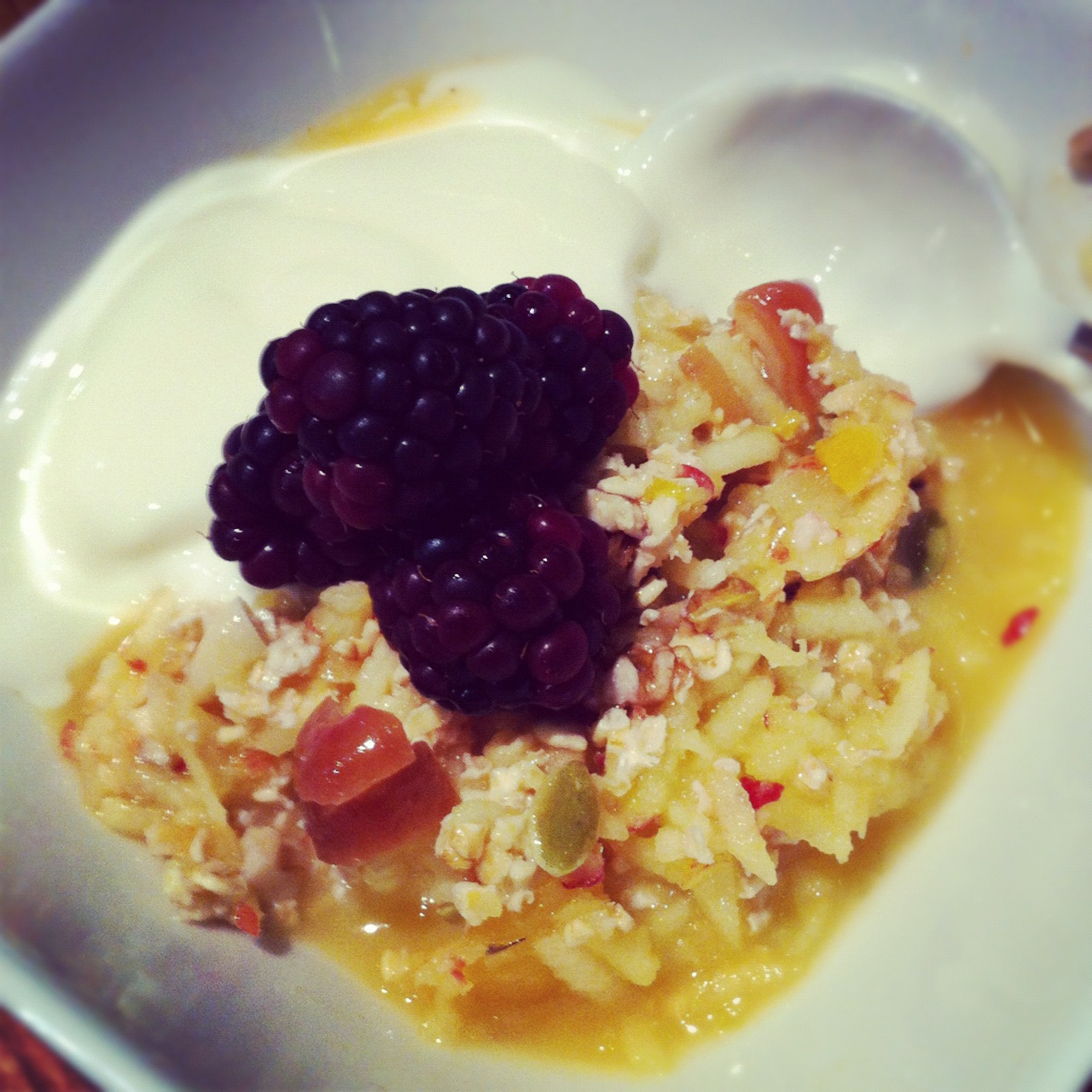
Bircher Muesli

I used a variation* on Hugh Footely-Pootely’s** recipe for this.

Mine, as you can see, was considerably runnier. I think the lack of wheat flakes wasn’t quite balanced out by extra oats, and therefore the apple added more moisture. That in turn meant some of the orange juice wasn’t absorbed. Don’t get me wrong – it was / is delicious. But you will need to judge the liquid content and do some experimentation if you don’t want to have to strain it before eating or just put up with slightly watery yogurt. Best made the night before.

*No wheat flakes as I didn’t have any (added extra oats), walnuts and almonds for the nuts, sunflower and pumpkin seeds, dried apricots, dried dates, Tesco value porridge oats. Yeo Valley fat free yogurt is gorgeous.

**That’s what he’s known as in our house, so thus he shall remain.

Beetroot, Apple, Feta and Walnut Salad

We got three raw beetroots in our veg box, and, lacking a mandolin and the will to clean up spattered oil, crisps were out. I could have shreddded them raw, but I wanted something a bit more wintery.

I roasted them using these instructions for about an hour, along with three large garlic cloves and a generous slosh of olive oil, and then peeled them while they were far too hot like an idiot let them cool a bit before donning Marigolds and peeling / slicing. I then layered them up with slices from about half a medium sized apple, some chopped walnuts left over from the muesli and about half a small pack of feta crumbled over the top. Ash thought it needed more cheese, I thought it needed a whole apple. For the dressing, I used the oil from the roasting with the innards of the baked garlic squeezed out into it (I discarded the remaining bits) plus a glug of balsamic. I could have done with a bit more oil, so I’ll be more generous next time.

I also baked some wholemeal bread to go with it which I didn’t knead properly so it ended up like a doughy brick with a wonderfully crunchy crust. I turns out Ash likes bread dough and I like crusts, so with some butter that worked out… but I might be a little more careful about the actual recipe next time.

Recipe: Baked Salmon with Fennel and Lemons

Somehow, despite Ash and I being together for nearly six years and married for almost four, I’d never really cooked for my in-laws properly before. The odd cake or cookies here or there, but never a proper sit-down meal. I finally got the opportunity to do so this weekend, and wanted to make sure it was good enough to make up for years of insufficient hospitality (I’m Greek. they’re Jewish; food is love).

I had a side of salmon – skinless and boneless – weighing in at almost 2kg in the fridge, and had thoughts about poaching it, and lemons and working fennel in somewhere. Then I considered baking and did some Googling.

I ended up taking elements from this Gordon Ramsey recipe for salmon with caramelised lemons and adapting it for a) what I felt like eating and b) what I had available. This was the final recipe:

1 x side of salmon (would also work with the whole salmon).
2 x lemons, sliced thickly (about four per lemon)
1 x fennel, in medium slices (fronds reserved and chopped up)
A small bunch of dill, chopped
A small bunch of lemon thyme, whole
4 x garlic cloves
A handful of peppercorns
Salt
Olive oil

Preheat the oven to around 170 (fan assisted) or equivalent.

I laid the salmon in a roasting tin lined with foil, and seasoned it with a little salt and the peppercorns.

I put a generous glug of olive oil in a deep frying pan and added the fennel and garlic when hot, frying until they were nicely browned. You have to be a little patient, but also watchful, as it turns rather quickly (I had to fish the garlic cloves out first). I then added the lemons, but you do have to be really careful here, as hot oil and watery lemons make for a spitting pan. The lemons need just a minute or so on each side to brown beautifully.

I placed the fennel, garlic and lemons on top of the salmon, then added a generous handful of chopped dill with the fennel fronds, and threw over a generous bundle of lemon thyme twigs.

A slosh of oil completes the topping, and then the package can be closed up into a foil tent, which doesn’t really have any gaps but does allow a moderate amount of height for steam to develop inside.

The salmon baked for 30-35 minutes; it helps to let it sit for a while after and, in fact, can be served at any temperature – so is an excellent make-in-advance recipe to have up your sleeve. Although it means a little faffing at the beginning, and probably some splattery oil mess, it’s also very, very easy for such impressive-looking results. The frying-then-baking takes some of the acrid intensity away from the fennel, but leaves a beautiful aniseed aroma, so that Ash, who is no great fan of raw fennel – or, indeed, aniseed – hoovered it up. Even Ramona enthusiastically chewed on a lemon slice, as it becomes densely chewy and more-ish, despite retaining plenty of lip-curling acidity.

I served it with simple sides – new potatoes, carrots, peas and beans – since salmon is so rich and oily, but it’s meaty enough to stand up to more indulgent treatment if you want to push the boat out.

The 21st Century Begins…

I’m pretty much always sad that I’m not at Walt Disney World. But today has an extra element of bittersweet longing as it’s the thirtieth anniversary of the best theme park in the world, ever: EPCOT Center (okay, Epcot. And yes, even now,  with Horizons* gone and that ending to Spaceship Earth and no new countries for decades. Today, I have all of the love and I don’t care).

This is where, just two years after opening, I fell in love with Disney.  And it’s why it doesn’t matter how old I get, I will always feel like an excited child at those gates. For some people it’s Cinderella Castle; for me, it’ll always be that monolithic golf ball.

Happy birthday, Epcot. I miss you.

*Okay, guys, I know it can’t come back. I get it. But take that extraordinary immersion – that incredibly long, detailed and rich experience – and bring it back in another form. I’m okay with that. I dare you.

2012 Social Charity 100 Index: Ooh!

I confess: I always feel a bit awkward about rankings.  A bit like scientific experiments, there is no perfect method. Every rating or ranking has to begin with a list of whos, wherefores and what’s wrongs. Inevitably, when it comes to social media, each attempt at ranking organisations has to place value on certain elements, which might or might not be what the participants were aiming at and placed value on themselves.

That said, all charity rankings are not created equal. Some come closer to calculations that make sense to me, combining follower size (reach) with follower growth (momentum) and fundraising (surely a good sign of an engaged community if they trust you enough to part with more cash over these most conversational of media). So it was interesting that Visceral Business‘s Social Charity Index 100 used information from JustGiving this year to add an extra dimension to the scoring process.

And so it was that I was very happy to see that Dogs Trust rose from 22nd to 6th, and, with the caveats above in mind, got a real buzz. To be clear: 22nd was nice. 22nd was lovely. 22nd out of the many great causes that do new and interesting and – best of all – effective things online was happily respectable. But top ten? After giants like Cancer Research and the hard and fast British Heart Foundation? That makes me feel a whole new level of pride in the hard work our digital team and all the other teams we work with have put in this past year.

For me, what’s really defined the last 12-18 months has been the greater ownership of digital media throughout the whole organisation. When I joined Dogs Trust in 2008, I needed to do a lot of looking for stories and coaxing them out of people. Now a key part of my community management is managing the flow of information coming at me from 18 regional centres and a plethora of head office departments. The digital team is part of discussions earlier and earlier in the process. I hear from several centres every day – here’s something for Facebook, for Twitter, for YouTube, for our centre pages, for Pinterest – and it makes me smile hugely when I get one of those emails with “I’ve got this mad idea…” in it.

One of the things we were always clear about was that we, as digital bods, might be specialists and might inhabit the digital world 24/7, but we were not – are not – gatekeepers to that. Facilitators, advisors, content shapers, yes. Exclusive creators and final arbiters? Never.

Of course it didn’t take going up in some charity rankings to make me aware of how we’ve grown, or what we’ve achieved. But it’s nice to be able to see it laid out in such a straightforward way. And it’s certainly given me a boost going into Hill & Knowlton’s sold-out Social Media Week London panel tomorrow on Secrets of Community Management, which I am delighted to be part of.

Take a look at the full 100 in the Guardian’s Voluntary Sector Network blog, or read more and access the full report at Visceral Business.

(Though, take note, Graun. That is not an infographic; it’s just a chart.)