

Afternoon tea at the Buddha Bar, Knightsbridge

IMG_4667In case it’s not obvious, I really, really, REALLY love tea.

So, when it came time to choose a fun thing to do with my friend K to belatedly celebrate her birthday, afternoon tea ticked the box. She’d mentioned that she’d enjoyed an Asian-inspired tea at the Buddha Bar before, and wanted to go back, so when a Time Out offer dropped on our laps it seemed serendipitous.

What was rather nice was that during the booking process the very helpful woman I was emailing spotted my blog link in my signature and, just for the hell of it, added an extra glass of champagne to our booking on the house. Which was very sweet (the gesture, not the bubbles) and much appreciated. Even after I managed to knock the second glass on the floor… but I’m getting ahead of myself.

IMG_4659The tea itself is four savoury and four sweet bites each. The fusion flavours are unusual for afternoon tea, but not so brave that they’ll put off the conservative-minded. Savouries were a hoisin duck bun, a deep-fried seafood wonton, tuna tartare on crisp crostini and a crunchy vegetable summer roll, with a couple of dipping sauces. I launched in with the summer roll first, and really enjoyed the tuna, which had a welcome hint of spice; the bun was lovely but the real star for me was the wonton. I could frankly have just gone for a bowl of those then and there…

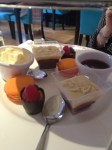
The sweet half was a rare sugary departure from my usual diet these days; as such the pistachio macaron seemed insanely sweet to me, but with a lovely gooey texture. The dense chocolate mouse was more like a rich truffle cake; this was balanced out to some extent by the light, fruity passion fruit tarts with pastry cases so crisp we gave up on spoons and used our fingers to avoid the inevitably flying bits of dessert hitting anyone else in the room. The winner for me though was the green tea cheesecake; a light whipped topping on a just-held-together crumbly biscuit base. And not achingly sweet (or at least it didn’t seem so after my tongue had been numbed by the other three).
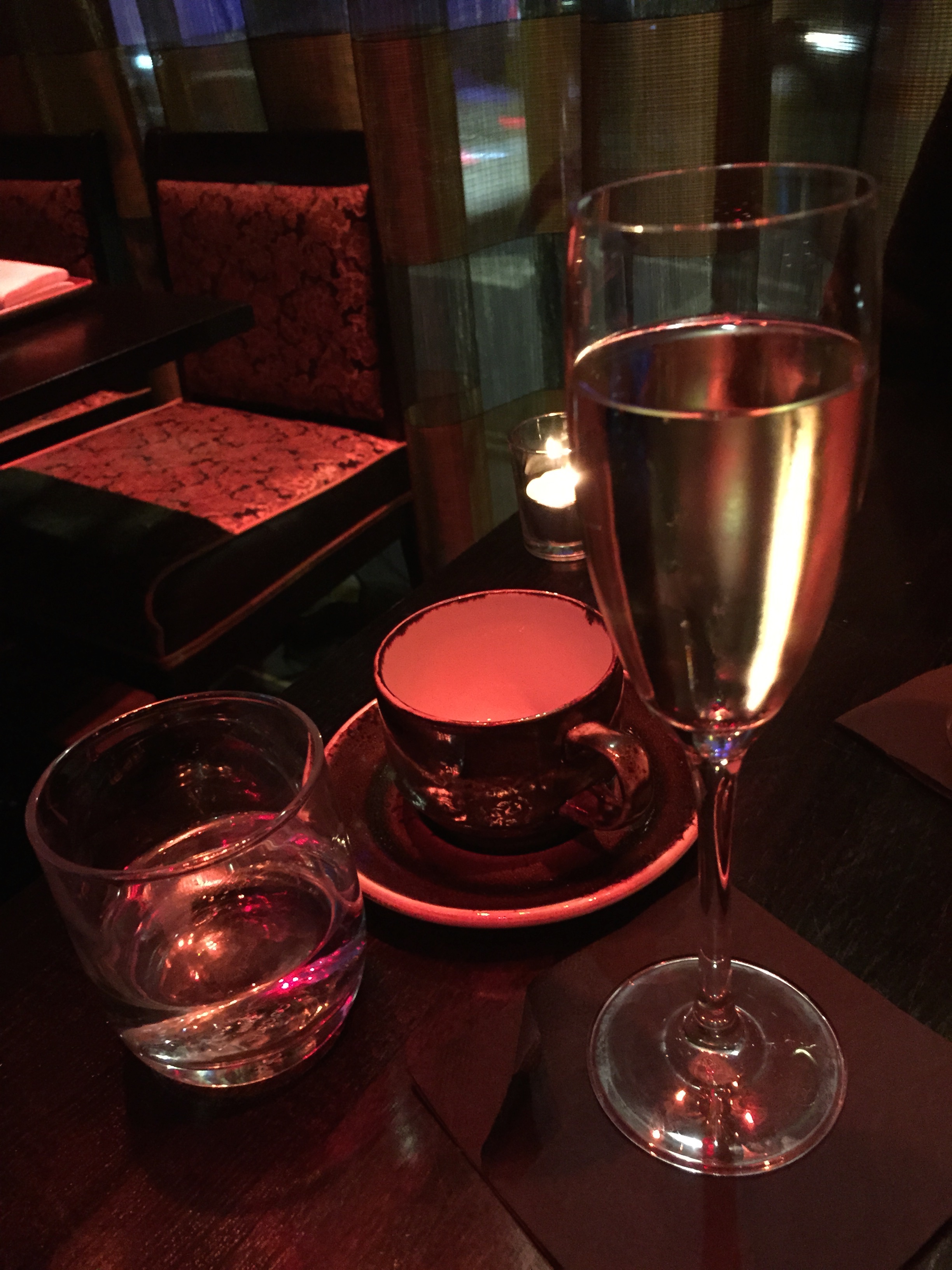
IMG_4671Canton Tea Co. jasmine pearl tea (loose leaf in pyramids) made for a lovely fragrant accompaniment, too. The two glasses of champagne were delicious… right up until an enthusiastic Greek gesticulation from me sent one flying. My appreciation for the incredibly attentive and sweet staff extends to the waiter who was at my elbow in seconds, towels in hand, being generally pretty charming about the whole thing. Luckily, it’s also pretty dark in there…

Speaking of dark, the way to the loos caused considerable hilarity, including one moment where the mood lighting was so… moody… we couldn’t see the door handle to let our way out of the bathrooms. The rest of then space is, as you might be able to tell from the lighting, a fairly exotic surrounding – an unrestrained yet pleasing mashup of Far East, Christmas lights and an incense-laced North African souk.

Would I go again? Yes, though it would, I think, be for an entirely savoury meal. This is in part because of the sugar thing; I found the savoury the part of the tea that I really wished there was more of. The balance was naturally in favour of cake – and large servings of it, at that – whereas my preferences increasingly lie in the other direction. It’s also I think because with a traditional afternoon tea there’s the sort of transitional point of the scones – they lead you from sandwiches to pastries via the gateway drugs of jam and raisins – but here it was a pretty sharp jump from chilli-flecked tuna to chewy meringue.

With that balance restored and a slightly more varied tea menu, I’d sing its praises anywhere; if you’ve more of a sweet tooth than I do and you’re tired of the usual, this is definitely somewhere to try.
I Quit Sugar: Eating out and on the go

I wasn’t intending to write much more about IQS; I’d shared my initial thoughts, addressed misconceptions, voiced my post-blip considerations and come to my end-of-programme conclusions and I’ve just kind of quietly been living a mostly IQS-friendly life ever since. I do occasionally splurge, but mostly I keep my fructose levels pretty low, and I’ve not regretted it. My skin has stayed clearer and my ability to resist an OMGSNACKBINGE is at its best for years (not infallible, and now I have an even bigger obsession with cheese, so…) and though it wasn’t my intention particularly to lose weight, it has stabilised at about 20lbs lower than it was.

Of course, I should have anticipated that come January lots of people would be embarking on various versions of their own reduced-, low- or no-sugar journey – most of them, in fact, focussed on reducing fructose, not sugar in general, although some just focus on so-called ‘refined’ sugars, preferring honey, maple syrup and drief fruit (I don’t really get the point of that, but to each their own). Naturally, I’ve thus been thinking about it more, and been asked questions by various friends and family. I’ve also observed a number of people on social media suddenly interested in ‘detoxing’ (meaningless) or ‘clean eating’ (even more meaningless and offensive to boot).

As such I wanted to touch on an issue that I think rears its head for anyone practising a dietary restriction, whether for health, medical, preference or religious reasons: eating out, and eating on the go.

Now, most of us are broke at the moment, and making our own lunches to bring to work, but at some point That Week happens when you seem to be buying an extortionately priced sandwich every day; also the drive to reconnect with friends inevitably seems to result in everyone being free over the same three days at the end of January and you leave a succession of restaurants considerably lighter of pocket and possibly of spirit, but with the nagging feeling you’ve done something wrong.

Well, rid yourself of that feeling immediately. Feeling guilty about food is never a good idea. If you have over-sugared, you’ll probably know (I get actual sugar munchies and sometimes nausea; a friend tends towards stomach upsets and headaches) and really what is there to do but drink water, eat your veggies, chow down on some yummy fat and move on? No-one made you sign your name in blood to pledge to give up sugar for ever and ever, and if you decided you wanted the damned piece of cake (or accidentally had something you didn’t realise contained added sweet stuff), then who cares? There is no place where lists are kept, and red marks are added by your name. It is, in the end, only food and not a moral decision that will haunt your every step until you turn into some sort of cursed Miss Havisham, forever condemned to chow down the neverending yet crumbling remains of a wedding feast made entirely of sugar and marzipan. Chill.

Still, I can understand wanting to feel like you have a go-to – restaurants and cafes you feel you can safely order a few things from without feeling ill or uncomfortable or, yes, guilty afterwards. Or you’d at least like some guidance in good choices to make if you’re going somewhere you have no say in. To that end, I’ve gathered together a few tips that have helped me navigate these waters without getting too bogged down in Super Special Snowflake Rules, and would appreciate any of your own you have to share.

  • Certain cuisines are a bit of a sugar minefield. Thai and Chinese cuisines – at least in the form that tends to appear on the British high street – do tend towards added sugar (that is a massive generalisation though; there’s almost always likely to be something you can have and both have plenty of protein, nut and legume-filled dishes). I prefer to avoid them unless I have a specific craving for them – then I’ll just have what I’m after and move on. There are also a few things that have ‘hidden’ sugar – for example, Japanese sushi rice is partly made sticky by the addition of sugar. It’s not really a big deal and you’re eating it with lovely fatty fish like salmon, so meh, but just so you know.
  • Cheese makes an excellent starter and dessert. I have before managed to have three courses that all involve cheese and I’m pretty proud of that. I tend to sidestep the inevitable fruit and chutneys on cheese boards, which can help.
  • ‘Health food shops’ are tricksy buggers. Whole Foods is often where I pick up some of the more expensive hard to find ingredients for various low-sugar dishes, but it also has plenty of healthy-looking pre-packaged foods that are heaving with the stuff. Be wary of ‘no added sugar’ signs that have the caveat that it’s ‘pure fruit sugar’ – that’s fructose, so… if you really want a fructose load, just eat the piece of fruit. You’ll get the fibre and goodness too.
  • Some fruits make better snacks than others from a low-fructose perspective. Strawberries, raspberries and apricots are my go-to and all travel well in a tub. Try having them with fat – a piece of cheese, some full-fat yogurt – if you’re prone to sugar munchies like me, as it helps you feel more sated and less snacky.
  • In terms of high street lunch chains, Pret a Manger, Pure (Made for You) and Itsu all have nutritional info on the website; Itsu, however, does not list sugar. From the carb count, you can usually make an educated guess (and it looks more than 6g sugars – not carbs! – per 100g, I tend to avoid) and there are some lovely coconutty, avocado-y, chicken-y choices. It’s often quite a nice way to have a little sweet touch (like a sprinkle of pomegranate) mixed in with a delightfully fatty main. At Pure I often go for the Falafalo Soldier – not exactly low sugar, but not high either (and yes, all their product names are that bad).
  • If I’m out and about with the Kid, she will generally request a trip to Wagamama. I’m happy to oblige because, despite the website being more fancy than easily navigable, if I have any doubts about what i’m going to order the info is all there. I particularly ❤ the Coconut Seafood Broth.
  • If you want something sweet, dark chocolate is never not marvellous, and the higher the cocoa percentage the lower the sugar. My current faves are Lindt 90%, Hotel Chocolat Dominican Republic 90% (and 100%) and Tesco Swiss 85%.
  • I’m a bit obsessed with tea-with-everything but if that’s not an option and you don’t want still / tap water, then ask about soda water; it’s rarely on the menu, but any place with a bar should have it as a mixer.
  • You know when you’re on a diet and it’s all “don’t choose the creamy dishes as they’re full of fat, choose tomato sauces”? Flip it. Cooked tomato is great stuff but in large amounts does boost the sugar level. Cheeeeeeese.
  • Consider alternatives for treats; for example, if you’re a massive afternoon tea fan like me, go for one that has good savouries as well as pastries, as after a while sugar-free you’ll be far more interested in those anyway. I’m dying to try Fortnum & Mason’s entirely savoury tea… you know, when I win big on the lottery that I never play.
  • Eat, enjoy and feel well. Whether that includes sugar or not.

My apologies if you were hoping for more strict rules and regulations than that, but I’ve had a disordered relationship with food for so long that I am all about the freedom now. The entire reason I tried sugar-free living was to fight off cravings and the feeling that I had to try and control everything – so I’m not about to undo all that work liberating myself just to obsess over every mouthful, or encourage anyone reading this to do the same.

That said, if you have a failsafe idea you’d like to share in the comments, go to it!


Ten Things About Tea

I thought I loved tea, and then two of my best friends came to stay. And now not only do I love tea, but I’ve radically evolved the way I drink it, with an ever-increasing list of favourites for different occasions, moods and times of day, and the ever-decreasing use of milk. I was always pretty straightforward – dash of milk, no sugar, because sugar in tea is an abomination unto Nuggan – and happy with a teabag. I still find myself able to drink this at work (though the teabag should barely be introduced to the water because that powdery, papery shizzle stews so easily), but at home the teabags have been banished to a sealed pot for insistent visitors, and the shelves are heaving with tins of loose leaf glory (always airtight tins, because tea will lose its freshness in no time without them).

So, because tea is really such a wondrous thing, here are ten things about tea; a random collection of fag-ends of knowledge and recommendations of Stuff I Like, because if I don’t share this kind of thing on my blog what, indeed, is the point of having a blog?

1. Although tea comes in different colours, it’s not necessarily a different tea plant. Black tea and white tea, for example, could be the same tea – the latter the new, furry, young tips and the former a fully fermented version. Oolong tea, with its distinctive delightfully musty scent, is part-fermented, and tends to produce a yellow-gold tea. Also, camomile is not tea; it’s an infusion, but no worse for it. Try the real stuff – freshly steeped flowers – for the best, sweetest, no-sugar-needed taste.

2. If you’ve tried Oolong teas and kind of like them but they seem a bit strong, Whittard does a very light afternoon blend that’s quite hard to over-brew.

3. I have a tea Tumblr. The posts from Australia aren’t me, but I shall leave my tea-swilling partner to be an International Person of Mystery.

4. Tea should genuinely be made at different temperatures. You want around 70 degrees (the point the kettle reaches about half an hour after it’s boiled) for white tea, and varying points in between that and 100 degrees for everything up to black. To be honest, this is getting a bit precious but you will taste the difference if you go for it. Or you could just switch the type of tea you’re having if you boiled the kettle and then forgot about it. In related news, if someone ever wants to send me one of these beauties, I wouldn’t cry. Well, I would, but not the sad tears.

5. Gen mai tea / genmaicha is a form of Japanese tea that includes roasted brown rice, which adds a sweet taste and a disorientating scent. It’s worth trying but is definitely quite odd to those of us raised on the milky black ‘English Breakfast’ version of tea.

6. Try drinking your tea black. The flavours are immense, and some black teas – Assam and Darjeeling for example – are really killed dead by the addition of cow juice brimming with sugary lactose. I mean, there’s nothing wrong with a milky cuppa, but you’ll find a whole new appreciation for the flavours of tea if you ditch the dairy now and again. You could also try a flavoured black tea like T2’s delicious Brisbane Breakfast (I did not believe tea with a hint of mango could be nice, but apparently…). They also do a glorious London Breakfast blend which has no additional flavourings, but uses a dash of Lapsang Souchong for a hint of smoke without the slap in the face you get from pure Lapsang.

7. I really bloody hate fruit tea. It’s just hot, faintly sweet, disappointingly flavourless water in deceptively interesting colours.

8. Ditto floral teas, which just taste like dishwater flavoured with perfume. I am not a fan of Earl Grey, Lady Grey or any of the other ennobled Greys. Bleh.

9. Wanting low-caffeine tea late in the day doesn’t have to mean switching to green or white (unless you want to – and there are plenty of good reasons to drink both). T2’s Daintree blend is lovely, as is the Panyang Congou, for getting the flavour of a stronger tea without the caffeine kick.

10. My favourite places to shop for tea are Australian outfit T2*, Whittard, Camellia’s Tea House, JING and any number of random outfits in Chinatown. (*now all over London thanks to investment from Unilever; nothing to do with any of my clients, though, and I loved them before I knew that, so there is no client conflict / sponsorship here).

And as a bonus – and because, as the members of Spinal Tap know, it’s better if you go up to 11 – here are links to two rather different afternoon tea reviews I’ve done: London’s The Pelham and Bath’s Bea’s Vintage Tea Rooms.

And now… anyone for a cuppa?

Italian afternoon tea at The Pelham’s Bistro Fifteen

IMG_4030An afternoon tea review right after my last three million posts about giving up sugar? What can I say? I like to keep you on your toes. The fact is, I do consider myself to have given up regular sugar permanently, but I’m still open to special occasions. And such a one was a weekend break of fun with a good friend, which included cashing in a Time Out deal for a special Italian twist on afternoon tea at the Pelham.

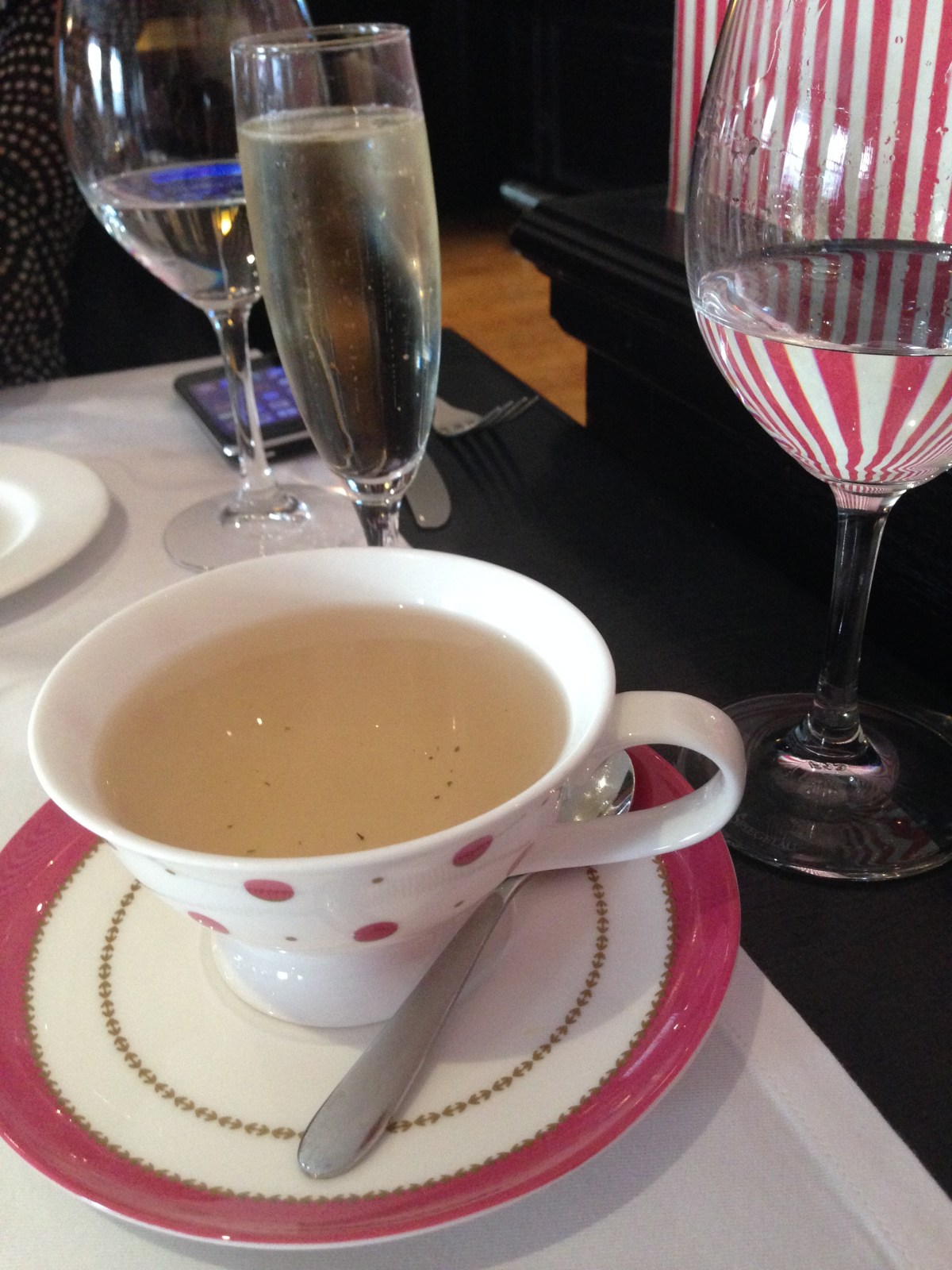
My friend, K, had been here before for a post-Christmas detox tea, so it seems themed teas are a regular occurrence. The listed value for the afternoon tea in question was £60 for two, similar to the usual Champagne Afternoon Tea, but we paid about half that through the deals site. The setting is the very pretty, tastefully retro Bistro Fifteen, complete with striped wallpaper, mint green chairs, a library corner and dotty Laura Ashley teacups.

IMG_4028The deal included the near obligatory glass of prosecco, which we duly sipped at happily. The server was a bit out of sorts, I think, as she just asked ‘what would you like, English breakfast or Earl Grey?’ and it was only on asking if there were other options that it turned out there was a whole tea menu.

The teas are provided by Camellia’s Tea House – do visit the one in Kingly Court if you can – and included infuriating titles such as Skinny Bitch (ugh!) alongside much more appealing options such as White Peony and a classic white jasmine – no oolong though, more’s the pity.

IMG_4031I opted for the White Peony, and K had Beautiful Skin, a greener infusion of dandelion, chickweed and other vaguely mint-scented options. The server then brought the food and dashed off without telling us what was on it, but we quickly worked out most of it and then eavesdropped on our neighbours to work out the rest.

At base were two sizeable and filling prosciutto-stuffed ciabatta rolls, a strange but tasty fried, lemony raviolo of some sort each and four warm, flaky, raisin-studded scones topped with a drippy glaze of marmalade and a garnish of pistachio powder. Clotted cream and jam were provided too, tucked alongside what was described to the neighbouring table as a mango macaron (but tasted for all the world like orange – either way it was chewy and delicious), a tiny chocolate cup filled with custard and topped with a blueberry and a raspberry and a small, super sweet white and milk chocolate pot. Finally there was a spiced biscuit each and beautifully bitter chocolate biscotti.

Though most things looked small and delicate, the scones were extremely filling and the biscotti generously sized and rich, so by the end we were seriously stuffed. Topping up hot water for a second round of tea, we relaxed in the very pretty and relaxed surroundings, surprising November sunshine peering in through the basement windows from the South Kensington street outside. It was lovely to then stroll over to the V&A, my favourite place in London and somewhere K had never been.

K would still be glad to go back to the Pelham again after her second visit, and I was certainly impressed and would be interested to see what other twists on a classic theme they might offer. I’m not sure I’d be too keen to splash out the full amount for a regular afternoon tea, as it is rather a lot even without fizz (£24.50 per person), but the plain cream tea of scones and tea at £10.50 would be worth it for the setting.

Nothing to declare here as everything was paid for by us as stated – simply writing it up because it was fun and I enjoyed it. 

I Quit Sugar: Thoughts from the end of the 8-week programme

After the half-way point and the week seven screw-up, I’ve had a bit of a chance to examine how I feel about IQS in general and whether or not I think it’s a) worthwhile and b) something I’ll be able to keep up indefinitely – since it is supposed to be a sort of ‘reset’ leading to permanent liberation from sugar binge cycles.

I’ve found it, largely, to be extremely beneficial. There are some caveats and watch-outs that I’ll list below, but on the whole I’ve found that mostly good things have come out of it. Such as:

  • Increased energy (eventually – I did have a two week sluggish dip in the middle)
  • Improved skin
  • A lower susceptibility to bingeing / bloating
  • Fewer sweet cravings (I still turn into a carb addict come Lady Week though I can usually stave it off with cheese and oatcakes – soz for the TMI)
  • More veg cravings (I always liked them but now I actively crave greens if I don’t get them)
  • Rediscovering how sweet certain things – especially fruit – really are (does wonders for your appreciation of them!)

I’ve also lost around 12-14lbs, which has levelled off and stayed stable for a week or two, suggesting that this weight is more or less my natural setpoint. I was aiming for better health, but I’m not going to argue if nature wants me to fit my clothes better. I do still need to work on fitness, but I am walking more than I used to.

On the whole, approached as a programme that is about resetting attitudes rather than going on a mad health purge, it’s a really handy way of structuring a fresh approach to food, and getting into healthier habits. I’ve struggled for years to ‘listen to my body’ and I’m still not 100% there, but without the influence of shedloads of sugar – and I was eating a LOT – I find it a hell of a lot easier than I did. Since completing the 8 weeks I’ve added back 1-2 helpings of fruit per day, usually lower fructose choices like berries, but they’re my favourites anyway; I also nibble on fairly regular infusions of 80-100% dark chocolate and it’s all felt very manageable. I continue to track what I eat out of curiosity, and I can still see patterns of more and less disordered eating here and there (the female reproductive cycle has a lot to answer for), but on the whole I’ve levelled out at around 25-30 grams of sugar a day, and that seems to leave me in a happy place. I had a slice of my daughter’s birthday cake and all was well – and I didn’t want more than a little bit. That was the place I wanted to arrive at, and I’m happy with it.

Now for the caveats.

  • Sarah WIlson touches on it in the book, but fat really can be a problem. I think I’m pretty much convinced that there’s nothing bad about fat in general and I’ve made my peace with eating more of it without that automatic feeling of guilt but there is such a thing as too much of a good thing; a few almonds = a good snack, an entire pack of almonds = unnecessary. Now, I refuse to be pejorative about food or eating, and I won’t say that it’s a case of ‘good’ vs ‘bad’, but I do know that there’s such a thing as ‘enough for me’ vs ‘too much for me’. And it’s very easy to blur that line when you’re crowding out sugar with fat. So it’s something to watch out for.
  • As a manifesto, the book has flaws. Some of the science is a bit woolly, the (meaningless) word ‘detox’ pops up and there is the inevitable cherry picking of data to support a particular view (and make the book readable, to be fair). I would have liked to have seen a twice as long introductory sector looking into this in more detail. The fact is, I already wanted off (most) sugar, because I find when I increase the amount I eat, I eat more stuff I don’t really want to and feel emotionally and physically crappy. But I missed the detail and delving of something more comprehensive like HAES.
  • The other thing to watch out for is unrealistic expectations. Wilson is careful not to make any specific health claims, and simply talks about how the knock on effect of her new approach to eating has appeared to improve her thyroid condition, but be wary of assuming that going low sugar will fix everything. If your symptoms improve, then that’s excellent, and at the very least I can’t imagine that putting a bit less crap into the body could be actively harmful. But don’t fall into the magical thinking trap.
  • Although the posters scream “lose weight”, it’s actually (rightly, in my opinion), a very small part of what’s touched on in the book. Wilson basically says some people lose a bit of weight, some people lose quite a lot – ie YMMV. Feeling altogether better is the aim here, not setting any weight or body targets.

This is probably the last I’m going to post about this, apart from if I share a suitable recipe, cos genuinely I think it all gets to be a bit dull and repetitive if all you do is evangelise about some food fad or other. I know that some people asked for an update after the 8 week point, so here’s what I’ve found overall, and I’m really happy to answer any questions here or on Twitter. 


I Quit Sugar: What happens when you inevitably* screw up.

Before I began the IQS programme, I had afternoon tea booked with a friend for a couple of months down the line. It actually fell in week seven of the programme – around the time a certain amount of sugar, or at least sweetness, creeps back in, but before you’ve really completed the programme.

Now, I know you’re thinking “well, that’ll have been the screw up, then”. But actually it wasn’t. I found myself pleasantly and comfortably controlled on the day – except it wasn’t a case of control but just calmly allowing my body to decide what it was comfortable with. I ate scones, but with a little scrape of jam because more than that didn’t taste that good anymore. I ate half each of three little pastries but then I just felt like I was done. I had half my glass of prosecco because it was too hot to drink any more.

I’ve got to say, I felt pretty smug. It was like everything everyone says about moderation had totally clicked but, more than that, I had gone in with the attitude that I wasn’t going to be restrained or say “I shouldn’t”. I was going to go in and have exactly what I wanted. And by giving myself full permission to do that, I didn’t feel the need to overindulge.

Flushed by my success, I went back to normal eating the following day. And then work book club hit, and suddenly wine and orange juice and crisps and sweet popcorn and fizzy cola bottles and jelly beans were all within a foot of me. And for the first time in weeks they seemed appealing. And I went for it. Spectacularly.

Within the hour, the following symptoms appeared:

  • Itchy, hot skin
  • Jitters / shakes (not the visible kind)
  • Headache

Overnight, I experienced:

  • Poor sleep
  • Anxious thoughts (you know, the 3am type. At 3am.)

The morning I felt:

  • Bloated and rough with a skin flare up.


Now, there might of course be other reasons for some of these. While I had very little wine, alcohol does have an effect on sleep so that could be a contributing factor. We’ve had a bit of familial upheaval recently with schools and whatnot – not negative, but stressful. It might or might not be related to things that happen to women on a lunar basis. Hell, there could well be a psychosomatic element. But it seemed thoroughly too coincidental by half that all these symptoms appeared suddenly, en masse, on the night after I chose to gorge on something I’ve been avoiding for weeks.

I do wonder how it is I fell into the trap in the first place – trying to be sociable? Lady cravings? Overconfidence in my new found ability to say no? – but from discussing it with one of my friends it seems she did the same: ate sugar, felt bad, regretted it, got back on the wagon. Lather, rinse, repeat until the message sinks in. And certainly Sarah Wilson talks a lot about ‘lapsing’ (which, as she says, is not a lapse but just an experiment to see if you really want to continue eating sugar). After my experience, I’m not in a hurry to repeat my test, and I’ve been ‘crowding out’ with fats and veggies today to try and stave off the inevitable sugar hangover cravings.

I present this not really as evidence of anything expect my own experience, so do take from it what you will. It’s convinced me to get back on track, but then I’m the only person I have to convince…

*By which I mean when I inevitably screw up. Your mileage may vary, and your engine may be better tuned. But if you were all that brilliant, you wouldn’t be reading about quittin’ sugar, cos you’d have done it already so ha! Now we’re rubbish human together. Group hug!

I Quit Sugar: a few questions and misconceptions addressed

It was nice to get a little flurry of comments after my last post, in which I explained my having hopped aboard the I Quit Sugar bandwagon. A few comments and questions came out of that that I thought I would address for anyone considering taking part but feeling scared to*.

1. I can’t give up carbs!

Great, you don’t have to! I’ve eaten bread, pasta, noodles, rice (and rice crackers) and sundry other carbs throughout. While watching sugar will naturally reduce the amount of carbs you have overall, fructose is the only thing you’re really watching for. If you have had an indulgent day and want to get yourself back on track it can be helpful to also cut out grains for a day. Plus many of the carb-based recipes that are included are GF or paleo or reduced grain, because this also reduces sugars and increases fats. But it’s primarily not a low-carb diet.

2. I could just rule out processed sugar and have natural sugars…

Yeah, at least for me, for this shiz to work, I had to nix all sources of fructose, including fruit, for the cold turkey part of the programme. Otherwise I find that the cravings are just as severe – and now that I’ve started including the odd helping of fruit here and there I notice it immediately. Sarah Wilson specifically talks about reintroducing – and not demonsing – fruit but keeping it to no more than about two portions a day. This actually chimes with general health advice to get the bulk of your five (or eight, or whatever) a day from vegetables.

3. I couldn’t give up the occasional glass of wine.

You don’t have to do that either. I’ve had a glass here and there throughout (though I’ve found my inclination to drink has taken a nosedive and I’ll just have one drink – or even half – when I do). Wine is actually low-fructose, as are some spirits provided you stick to no-sugar mixers.

I actually had my first bite of dessert the other day at a family lunch, though technically I shouldn’t have for another two weeks. It was one of my favourite kinds of things, and I took a spoonful gladly. And then, having tasted it, I didn’t want any more. I tried one other mouthful – of something else I like but rarely get to eat – and that was quite enough too. It sated my desire for sweetness and being sociable, and then I was done. And, in fact, the next day I felt a bit snacky and substantially bloated, so I wasn’t in any vast hurry to try again.

This doesn’t sound so incredible unless you consider that prior to this I had virtually no impulse control when it came to sweet treats. I texted my friend who got me on the programme with the words “IS THIS HOW NORMAL PEOPLE EAT?!”. It feels really weird to see longer gaps appearing between meals, less snacking, fewer cravings and no propensity to eat until painfully stuffed.

I’m into week six now. I look forward to regrouping at the end of week eight and sharing my thoughts, observations and tips. But so far, so amazingly freakin’ good.

*Why are we so scared of this stuff? Me included! We want to cling to our routines like they’re the only possible way to live, even when they’re hurting us. Ah, humans.

I Quit Sugar: my thoughts from the half-way point

Suddenly, I Quit Sugar is everywhere. Tube ads, articles… maybe I’m just noticing it more because I’m following the programme, but it does seem that it’s the new kid on the food fad block.

I actually didn’t come to it through any of the marketing, but through a very good friend who tried it. I wasn’t immediately convinced, but recognised that I do suffer from poor impulse control and tendencies to binge when around sugary foods – including fruit.

Still, I had questions. For example:

  • Isn’t fruit sugar good sugar, as long as you eat the whole fruit? (We all know that thing about fruit juice being high sugar without the fibre, right?)
  • Isn’t it magical thinking to claim that quitting sugar will be the answer to various health woes?
  • How is it even possible to live without sugar?
  • Isn’t it rather difficult for anyone on a restricted income to carry out this kind of diet?

So, I thought the best thing to do was read the book, and once I’d done that I was happy to try the programme. Sarah Wilson’s story is necessarily personal, but she does draw on actual research to make her case – and certainly there is something disturbing about the massive volumes of sugar we consume on a daily basis. I also have PCOS, which goes hand in hand with insulin resistance, and a close relative with Type II diabetes. So, no matter what, I needed to reduce my sugar intake, and if starting out by going (more or less) cold turkey on fructose – the only kind of sugar Wilson really sets her sights on – was the way to do it, then I was going to give it a try.

I’m now into my fifth week of an eight week programme, and in that time I’ve had no chocolate, cake, biscuits, table sugar, added-sugar drinks or sweetened processed foods. I’ve had very limited fruit intake, but substantially larger vegetable intake (and I was no salad-avoider before this). Once in a while I have looked lingeringly on a dessert and sometimes I’ve overdosed on fat instead (hellloooo, cheese!), but mostly I’ve kept to an unprocessed, whole food heavy diet. And, to be honest, it’s not been that difficult – once you step off the sugar rollercoaster, it does become easier to resist it.

Here’s what I’ve found so far:

  • The book and programme themselves are actually very non-specific. Apart from stating things to avoid (and the real cold turkey phase doesn’t hit until about week 3), there are no meal plans. There’s no insistence on what you should eat, but shedloads of recipes that could help. I feel much closer to following a Health at Every Size type approach, because I’m choosing my food mainly based on what tastes good and appeals to me.
  • Some of the suggestions I have simply ignored. I don’t judge anyone who wants to follow Wilson’s advice to beat sugar cravings with a spoonful of coconut oil straight from the jar, but I can’t say I find any delight in the thought of downing something the consistency of petroleum jelly. I like some coconut milk based meals but I’m not that big a fan, so I’ve had to adapt. I simply cannot stomach porridge made with 125ml of coconut milk and use less than half of that per bowl of pumpkin porridge, upping the pumpkin content instead. It means I’m full for a bit less long, but I actually couldn’t finish the first bowl when I made it to the recipe. I also leave off the toasted coconut flakes – too much!
  • There are times when the science gets woolly and that annoys me and makes me question the overall methodology; while it’s true that there might well be some physical symptoms that reflect the adjustment from one diet to another (I’ve experienced some myself), suggesting that this is ‘toxins leaving the body’ sounds, frankly, a bit woo for my liking. On one occasion where I had a meal out and likely ate some sugary sauces, I did find my digestive system reacting negatively.
  • I have lost some weight, presumably because when you replace sugar with fats you feel full faster and therefore eat less overall. Out of curiosity, I’ve been on and off tracking what I ate, and my caloric intake is definitely lower than usual even though I’ve been making no effort to restrict it, or even looking at how many calories anything contains.
  • Over time, sugary foods start to look less appealing. Some restaurant desserts were harder to resist because they’re so beautifully made and really nice chocolate and / or ice cream will probably never stop being appealing, at least to me. But when you’ve committed to low sugar, breaking that promise to yourself means you feel like it had better be worth it – and be the best confection you can get your hands on.
  • It IS expensive – the fact that I reference unprocessed whole foods and restaurant meals should indicate that. I reject the term ‘clean eating’ on several counts; firstly, when a phrase means something different to each person who uses it, it means nothing to anyone, and secondly the implication that anyone not eating like me is ‘dirty’ is pretty obnoxious. There are times when this programme seems as exclusive as so-called ‘clean eating’. No, it’s not impossible to follow on a lower budget, and the slow cooker book in particular will help with batch cooking and family meals. Still, it would be a lot more effort – effort I can’t imagine it would always be a priority to make. So I recognise that to be able to carry this out is a pretty privileged activity.

I still don’t have the answers to all my questions. I’m now more or less convinced that fruit intake is fine provided it’s kept to two small servings per day, but that fructose in general does have strange body effects (I’ve always wondered, for example, why bananas are supposed to be filling when they make me ravenously hungry, and the high fructose content does explain that). I recognise that yes, it is tricky to do this on a restricted income but no, it’s not impossible to keep sugar intake to a reasonable level all other things being equal. The jury is still very much out on the health conditions; while diet clearly can impact, and help prevent, various conditions, I think it’s unquestionably risky to claim that giving up or eating a particular foodstuff is going to be the Solution To All Health Woes. So I choose to continue taking that particular claim with a large pinch of salt.

It will be interesting to see what happens after the eight weeks, and whether the habit really is broken for life – particularly as Wilson does advocate testing yourself afterwards by trying out sugary foods. I can but report back in a few weeks…

Sugar Free Almond Milk Chai

IMG_3343[1]

A double batch with loads of tea – a little too much, actually, but it makes a striking photo!

…of sorts, anyway.

There are lots of good reasons to enjoy chai – a spiced, milky tea – but too often you get the Starbucks-type version, which is an ultra-sweet syrup added to hot milk. Making your own is a relaxing ritual, and absolutely worth it, if for no other reason than to find a way to use up some of those bottles of spices bought for other recipes but rapidly losing their freshness and gathering dust in a cupboard or rack somewhere.

Now I’m the first to admit the version below is lacking in authenticity in a big way; not only does it use almond milk, but the mix of spices was more dictated by what I like and happened to have in the house than by attachment to any particular tradition. So please see this as an experiment more than a recipe.

This makes a generous mugful; I have also made double the amount and kept it in a small insulated flask to sip through the afternoon. And please note that sugar free means fructose free – so it’s I Quit Sugar suitable, but does contain an optional sweetener in the form of rice malt syrup.

300ml unsweetened almond milk
1 heaped tablespoon black tea (I favour Darjeeling)
6 cardamom pods
3 whole cloves
1 star anise
3 whole peppercorns
1-2 cinnamon sticks
A dash of ground ginger, or a small knob of fresh, grated
A dash of grated nutmeg (fresh is nice, but not essential)
1/2 tsp vanilla extract (powder if you want to be completely fructose free, but it is just a trace)
Up to 1 tsp rice malt syrup, optional (to taste)

IMG_3345[1]

I do like the odd dash of cinnamon over the top, too… (And do you love the Spaceship Earth-reminiscent mug?)

Don’t be tempted to overdo the tea to get a darker colour – it will stew and add bitterness, as I found out when I got a bit too enthusiastic….

1. Warm the milk on the hob to just below simmering point. Bringing it to this point first prevents the tea from stewing later.
2. Add the tea and flavourings, and keep at a very gentle simmer for a couple of minutes. Take off the heat and allow to sit for another minute so it completely brews without boiling.
3. Strain and sip.

In my more experimental phases, I’ve been known to throw in a teaspoon or so of milky ooling tea to add a buttery caramel note, but that’s definitely an unorthodox mix of cultures…

Cooking with Pinterest (oh, and Tom Aikens…)

Baked Scallops with Sauce Vierge. We went a little overboard on the tarragon, but it was still delicious.

Baked Scallops with Sauce Vierge. We went a little overboard on the tarragon, but it was still delicious.

God bless Vikki Morgan‘s busy schedule, and her generosity in sharing her invitations to cool events.

When Pinterest extended an offer to join Tom Aikens (no big deal! *stricken face*) at Atelier des Chefs and learn to cook three beautiful seafood dishes, Tiff Jones and I grabbed the opportunity to go in Vikki’s place, and were warmly welcomed by the lovely Lizzie and the team for a most awesome evening.

With bubbly and Chablis making the rounds, we quickly relaxed and got into groups of five – ours included the wonderful Botanical Baker, Urvashi Roe, whom I’ve been following online for a long while now – dividing our tasks and trying to cook along and follow Tom’s instructions. His reputation for being frenetically active well-earned, he dashed in to save us from ourselves – seasoning and stirring here, tasting and plating there and occasionally indulgently (kindly) shaking his head at our less than perfect skills.

We made three dishes – salmon with pickled beetroots, baked scallops and sea bass with a delightful citrussy, herby pea shoot salad – and sat down to eat and drink as a group afterwards. The setting is great, and I think I’ll be back before long for one of ADC’s courses (especially as I discovered they weren’t nearly as expensive as I thought they would be; I have my eye on sushi, knife skills and vegetarian classes).

A personal highlight of the evening for me was discovering I’m not completely terrible at thinly slicing fish (a skill Casper will be delighted with, if only he can sample the results). But really what we took away from it was exactly – I think – what the team hoped we did; that is, that cooking fish and seafood respectfully with fresh herbs and lovely dressings and sauces can make for beautiful light meals.

If more inspiration is needed, the Pinterest team would undoubtedly want me to remind you (and they’d be right) that Pinterest is absolutely heaving with recipes, food photography and cooking tips – and you can of course search by ingredient and recipe now. I’m certainly going to be revisiting and reinvigorating my own boards, and you should join me. You’ll find other pins there from the night, for a start.

Thanks to Pinterest for a fab evening, which the team has blogged about here, Mr A himself for his precious time and expert advice, Tiff for her awesome company and Vikki for the opportunity to attend.