
Papercats – a story

Once there was a boy called Tom, and he lived in a world of paper.

Of course it wasn’t literally paper. He had a house, with broad stone walls, a scarred wooden table and a cold kitchen and warm bedroom – a sure sign of someone who spends too much time in their own head. Tom didn’t have a family and he didn’t have friends. Instead, Tom had paper.

Throughout the day and long into the night, Tom made things out of paper. He made animals and plants, buildings and landscapes. He crafted bridges and bred dinosaurs. He built people and sat them around tiny paper plates, cups and saucers. But at the end of every day, Tom would examine his work sadly and realise that something was missing. Perhaps a crease was messy or there was a smear on the crisp white card. And, sadly, Tom would crumple the paper figures up in his hand, stack his paper neatly at the edge of the table and shuffle slowly up the stairs to bed, where he would sleep badly.

Day after day, night after night, Tom worked steadily on his paper world. And day after day, night after night, he went up to bed disappointed. Until the night that Tom ran out of ideas.

He sat at the table, frustrated and dismayed. He had never before been stuck for inspiration, but this time it seemed like he’d already made everything there was to be made. His hands started to itch to fold paper, but his brain didn’t know what shape the paper should take.

IMG_0328Finally, he lifted a sheet, turned it over in his hands, and eventually started to work. He realised that among the many animals he had made – weasels, parakeets, dogs, frogs, zebras – he’d never made a cat. And that’s what he was going to try to make now.

When the cat was finished, Tom looked it carefully. This cat would never do. Its left ear was too small, and its tail a stubby mess. Immediately, Tom crushed the cat in his fingers and started again.

The second cat was better than the first, but still – it simply wasn’t right. There was a smear on the right haunch, and the head was at a funny angle. Usually Tom would simply move on to the next thing; in fact, he couldn’t remember the last time he’d even given anything a second chance. And now, as he feverishly grabbed another sheet of paper, he was trying for the third time.

Tom set to work. Piece after folding piece, crease after folding crease, the cat began to take shape. His hair began to fall into his eyes, the cold chill in the kitchen crept up around his shoulders and his fingers began to feel stiff and sore, but still he went on. At last, the final fold was in place, and he gently set the cat on the table and eased down his aching shoulders, staring at the paper pet.

This attempt was….

Perfect.

Tom sat back, confused. He could not find a single fault with the cat. It sat upright on its haunches, a neatly proportioned tail curled around to the side. Its head was tilted with a curious expression, its ears were pointed and perky, and the curve of its back was smooth and blemish free.

Tom slowly rose from his chair. He stacked the paper neatly on the table, never taking his eyes off the cat, and then turned his back and walked up the stairs to bed.

In the gloomy, cold kitchen, nothing moved. Until the cat suddenly yawned, stretched and wandered off into the darkness. It was hungry, and thirsty, and bored. It sniffed at the paper stack, and tasted the edge of a sheet. It jumped down off the table, and chased dust across the floor. It clambered up to the sink and tried to lick droplets from the tap, but this made its muzzle soggy so it edged to the lukewarm radiator and stayed there a while, trying to dry its nose.

Upstairs, Tom was having the worst night’s sleep he’d ever had. In fact, since every time he was about to drop off he jerked back awake, sure he could hear clattering and banging in the empty kitchen, he couldn’t even really call it a night’s sleep at all.

Finally, he gave up and made his way downstairs. Everything was exactly as he left it. Well, almost. In the middle of the table, where he’d left the cat, was… nothing.

Tom looked on the floor, in case the cat had somehow blown over. There was nothing there. He crawled under the table. Nothing there either. He lifted the stack of paper, even though it was flush to the table top. Nothing at all. But the edge of the topmost sheet was strangely frayed.

Finally, Tom sat down, placed the damaged sheet aside, and began to make another cat. And it was just as perfect as the first.

After staring at the new cat for a long while, Tom once again left it in the centre of the table and went up to bed. And this time, for the first time, Tom drifted off almost immediately into a peaceful, dreamless sleep.

The cats met in the middle of the table, approaching each other cautiously and then circling around and around. Then they began to explore.

Eventually, they came back to the pile of paper. They looked at the stack, then looked at each other. Their noses quivered. Together, they turned to look out of the window, where the moon was still high in the sky. And then they turned back to the stack.

The sun was burning brightly by the time Tom woke in his bed. He felt rested, and that in itself was strange, since he never usually felt rested. He felt calm. He felt happy. He felt… hungry.

Tom got up, went to the bathroom, got dressed. He stood at the top of the stairs and stretched. Then he shuffled downstairs to the kitchen, where he stopped in the doorway, stunned.

Every inch of every surface was jammed full of paper cats. They crowded the floor. They cluttered the ceiling lights. They clustered on the chairs. The table. The worktops. The sink – apart from a space around the plughole, where the cats seemed to be edging away from the drips.

Once there was a boy called Tom, and he lived in a world of paper.

Of course it wasn’t literally paper. He had a house, with broad stone walls, a scarred wooden table and a warm kitchen. Tom had family, and Tom had friends. And every one of them was a perfect paper cat.

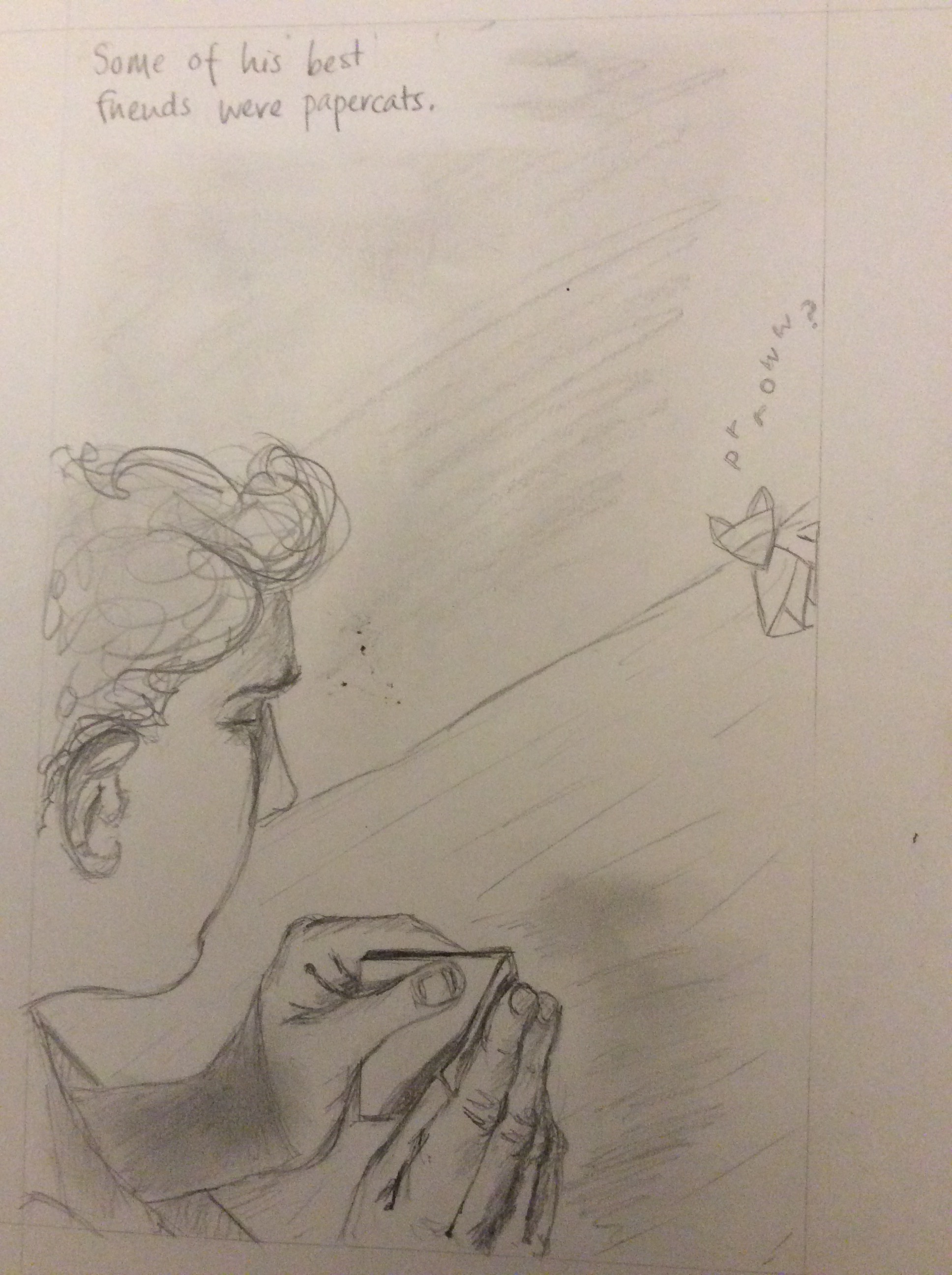
A little background: As a result of my #100forchildsi sketching, a few stories to accompany my scrawls began to grow in my head. One of them was just a single image, and I drew it once in pencil and once painted – that’s it above. I hoped to next try a plain ink version… it’s never been quite right. Anyway. It was never intended to be more than just a single image, but then Ramona invented a game where we each had to tell a story, and they were becoming increasingly outlandish. Eventually, this image popped into my head and as we were walking through town, crowds milling around us, she held my hand and listened carefully to the story of Tom and his paper friends. If my 100 days of artwork taught me anything, it’s that an unrefined bird released to the winds is worth two fully-polished articles in your head, so I thought better to commit it to screen, faults and all, than to keep replaying it in my head and watching the colours dim each time I failed to do anything more with it. And besides, Ramona might ask me to tell it again.

I am Squarehead – Simon Frank and Margit Mulder

I am Squarehead book coverIt’s always awkward writing about something created by people you know. For the full record, Simon Frank is someone I’ve known for a fairly long while as part of former third sector agency Beautiful World; furthermore, my graphic designer husband Ashley was employed by them and still works with Simon on occasion at Bats in Belfries.

None of that, however, is why I’m writing this blog post (and I certainly wasn’t asked to). While I admire I am Squarehead greatly, I wouldn’t have decided to put my thoughts out there if my daughter hadn’t recently fallen in love with it after being given a copy by our friend, and Simon’s business partner, the inimitable Rochelle Dancel.

The thing is, it’s actually really difficult to get Ramona to like anything. Sure, parents can influence, show approval or outright ban stuff. But that doesn’t always come to much; both Ash and I absolutely love Jon Klassen’s beautiful and wickedly brilliant I Want My Hat Back but Ramona has gone from being gut-wrenchingly terrified of it to merely being deeply suspicious of it. Also, I swear she can sense enthusiasm and just says no to wind us up sometimes. Some books she has never taken to, or been scared of – Mog in the Fog, Edwina the Emu – others she has loved instantly – all the other Meg and Mog books, Possum Magic, The Day the Crayons Quit . Still others she has suddenly flipped from hating to loving, dependent on God knows what – like We’re Going on a Bear Hunt. So for her to so quickly, passionately love a book with a deliberately scary moment in it – albeit one that is quickly turned on its head – is something we always find worthy of note.

See, Ramona is definitely a kid who does some round thinking in a square world – just like Squarehead, who has to leave town and make some friends who also don’t fit the spaces they’re being forced into before coming back to change things for the better for everyone. She’s always been immensely good at dealing with the things that I know often throw kids for a loop – changing nurseries, starting school, moving into a big girl bed – but she can also find some apparently innocuous things very hard. Sometimes this has included introducing new books, where she is very wary of scary moments. School, where she burned through the reading scheme and is now allowed to choose books written for kids two or three years older than her and reads them mostly independently, has really helped with this as her confidence is constantly climbing and she changes books almost daily. Still, she’s one of nature’s overthinkers (can’t imagine where she gets it from).

The thing is that, as Squarehead points out, once you’ve had a thought, you can’t unthink it. But, as Squarehead discovers, you can sometimes be accosted by something you think is utterly terrifying, only for it to turn out to be something you love very much.

I don’t know whether I am Squarehead appeals to Ramona because she sees herself in it at some level, as I do. I don’t know whether she just likes the idea of a story written by someone Mummy and Daddy know (Simon has since signed it, and now she reads the dedication aloud to me). I don’t know if she’s just charmed by Margit Mulder’s deceptively simple illustrations – my personal favourite is the bathtub with square bubbles. Maybe it’s all of those or something else entirely. Whatever it is, it just seemed so perfect to me that I wanted to record this moment; too soon she’ll abandon this and move on to the next thing. For now, awkwardness aside, this is a snapshot I wanted to keep.

David Bowie at the V&A, and why my sister nicely ruins everything

My sister, in the nicest possible way, ruins everything. Take snow. I used to get excited about snow! And then she pointed out that it was fairly miserable for people with nowhere to shelter from it.

Then there was that time she ruined Together in Electric Dreams by pointing out that if the object of his affection didn’t smile until it was time to go away, then maybe they didn’t like Phil Oakey that much anyway.

Or the time that she snorted at the idea of conditions being remotely ‘normal’ in Enola Gay. I mean, honestly. Am I really supposed to think about things?!

And then she ruined 30-odd years of thinking perfectly nice but faintly indifferent thoughts about David Bowie (except as Jareth, of course, where he is the Best Thing Ever), by asking me to go along to the V&A retrospective about him.

Because actually, as it turns out, his body of work screams pretty much every life lesson worth knowing. The exhibition – lovingly curated and presented beautifully in an enjoyably immersive experience complete with headphones that play a soundtrack triggered by the nearest display – is not very much about David Bowie himself – except as he can be known through his work – but mostly about the art of and around his work. It includes sketches and lyric notes, a piece from the graphic designer about the creation of the cover for The Next Day, videos of collaborators and influences. It’s a massively rich collection, and it’s only a tiny slice of the massive volume that could have been displayed, I’m sure.

We stopped at one point, in the middle, already overwhelmed with the quality of what we’d seen – and before we’d even reached the man’s mid-20s.

“If you just completely commit yourself to it, and keep producing work so prolifically,” she commented, “you’re simply bound to strike gold more than other people.”

I thought about other vastly active artists – the obvious ones for me at this moment are Gaiman and Palmer – who might not always hit the target but whose monolithic archives mean that they are always producing something, and therefore are more likely to produce something excellent. And, besides, practice makes perfect, right?

I’m not suggesting that innate talent isn’t important. But as my former colleague Stacey, bassist for Axes, once said to me: “It pisses me off when people think this kind of thing just comes to you. Sure, I’m musical, but I worked my arse off to get this good.”

And, crucially, it’s not enough to be good on your own. You have to share it with someone else. Perhaps with everyone else. Because then it takes on a separate life of its own, too (here I think of Mark Billingham, author of the Thorne detective novels, who – rightly, in my opinion – figures “a book isn’t a book until it’s read”).

Basically, the brilliant, when it comes to what they are brilliant at, simply don’t do shy, even when it hurts, and they don’t do lazy, because that doesn’t make sense to them.

They also don’t have to do drama. Have you ever noticed? People like working with them, and hiring them, and talking about how easy they are to collaborate with. When you’re reasonably secure in your ability, and totally passionate about and dedicated to the production of whatever it is you produce, you simply don’t have to be an ass about it.

And so, back to Bowie and my sister. My sister, who ruins things by not ruining them. By, in fact, forcing me to think, and reflect, and love her ever so much for it,  even while I resent the nagging feeling that I should set my bar higher, and rise to meet it.

As we were leaving, she said to me, contemplatively:

“You get the impression that the world is just a better place for having had him in it.”

Now what a legacy that is.

Great British Chefs: Summertime, Action Against Hunger and Blogging!

I’m really very excited, as my very first post for Great British Chefs has appeared on their blog today! Being me, I managed to combine social media and food in a post, asking about the future of food programming and the role of platforms like Twitter in developing the competition and campaigning side of things.

I consider myself extremely privileged to have now appeared on four sites I regularly enjoy reading (BitchBuzz, Bea Magazine, The F Word and now GBC), talking about all my favourite things.

And speaking of GBC, campaigning and privilege, have you downloaded the new Summertime app yet? You should, because it’s ace.  One of the things I really love about GBC apps is the emphasis on really beautiful design; I don’t think I’ve ever actually made anything from Feastive which is not a failing of the app’s, but entirely my own; still, I could look at it all day. Plus I think I’ve mentioned before – about four million times – what a Wareing fangirl I am, and his recipes appear on both. But what’s really special about Summertime, apart from its current relevance, is that it was developed in partnership with Ocado which has allowed GBC to donate all the proceeds to Action Against Hunger. It’s priced at £1.99, of which at least £1.20 goes to the charity. Just £36 can provide a month’s supply of therapeutic nutritional products (such as Plumpy’nut, for example) to nurse a severely malnourished child back to health. That’s maybe thirty app downloads – and of course there’s nothing stopping you heading to their website to donate too.

Food! Technology! Non-profits! Blogging! It’s a Christmassy day in August. And now I’m off to write a review of Brave for BitchBuzz, which means two more of my very favourite things in the world: reviews and Disney.

Bloody hell, I’m a lucky woman.

Book Obsession: Amelia Peabody Mysteries

I have a confession: I’m a little bit obsessed with murder mysteries.

And I’m not just talking about the gritty, modern types like Mark Billingham’s Thorne series – though I’ve read all of those now, I think. And there’s such a thing as too gritty; Jeffrey Deaver and Patricia Cornwell largely leave me feeling feeling ill, rather than exhilarated and slightly spooked. But I will admit to a fondess for Lee Child’s Jack Reacher series.

Back to the point.

My other fondness is for classic mysteries that are steeped in their period, the most obviously example being Agatha Christie. On summer holiday after summer holiday in Greece I’d plough through Marple after Marple, Poirot after Poirot and occasionally dip into those weird ones like Death Comes as the End.

And it’s funny I should think of one set in Ancient Egypt, because that particular period is the focus of my new mystery heroine, Amelia Peabody.

Amelia, a Victorian feminist Egyptologist-slash-detective, is the creation of Elizabeth Peters (a pseudonym for American author and, funnily enough, Egyptologist Barbara Mertz), and I’m utterly in love with her. Her story begins with the birth of her independence; sole daughter to a father who also has worthless sons, she has been left with the burden of nursing him through old age. Without a decent son to heap such privileges on, she is able to access a far more comprehensive education than most women. She also inherits the family wealth, and sets out on a solo trip to Egypt to indulge her passions. But almost as soon as she arrives, she stumbles from one peculiar incident to another, and murderous intent is in the air…

The series has now swelled to more than fifteen volumes, and Amelia has amassed an extended family, but even many books later – with grown up children – she doesn’t lose her edge. She doesn’t just pay lip service to feminism; she lives it. Thanks to her education, she quickly picks up the moniker of the ‘lady doctor’, and while the early novels repeatedly stress her dedication to breaking female convention and fighting for opportunities and rights for her sisters, subsequent volumes see her facing her own latent prejudices and class and race privilege as well.

It’s inevitable that in some of the exchanges with the locals in Egypt there is going to be an element of uncomfortable colonialism. There’s also the inescapable sense of gracious white saviours, at least at first, although care is taken to stress the abilities of the local women to figure out their own ways of gaining power (though sadly this is often, though not always, through the sex trade, criminal enterprise or similar). Over time that starts to erode, and relationships grow to the point that they become known as her ‘Egyptian family’ even before that bond is cemented in law by a marriage. Several Egyptian women emerge as progressive and trailblazing in their own right, fighting for opportunities and status rather than having it graciously conferred on them.

Is it perfect? No. What is? Amelia is a woman who still carries enormous privilege, even as she lives in a world with very restricted roles for women. But what’s great is that the books tackle those issues head on in a way I’ve not seen in a long time – and certainly not in this setting before.

Best of all, they’re written in the most marvellously indulgent fashion. Sometimes when I ready back through my writing, I realise I have a bit of a fondness for slightly old-fashioned terminology (‘marvellously’, for one, and I’m also keen on ‘rather’); here I can indulge in that to my heart’s content. Amelia’s erudition is a delicious masterclass in Victorian melodrama. She doesn’t think, he ‘ratiocinates’. There’s a shadowy figure that dogs their heels over several books that she insists – to everyone’s annoyance – on labelling “the Master Criminal”. She lectures and quotes, pontificates and pries; in summary, she’s absolutely wonderful.

It’s impressive how well American Peters has come down on the right side of tea-drinking, carriage-riding twee-tastic Englishness, too. Although there is an element of cariacature, it’s all swept up in the general overblown nonsense of it all. The icing on the cake is a strong vein of wry humour and a cheeky nod to sexual chemistry – the series could teach E. L. James a thing or two about subtlety since it’s extremely passionate without a single graphic moment.

I’m very grateful for my beautiful and brilliant friend, and fellow Bea contributor, Erin Leclerc, for recommending these books to me. I got the first four in a bargain collection for Kindle, and suggest that if any of that sounds appealing, you do so too. Or buy paper versions. Or visit a library. Go on, then.

Enjoy.

Reflections on Ramona: 19 months

I’m having the opposite of writer’s block: blogger’s overload. It’s when there’s so much to write about fighting for precedence in your head that you stumble into a kind of blogging intertia. Not good. So I’m knocking it on the head by devoting an evening to writing an easy post, with more varied ones to follow.

Anyway, I’m due my regular reflection on a small person who is, quite frankly, rather brilliant.

Ramona’s hit the toddler stage full blast, running around like a loon and talking nineteen to the dozen now. There are lots of exchanges like this:

R: “Driiiiiink… driiiiink…”
Me: “As soon as I get you into your sleeping bag, you can have your drink. You know that.”
R: “Yes, Mummy. I know.”*

And she’s valiantly banging away at full sentences:

R: “Daddy carry ‘mona down’tairs?”
Me: “Yes, darling; he’ll be back in a minute to take you downstairs.”
R: “Daaaaaddyyyy… open the door, carry ‘mona down’tairs now!”

The long and painful bath phobia is now over – in fact, she throws a strop if she thinks she’ll miss her bath, and pointedly stands at the bottom of the stairs announcing “goo’nigh’, bath-time” and clutching Weasel to her chest. She’s becoming more and more dextrous and fearless, although she’s still bewilderingly daunted by stairs and won’t climb more than one before requesting to be picked up (though to be honest that’s something of a relief).

She’s obsessed with reading, as ever, and I’ve managed to nab a couple of audio recordings of us reading together. I really want to grab some video of her amazing reactions to her favourites. Full kicking, squealing, overexcited toddler joy. I’m going to miss that so much and am determined to enjoy every moment, and have them to look back on!

She’s also rather obsessed with the box, and we’re having to make an extra effort to model good behaviour by turning it off. Most of her favourites are positive and educational, from ‘Mi Tubble’ (Something Special) to Peppa Pig, a work of subversive genius that I enjoy watching as much as – possibly more than – she does, but nonetheless we’d like to direct more of her energies to things like painting and drawing, the latter of which she’s recently become quite interested in. (By which I mean scribbling aimlessly, but the crayons have helped her become very reliable with her colours as I hand them to her one by one as she gets the colours right!)

She’s a phenomenally good eater, and a fair sleeper, both of which I’m thoroughly grateful for. And she’s a sociable little soul who has learned the value of a cow-eyed “pleeeeease?” already.

She can be a bit of a drama queen, as I think are most toddlers, so of course the flipside to all this incredible development is throwing massive, often unexpected hissy fits that are quite extraordinary in their volume and extent.

But it’s so easy to forget that when she trundles around the house randomly throwing guerilla hugs at people’s legs while yelling “CUDDLE!”.

I’m so easily pleased.

*Sounds massively precocious, but actually mimicking Chris Haughton‘s brilliant book, A Bit Lost, in which she fills in the part of Squirrel. Other classic Ramonaisms taken from books include yelling “MEEOOOOWW! Poor Mog!” (Meg and Mog) and insisting “‘Iway Bat, ‘Iway Bat… R… R… Rat” because I’ve corrected her so many times (The Highway Rat).

The point of blogging

That’s a bit of a misleading title actually. What I should have said is ‘the point of this blog’. I had to face up to that a bit in redesigning it, and it got me thinking about all the different reasons for having the site in the first place, and how I got here.

My blogging history is pretty much LiveJournal… Vox… (brief foray into Blogger)… here. My LJ was locked, my Vox was not under my real name but I gradually put real photos on it. And then I started working in this field and thought it would be a good idea to have an online home for me.

Of course there are downsides to that. When I had a blog not in my name, I could blog about family and friends without making their identity public (to this day if I’m going to say anything really personal about someone on Twitter I’ll do it by DM. It’s not fair otherwise- it’s my public profile, not theirs). I wrote about my pregnancy before I told work, which was a wonderful outlet. I could be, I think, a little more honest and transparent, as we all are under a film of anonymity.

But I also couldn’t easily talk about my work, and was always second-guessing how much I could say about myself.

Part of the reason for creating this site was essentially to have something that could serve as an online CV. It’s good to have a place to collect achievements and things I’ve been involved with. Every so often I update my real CV without doing anything with it, just to give myself a sense of what I’ve learned and where I’m going and I often come back here to remind myself!

That’s why I couldn’t call this a blog about anything in particular. I talk about social media because they’re the basis of my job and a major interest. I talk about babies and parenting because that’s my life at the moment. I talk about Disney and cakes and books and feminism and cats because I want to.

I used to think that maybe that was a weakness of this blog, and I think it put me off updating it sometimes. I’ve got so used to the pro-blogging world that I felt like this blog ought to have a niche area of interest and stick to it (fairly) rigidly. But of course I’m not trying to make money out this blog. (One could argue that ultimately I’m trying to make money out of me, but I think if you’re considering hiring me for something then it’s okay if you know I have a life outside work. I would have thought that would be a bonus, actually). I’m not trying to appeal to a particular audience. I’m just using this in a simple, cave painting kind of way: to talk, to share, to vent. And, if I’m lucky, and people are interested, to listen, too.

I’ve just gone back to the start, really, and just taken blogging for what it is for most people, most of the time.

But you know if I were ever going to launch myself down the path of pro-blogging for myself, I’d want to keep this bit of Pro Blogger wisdom about not comparing myself to others in mind.

And now maybe I should get on with the actual blogging about stuff other than, erm, blogging.

Blog refurbishment

Like the new coat of paint?

I have a bit of a secret weapon on board here, which is the less mouthy Goldstein in the partnership: my husband. Look, here he is! And here! Give him a wave.

He patiently listened to my mad ideas about cats and Disney and Disney and cats and blogging about Whiffle. And he made them into something that I think speaks pretty well of me.

I’ve also tidied up the copy on the Pages and removed some of the extraneous bumpf. I’m a great believer in spring cleaning writing – and websites – and this bout of scrubbing and polishing was long overdue.

I hope you enjoy the new look.

Review: The Epcot Explorer’s Encyclopedia – R. A. Pedersen

It seems that now I’ve started blogging more, I can’t stop.  And since I’ve just read a book I really enjoyed, for a number of reasons, I feel the need to share this with you.

It’s no shock to anyone that I’m a big Disney parks fan, and anyone who’s ever asked knows my favourite park is Epcot. Since I first visited a mere two years after it opened, it’s always been the park I’ve looked forward to the most. Being a bit techy, a bit foodie, a bit of a traveller, a bit of a geek, it’s the best possible theme park in the world (or World) for me. And knowing that it started life intending to be the model of a future city is just insanely appealing. But I’m an Epcot fan, not an Epcot history buff; I live too far away and visit, by financial necessity, too infrequently to spot every update or track every plan for the space.

Pedersen, a former Unofficial Guide researcher, has taken all that insane appeal and married it to an Epcot (and EPCOT Center) geekery that is truly admirable and a little scary – in a good way. This is not a guide book but a history; it describes the evolution of every single attraction in the park, from Mission: SPACE to the Mexico pavillion and back again. Drawing on planning permits, information released by Imagineers, decades of Walt Disney World promotional literature and much more, it balances scene-by-scene detail with little forays into fun fact territory.

Picking apart an attraction might sound negative, but it’s actually fascinating. Far from destroying the magic, it heightens it; in the case of lost and lamented Horizons, it’s practically the only way those of us who can’t make it to a WED Convention might hope to relive it and share it with those who never got a chance to experience it. The encyclopaedia* layout also means it’s easy to skip over parts that are less personally interesting; I admit the development of Innoventions etc. is not half as interesting to me as the growth of the World Showcase pavillions, so I more-or-less skim read the list of stalls and stands.

I was not tempted to skim elsewhere, however, because the writing style is full of wit, lightheartedness, self-awareness and passion. It made me laugh out loud a couple of times, and smirk a few times more. It could do with a little tidying because annoying language fascists like me might be a little distracted by the odd typo, but given the overall eloquence I feel I’m nitpicking. (Now you know how much I liked it; when have I ever been that laissez-faire about language before?!)

Really my only criticism is that there isn’t more of it. The abrupt ending after the last bit of World Showcase miscellany has been thrown in made me feel a little bereft, especially as there was an engaging introduction. Admittedly I’m unsure what else there was to cover, but I was sorry to see it end and somehow wasn’t expecting it. Perhaps that’s the curse of the Kindle.

The UK edition is currently available from Amazon for Kindle, but a paper copy is forthcoming. You can also follow the author, @EPCOTNRG, on Twitter and visit his website, devoted to the ‘flora, fauna and fun of the world’s greatest theme park’.

*US spelling in the title, UK spelling in the review. So there.

Review: Harry Potter and the Deathly Hallows, Part I (aka HP7 i)

A funny thing happened when the credits rolled on HP7i. I didn’t feel an overwhelming sense of irritation with David Yates for the first time since Order of the Phoenix.

At long last, Yates’s changes made sense. His near-compulsive need to shovel in extra set pieces (as if Harry Potter didn’t have more than enough already) was restrained and used with a certain amount of charm. Steve Kloves had grabbed back the script with both hands – his absence was keenly felt in HP5 and, as I’ve already said, his dialogue couldn’t rescue HP6 – and the story was coherent even for the likes of my husband, who has seen most of the films but read none of the books.

While Daniel Radcliffe still sometimes seems to emotionally tune out and Rupert Grint was necessarily underused, Emma Watson’s Hermione deftly took the centre stage that she is often afforded in the final book and the all-star Who’s Who of British National Treasures always could be relied upon to turn in generous and gripping supporting turns. Alan Rickman was necessarily sidelined, but that will only make his more pivotal role in the final installment all the more fun to anticipate.

The visuals were dark, gloomy and sweeping, as befitted this darkest of conclusions. Yates even snuck in some unexpected raciness, which was slightly disarming but served as a good reminder that the key cast isn’t actually 11 years old anymore. The costume and makeup crew gleefully went to town on Bellatrix, and the various transformations, from Polyjuice Potion to Stinging Hexes are delightfully gruesome.

Although I wasn’t as taken with HP7i as I was with the stunningly constructed Azkaban, for the first time I think it’s more because it’s very difficult to compare half a film with a rounded story rather than because every director apart from Cuaron has been slightly disappointing. I was left feeling like I’d seen a very long trailer for a considerably potentially exciting final film, but also that I was okay with that.

Not one for the really, really faint of heart or sensitive youth, but worth enjoying in the cinema nonetheless.