
Reflections on Ramona: 22 months

I don’t know what happened, but at some point when I wasn’t looking, someone took away my baby and replaced her with a little girl. There are so many ways to define a very young child as a toddler, and all of a sudden Ramona seems to have hit the classic definition between the eyes.

The most obvious symptom is the fake tantrum. I fill a blue cup with water, and she flattens herself on the floor yelling “Nooo! Nooo! PINK CUP! MILK!” and then pertly looks over her shoulder to check if I’m impressed. She seems genuinely shocked when I say “Ramona, I know you’re not really sad, or crying” and, at the moment, seems to shrug and give up as if to say “well, it was worth a try”. I wonder how long before she starts digging in harder.

She’ll wander about whining “what’s wrong?!” until she gets asked, at which point it becomes evident that, in fact, nothing is. She keeps claiming to be hungry, which is a tricky one because I don’t like to ignore that, but I’m beginning to work out when it’s genuine and when it’s not.

Her memory is formidable. She can narrate the vast majority of The Tiger Who Came to Tea and could do after about the fourth reading. (And the tiger eating all the sandwiches in one big mouthful – OWP! – is the new supper wriggling away in terms of sheer hilarity.) She’s also really into building, which is nice. I get shanghaied into building wooden block “pyramits” more often than not, and then we take turns trying to balance blocks one on top of the other in a tower. If we succeed, it goes something like this:

Ramona: “WE DID IT WE DID IT!”
Me: “Well done, Pickle.”
Ramona: “Is gonna fall over?”
Me: “When you knock it over, yes.”
Ramona: (knocking it over) “It fall over. Oh dear. Try again!”

My mother’s taught her to say “Oh dear, how sad, nevermind” in a dreadful echo of that proud bastion of appallingly offensive sitcoms,  It Ain’t Half Hot, Mum. I pretend I can’t hear it.

But the best bit is how brilliantly her singing is coming along. She brings home another song from nursery or a grandparent every week, and then proceeds to mash them all together and, if we’re not quick enough on the uptake, congratulate herself loudly on her, erm, tunefulness. We’ve been playing Laura Veirs’ lovely Tumble Bee* in the car, and today I sang a bit of one of the songs for her at which point she insisted “we can play music now?” and then, when Prairie Lullaby had finished, added “maybe Because, Because, Because now?”, which was her way of requesting Veirs’ lovely version of Woody Guthrie’s Why Oh Why?

That’s worth an Incy-Wincy-Spider-Goodbye-Song-from-Something-Special-Old-MacDonald mashup any day.

*I gotta admit, I did not see myself liking kiddie folk music. I blame Ash entirely.
Reflections on Ramona: 21 months

I actually came on here to blog about food, because I’ve been cooking lots lately and I wanted to share some recipes and stuff, and talk about Great British Chefs (again) because God knows I love talking about it. But instead it feels more natural to write about Ramona right now, so I’m going to go with the blogging flow. And, in fact, start with food.

With talking about food.

With talking about food in her sleep.

With shouting about food she does, or doesn’t want, in her sleep, for a full hour before she properly wakes up. She’s doing that toddler thing a lot at the moment where it’s all “I want this! I want this! Oh, you’re giving it to me? I DON’T WANT IT! EXCEPT I DO!”. And in her sleep, it’s coming out like so:

4am: “Want try some chicken”

5:30am: “No Wee-ta-bix! Noooo Weee-taa-bix! Nooooo Wee-ta-bix!” (repeat until your mind is lost.)

6:30: “No cake! No cake! No cake!” (Pinter pause) “Caaaaake!”

As one family member put it: “she’s half-Greek, half-Jewish. What are the poor girl’s chances?”. It’s true – both clans are never knowingly underfed.

She’s getting more and more independent, and there’s a huge side order of random. She giggles like a loon at everything. I recently bought her Meg Goes to Bed because we practically wore out Meg and Mog and one night she got so hysterical will laughter over the bit where the spaghetti turns out to be worms and slithers away that it took twenty minutes to calm her down enough to sleep. In her cot she was lying on her front crying out “supper wriggled away! SUPPER WRIGGLED AWAY! PLOP PLOP!” and giggling frenetically. Loon.

My worries from last month that I was holding back her physical development went up in smoke when everything she’d refused to do until now suddenly clicked. Stairs are being climbed. Slides are being slid down. She runs up the driveway yelling “‘AMONA WIN THE RACE!”. She babbles on about going “outside, play foot ball with Mummy / Daddy!” (she says it “foot ball” as if it’s two separate words, endearingly). Her version is football is most handball, or a sort of desultory rugby, but that she got Ash to deign to put his foot near a ball is nothing short of a miracle. One day she can take over my efforts to get him to care enough to understand the offside law.

Her speech is going from strength to strength, though she clams up if too much attention is paid; the nursery staff have told us they were constantly underestimating her until we told them what a babbler she is. They realised how much she talked to other kids and tried chatting to her one-to-one more, and I love how they’ve paid close attention to everything we’ve said. She’s into singing in a big way now; no car journey is complete without a rendition of Twinkle Twinkle Yittle ‘Tar. Apparently she loves that particular number so much she sang it to all the kids sitting round the lunch table at nursery.  I welled up when she sang Ten Little Ducks for me because I sang her that over and over when she was very small and it was the only thing that would pacify her as a grumpy, post-colicky tot. Her version is a fraction different:

“Ten little ducks… swim one day… over hill and far away… Mother Duck said ‘quack quack quack’… only three…two…four… three…two ducks came back…”

All of this rosy-spectacled gazing doesn’t take away the fact that she’s now beginning to throw really targetted tantrums, and be deliberately disobedient, and give me those looks that says phenomenally cheeky backchat is just around the corner.

But I know we’ll get through it. And being a bit of a hardass, and telling her off, and not always letting her get her own way – all things I’m already doing – will be worth it to let her find her true potential and be a decent person. She’s getting better about her pleases and thank yous, though there are still lots of reminders needed. And for some reason, after saying ‘yes’ beautifully for months, she keeps saying ‘yeah’ now, which we’re trying to talk her out of.

She’ll always have me wrapped around her little finger to some extent, of course. But she doesn’t have to know it.

Cybher: The Round-Up

I’ve just submitted a piece to BitchBuzz on the general wonder that was Cybher, so here I’m just going to stick to my own personal highlights. If you want to find out more about the event, just head over to the website.

Well, what a day that was. I’m seriously in awe of Sian To, as she swept like a nattily-dressed force of nature through proceedings without ever losing the smile on her face (except when she teared up at how far Cybher has come, which is understandable). Impressive stuff.

The highlights for me:

  • Meeting Disney PR / social media bod Grace Yee and boring the poor woman silly with my thoughts on Epcot, Alan Menken and Mickey Mouse Clubhouse (or, as Ramona called it this morning ‘Mickey House Clubmouse’).
  • Getting to see two marvellous women, Lori Smith and Natalie Lue, both leading sessions on their areas of expertise, and owning the room.
  • Seeing the world’s most self-possessed nine-year-old presenting on a huge and intimidating stage without blinking.
  • Getting a list of apps to explore for work as well as fun.
  • Finding out some more proactive strategies – and legal info – for dealing with trolls when ‘not feeding’ doesn’t work (and I always think ignoring it is somehow pretty unfair anyway).
  • Being really inspired by Jennifer Begg and others in a session about social media for social good. (Must read Half the Sky!).
  • Meeting and chatting to various people I know in real life and from Twitter such as Gail Doggett and Esther Freeman, but also people I’d never met before who were rather marvellous.

An honourable mention has to go to the Palmer’s PRs who must have got sick of hearing the words “I had no idea you did all this stuff!” and calmly passed out immensely generous bags of cocoa butter goodies – presumably so they never had to hear it again. Oh, and we had the most kick-arse branded goodie bags – actual leather satchels – I’ve ever seen. None of which are the main reasons anyone goes to an event like this – no, really – but they’re a massively appreciated bonus.

It really was a fabulous day and I would go again. So there.

When is a hat not a hat? When it’s a Hat

Many months ago, Ramona strolled out of daycare holding a fuzzy piece of fuchsia fabric from the odds-and-ends box. It looked a bit like the unfortunate remains of a Muppet that came to a sticky end but the staff said they wouldn’t miss it and she could keep it.

Perhaps because at the time she also happened to have a pink hat, she christened said rag “Hat”. Hat lives in the car, only. He is the first thing she asks for in the car, so when Hat accidentally fell into a puddle and we had to take Hat away to be washed, this caused some comment.

A few days later, Hat was finally returned to Ramona, who was ecstatic. This week, I’ve heard the following about fourteen times:

“Hat clean!”

“Hat had go wash…”

“Hat fall in puddle.”

“Hat in CAR!”

“Hat CLEAN!”

If you need a better reason for using ordinary household bits and bobs as toys, I can’t think of one.

Reflections on Ramona: 20 months

So, I’m pretty sure she’s already smarter than me.

Her memory is utterly phenomenal, and her babbling away totally charming. Although most of her speech now consists of three to four word sentences, lacking much in the way of structure, she also came out with “I’m going to eat it all up!” the other morning at breakfast. She can correctly recite about 80% of the alphabet without prompting, count to ten easily (twenty if she’s feeling it) and recognise 4 or 5 letters reliably. I’m just about bursting with pride.

I’ve been mildly worried recently that her motor skills aren’t quite on the same wavelength  – not because I expect her to be able to do more, or am concerned about her future abilities, but because I know I have a tendency to worry about her physical safety and restrict her a bit, and I thought I might be holding her up. And it’s not because she’s a girl, but because we simply don’t have that much safe space (I don’t mind her falling over, but I do mind her getting injured, unsurprisingly). I really started to fret when she started saying “be careful, Mummy! Be careful Daddy!”, as I realised just how often I was, effectively, teaching her to be scared.

But I’ve noticed something about the things she’s resisting doing recently, and that’s that her reluctance doesn’t seem to be motivated by fear.

For example, she won’t climb stairs. Unless, that is, I hold her hands, and she can climb them one step at a time, like an adult. She only deigned to attempt a hands and knees crawl into a playground Wendy house today because another kid did so – eventually though she refused and wanted to have her hand held, so she could step in in one.  A couple of weeks ago it took around 25 attempts, with me progressively supporting her less and less before she would climb up an incline holding onto a handrail instead of me (she flatly refused to go on hands and knees). She’s fascinated by dirt, and lives in a household where we wipe hands only the normal amount, but doesn’t like using her hands to climb or crawl (and as a baby surfed furniture before she crawled and crawled for only three weeks before walking independently).

So… what is it? Is it laziness, motivated by the fact that I all-too-easily give in and help her? I think this is a likely culprit, and am working on that – she knows what ‘try’ means, and she’s hearing it more than ever now. Is it a little bit of perfectionism and frustration, wanting to get straight to the end point without bothering with the intervening stages? My mother says my sister was a bit like that and she still is a hard-working perfectionist, in a good way. Six of one, half a dozen of the other?

It’s really me, and not her, I’m worried about. The world will waste no time placing limitations on her, so God knows I shouldn’t be. I think I owe her the time spent reflecting on and changing my own behaviour if I expect her to keep working on hers.

Speaking of which… ahhh, toddlers. She’s mostly fine and cheery, as long as her need for sleep is observed. But boy does she have a meltdown if she thinks I’m cross with her. She’ll do something naughty, laugh, apologise, and do it again. Typical boundary testing. And then I follow through on the consequences and make a stern face, and… oh boy.  And you can see that the tears are of real distress. Tiredness led to a tense moment at bathtime followed by a tearful bedtime and I made sure she got a solid block of cuddles, kisses and being told how much I love her before going to sleep, just to balance it out.  This child has known nothing but affection and gentleness all her life, but she’s so thrown by anything in our relationship feeling out of sorts. Where does that come from? Either way, I’m never going to scrimp on pouring on the reassurance. She will know, every day of her life. how much her family adores her.

This stage fills me with wonder and scares the crap out of me at the same time. Yet, I feel like I’ve said that at every stage, so I guess as a parent you never really grow out of that, huh?

Finding the balance

Not the work-life balance. I always think that’s a bit of a nonsense question, mainly because most of the time only half the population is asked how she plans to achieve it. Also, I think framing it as ‘achieving a balance’ is actually not particularly empowering; it sort of suggests another job you have to do and another standard to be judged on. Nothing wrong with standards and challenges, but we don’t need to find them absolutely everywhere.

No, the balance I’m talking about is the constant push-pull of power vs limitation, and particularly how this applies to being a parent.

I starting musing on this mainly because of a few articles I’ve read lately about the ‘best’ way to be a parent.  No-one but the most outstandingly opinionated wants to say there’s a best way, but we all judge. All of us. Some of us learned not to quite so Judgey McJudgerson once we had kids and realised that no, actually, it’s  not always possible to predict and entirely control their behaviour. But we all think we know better, and we have to, or we’d never have any confidence in our own abilities. While every parent feels like a tiny creature navigating a huge, dark ocean in the certain suspicion that the light ahead is an angler fish, that veneer of confidence – combined with a passionate desire to fling open every door and clear every path for our kid – is what keeps us going.

So we have confidence, and we have responsibility. Oh my, do we have responsibility. Like puppies waiting for a treat, we constantly want reassurance that we are doing our best: that we are good parents. The alternative is unthinkable. We know we have to be completely responsible for our child’s safety; either by physically being there to protect them or by making sure they’re in carefully vetted, trusted hands. We know that every success will be a credit to the child, while every failure is a demerit to the parent; the wagging finger of the tabloid reader is in our own heads, telling us it’s our job to make everything right.

Of course, this is true. But there’s also a problem, which is that there’s no such thing as a good parent. Or at least good parents come in infinite variety.

It’s easy enough, most of the time, to spot a bad parent. Disinterest, or worse, active uninterest. Abuse of any kind. Neglect. Relentless negativity or the other extreme: indulgence to the point of stupidity.

But how do you tell a good parent? Is it the one whose kid has the greatest successes? Wins the most prizes? Makes the most money? Is the most content? Is widely lauded? Has a family of their own? Or is the kid who actually has a pretty hard time because of circumstances the family could do nothing about but still comes out of the other side more or less in one piece? Should we be judging the parents, the kid or the society when it comes to those kids that don’t make it through okay – can’t you have done everything you possibly could to be a good parent but still not have a happy, safe, contented child?

Bad parenting is judged by both method and outcome, but it seems people only want to talk about the latter when it comes to good parenting: “My kid’s in one piece and not on drugs!” “No teen pregnancies here!”. Not only does that expose some prejudices, it also reduces the positive ‘good’ down to the neutral ‘not bad’.

Plus let’s not forget: once the kids go to school, all bets are off. You’ve done your damnedest until then to fill them full of your good, solid, positive values and from now on you’ll be fighting their peers and wider influences all the way (or at least until they have kids and turn into a version of you). Which is not to say their peers are wrong and you’re right, or even that you won’t often be on the same page. But there comes a point when it takes a village, and the village ultimately has a very big mouth.

Parents have enormous power and, superhero-style, tremendous responsibility. They also have limitations. That’s the balance. That’s the struggle. Finding the point in the middle where those intersect and effectively, religious or not, employing a version of (at least the first half of) the serenity prayer.

And once you’ve grasped your own balance, don’t forget to set it free into the world.

Or, to sum up this post in a single sentence: A supportive smile to the mother with the screaming toddler goes a hell of a long way.

Facebook Timeline for Pages: how are we all doing, then?

We left ours until just the day before – giving us  just enough time to make sure there were no problems with our cover photo etc.  And, with a little predictable and understandably grumbling from the community, we’ve adjusted pretty quickly.

But, of course, I’m curious to see how other people are taking to it. If being a community manager has taught me anything, it’s to embrace change on social channels, because it’s coming whether you like it or not and after a while you won’t even remember what it was like before. Below are my thoughts as they come to me – what are yours?

I have to admit I was a little taken aback by the way Timeline for Pages bundles ‘Others’* into a little box on one side; after four years of painstaking efforts at establishing and nurturing conversation between members of the community, they’ve been shunted off to the side overnight. Still, I suspect those who are keen on engaging will continue to engage, and while the message box is still mostly full of messages that could just as easily have been asked publicly I suspect it’s helping people who might not feel comfortable sharing out loud to speak to us, which is definitely a win for the organisation and our relationship with our supporters.

It’s a slight annoyance to me – given how image-heavy rehoming appeals are – that when comments are spammed you can only check them on the actual Timeline, not when viewing the image itself. When you put up a lot of pictures and encourage lots of people to say ‘awwwwwww’, you get a lot of accidentally spammed posts. But it’s a minor hindrance that I’m sure will be rectified in time.

The admin panel I do like; somehow, although it’s just the notifications tarted up, I like it better that way. I suspect I’m getting through the posts much faster and I’m certainly responding to comments on older posts more promptly; where I might have missed these things before, particularly with photos, it’s a lot more obvious now. And it means it’s that much easier to see where an update is needed and contact the relevant centres to get those updates.

I was a bit flummoxed by the cover photo restrictions, which are very negative about any kind of promotion – even a URL! I think a lot of organisations are going to ignore the regulations that insist on basically zero calls to action  – I know lots already have – and they’re undoubtedly going to get away with it, but is it worth doing so if the bulk of the activity on the page is in the News Feed anyway?

Are you sold on the new layout? Reluctantly compliant? Feverishly dreaming of developing an app that will allow you to view it as if it were an old style Page?

I’m pretty sure it’s ultimately going to make life easier for me; I’ll just have to examine Insights and wait and see if I can say the same for our community.

*I think labelling anyone as ‘Other’, no matter how technically accurate, makes me feel a little uncomfortable. I don’t like feeling like a community is Them and Us, even I am the one in charge of making trolls go away and answering questions.

Content Planning: How do you do it?

Excuse me if you’re here to read about toddlers, baking and cats. There’s plenty of that about, but sometimes one needs to talk of other things. Not cabbages and kings, though.

In fact, I’ve been thinking quite a bit recently about planning content.

In the last year, as well as creating content I’ve been increasingly planning, editing and scheduling posts from multiple sources. Combined with greater access to tracking tools that enable me to hone our output, this has meant that a more formal structure was needed than we’d used in the past. From January, I implemented my social content planner; it’s already gone through one iteration and will doubtless see further changes. It’s certainly already made me feel an even greater sense of momentum in my work, so it was definitely the right choice to go ahead with this.

I then got into some conversations about this on Thursday at a Charity Comms social media event where I was running a workshop on intermediate-level day-to-day Twitter use – mainly for newcomers to social media with limited time and many departments to appease. This last part obviously raised questions about the role within the organisation that a community manager holds – from digital department existence / status, to the attitudes of senior management towards digital media. Clearly that impacts  both content creation and planning, because other departments need to place value on what happens online in order for the organisations digital channels to be relevant and vibrant.

Following that, on Friday the subject of planning arose with Jack Ashman, and an interesting chat ensued about how complex or sophisticated planning should be, touching on things like the size of the department, number of content-creators and the nature of the platform being planned for – I mean, who hasn’t noticed that their communities on Twitter and Facebook act very differently from each other?

I’ve heard descriptions of every system, from ad hoc mental notes to complex three-month multi-departmental spreadsheets, and every one seemed appropriate to the budget, time resources and scale of the department or organisation. And that combination is great inspiration to get one’s own house in order.

So, really, what I want to ask, in the style of a certain fondant-filled chocolate egg, is: how do you do it? 

Is there, indeed, a perfect way?

Note that I’m not saying we shouldn’t track. In an ideal world, I’d have the time and resources to track more than I do, and I keep tweaking that to try and get more information to analyse. So it’s not that end of the process I’m thinking about really (obviously, the results from that will feed into the way that the content is actually entered into a planner, and that could have some influence on the way a planner is designed, but I suspect not a fundamental impact).

My system, which involves both a digital document and pencil and paper, works for me for now, but I know it’s going to have to keep evolving and being polished – though without me getting so attached to it that I lose the ability to flexible and spontaneous online; I’m a big fan of keeping a natural tone of voice, which is why I plan the content topics and not the posts, unless they’re requested and approved by another department (usually with our input). But in order to keep tweaking and adjusting, I’d love to hear some tips and links that are personally recommended, rather than drawn from hastily created ‘top ten’ posts that social media blogs are tiresomely littered with.

I’ve got to admit, all this planning and tracking talk really speaks to the part of my soul that arranges my DVDs alphabetically – thought separating out all those that can be grouped by director and putting those chronologically.

What? They’re easier to find that way…

Update: Thank you to Sarah Jackson for this post (also eventually came through as a comment below). I’ve already taken a couple of ideas from it for getting our blog tidied up and more regularly posted on!

On Pinterest and Pasta

I was going to write a post declaring how very stupid it is that someone has developed something very similar to Pinterest and is trying to make its USP that it’s ‘built for men’. But, really, if you can’t instantly see how stupid that is, then I’m not sure I have the energy to try and convince you. (But seriously: 58% women is too much for some men? Do they know that they world is 50% women already? Do they realise how badly represented women must be for just a few extra to freak them out so much? Should we all just sign up when we can and post nothing but pictures of Barbie dolls just to annoy their mods?)

Ahem. Instead, I’m going to talk about how Pinterest led to macaroni and cheese. Ah yes, women talking about food! Because women belong in the kitchen, right? And therefore Pinterest is for women! Keep walking…

(And if you hadn’t noticed already, the catering industry is phenomenally male-dominated. Take a look at this list of Michelin-starred restaurants  or even just watch a single episode of MasterChef in any country and tell me otherwise.)

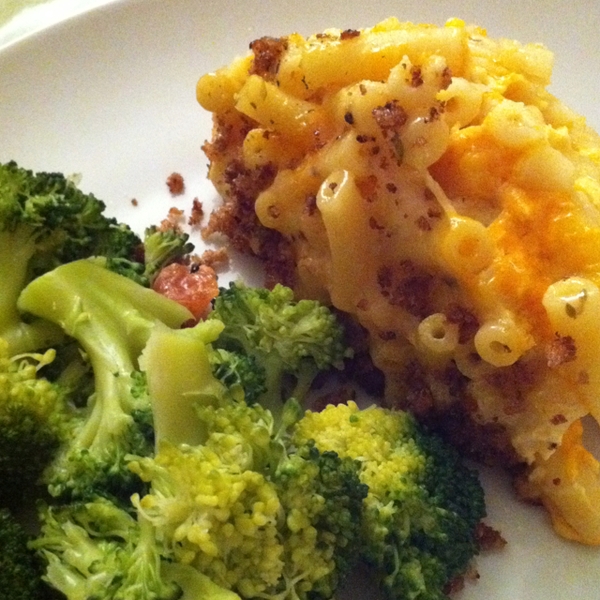
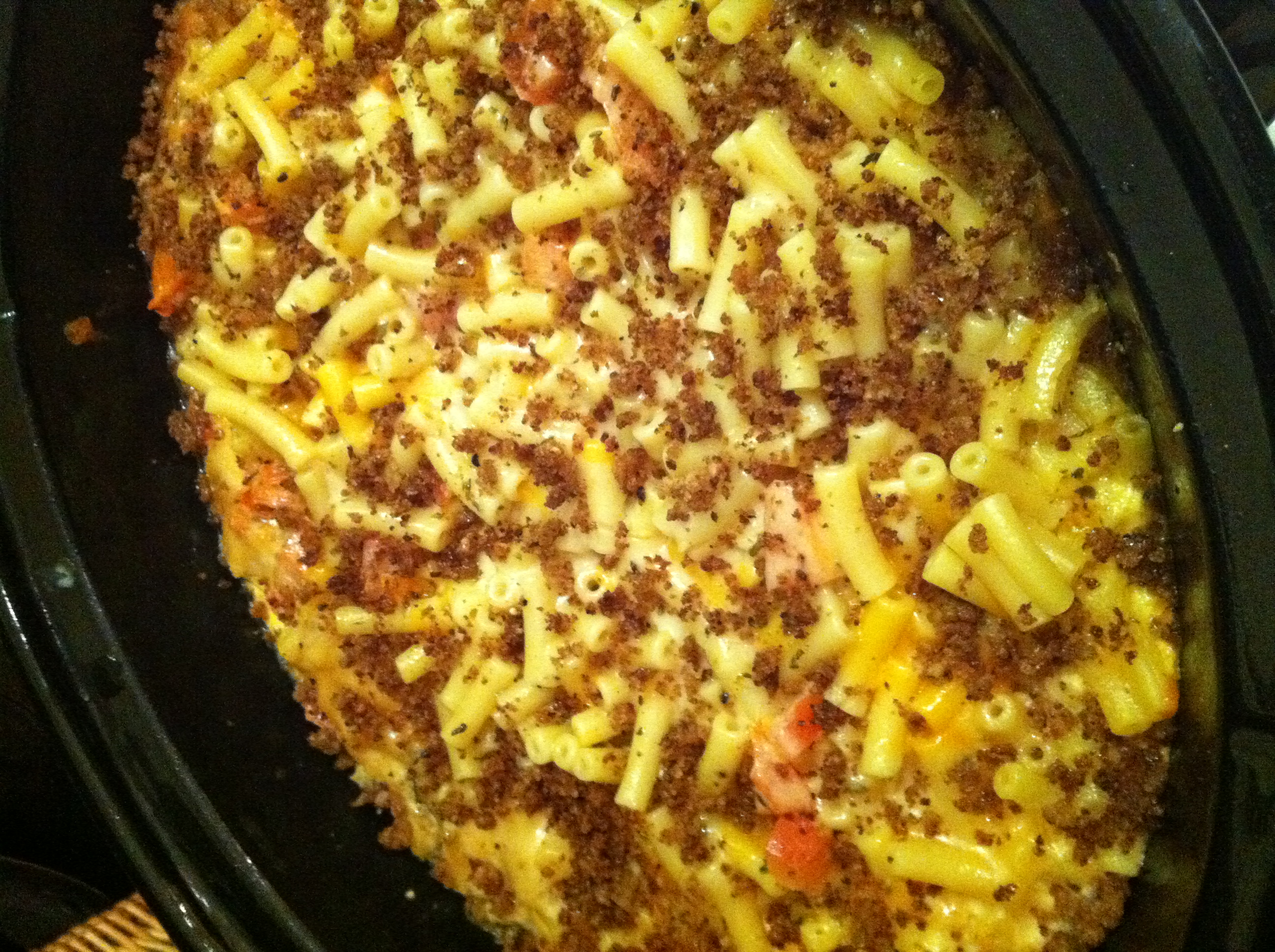
Anyway, there I was on Pinterest, following several men lots of feeds about food, and I saw this recipe for slow-cooker macaroni and cheese. And I repinned it. And thought about it. And thought about it some more. And then made it.

The Good: cheesy, cheesy tasty goodness. And because it’s not a strong-tasting meal in the first place, the slow cooker can’t really reduce the favour. Also, no stirring! I stole the idea of adding some tomato and oregano, which was lovely, and also the toasted breadcrumbs on top.

The Not Quite So Good: I doubled the recipe to feed six people and got the timings off, so I left it too long and it became a ‘set’ mac and cheese instead of gloopy. Still totally edible, but not quite as comforting. I like something in-between stove-top gloop and totally set, for preference.

Of course, I dished it up with the best possible accompaniment for macaroni cheese: broccoli. Cooked al dente. And Ramona loved it, so despite my mistakes, a win all round.


Reflections on Ramona: 18 months

I’m still having trouble adjusting to the idea that, as of next week, I’ll be the mother of an 18-month-old child. I’ve been calling her a toddler for a while now – mainly because she toddled at 11 months – but there’s something about the magical one-and-a-half-years-old mark that brings it home to me: she’s growing up.

Alright, we’re a few years away from driving lessons and visiting universities, but she is now, unmistakeably, a little person, and not a baby. Her personality, striking from the outset, is now very clear, and as she ramps up her communication with us, it’s simply staggering realising how much she’s learning every day.

Talking came on very suddenly; a few weeks ago she blurted a word here and there, and now you can’t stop her chattering away. Understanding is far from foolproof, of course. She may yammer away, but much of the time it’s incomprehensible, apparently random. Still, it is undeniably exciting and weird to have conversations with her. She’s particularly talkative in the car with me, when she babbles from the back seat. She’s always liked itemising everyone she loves (“Yiayia?” “She’s at home.” “Pappou?” “He’s at home.”) as if knowing that everyone’s where they should be gives her an anchor; maybe it does. Now she likes me to tell her that everyone loves her. And sometimes she really makes me laugh.

R: Yiayia?
Me: Yiayia loves you very much.
R: Pappou?
Me: Pappou loves you very much.
R: Capper? (Casper, our cat)
Me: Casper… well, he thinks you’re okay.
R: Capper wuvoo? CAPPER WUVOO?
Me: Casper loves you very much.
R: Yes.

Or, a few days later:

R: Yiayia?
Me: Yiayia loves you very much.
R: Pappou?
Me: Look. Everyone loves you. You’re the best!
R: YES.

Ash also gets in on the act:

Ash: Are you happy?
R: Yes?
Ash: Are you okay?
R: Yes? Sad?
Me: You’re sad?
R: Yes?
Me: Why are you sad?
R: Yes?
Ash: Are you a traffic cone?
R: Yes?

Both sets of grandparents are industriously teaching her things she can parrot, but not possibly understand, but that’s fine. Learning by rote has a bad reputation, and certainly I can’t see any point in endlessly repeating something you don’t understand when you’re an adult, but that kind of pattern-matching is incredibly useful when you’re very small. Constant repetition – I’ve had to hide certain books, so sick am I of reading them to her, and I NEVER thought I’d get sick of a book! – is the name of the game.

On the subject of books, we do all love a set of books published by Parragon that my in-laws got her for Christmas and Channukah. Based around simple emotions, they help children express happy, sad, angry, shy, proud, brave… absolutely lovely. She’s too small to embrace naming most of the emotions other than the first two (her gurning in response to ‘happy face!’ ‘sad face!’ is hilarious), but she’s started to memorise sentences and associate words. So if I read “I feel happy when I’m with…?”, she’ll gleefully shout back “Mummy!” and it’s basically the very best moment of my day, no matter what else has happened.

I can’t find the books on Parragon’s website, but I imagine some of their other board books are also excellent. They came as a stack of mini board books in two long boxes with carry handles that she took to slinging into the crook of her arm and strolling around the living room with until they collapsed under the onslaught of toddlerish prodding.

I’m slightly terrified of what happens next, because between incomprehensible shrieking tantrums – often related to teething, which is a truly evil thing – and scarily sudden progress, I’ve once again got to that stage when, just when you thought you knew the lay of the land, the goalposts have shifted again.

For example, she’s always been great at night and is a joy to put to bed; despite my refusal to try controlled crying when she was smaller she has not developed any sleeping hangups. On the contrary, since she feels secure she’ll now go in awake and quietly soothe herself to sleep, rarely waking up unless something out of the ordinary (sickness and New Year fireworks) disturbs her. But on the flip side she’s recently, quite suddenly, gone back to being absolutely random about naps when she’s not at nursery, sometimes sleeping for ages, sometimes not, sometimes early, sometimes late. I thought we’d left that unpredictability behind a few months ago. But hey, I’ll swap complete routine confusion during the day, which is perhaps inevitable when you’re with different people through the week, for a near-flawless routine at night.

Well, for as long as that lasts, anyway.

Oh, Ramona. You’re usually so busy asking me about everyone else that I have to remind you about Mummy. Mummy definitely, positively, unquestionably loves you very, very much.